
TL;DR
Choosing tree removal methods for safety depends on the tree’s location, structural condition, and surrounding obstacles. The four main approaches are straight felling, sectional dismantling, crane-assisted removal, and chemical removal, each suited to different risk profiles. Tree work carries a fatality rate roughly 30 times the national average, so understanding the vocabulary of safe removal matters whether you’re hiring a professional or evaluating a quote. This guide defines every key method and term, then gives you a decision framework to match the right technique to your situation.
Why Method Selection Is a Safety Decision, Not Just a Cost Decision
Tree removal kills more workers per capita than almost any other occupation in the United States. The Bureau of Labor Statistics has reported a fatality rate of 110 per 100,000 tree trimmers and pruners, roughly 30 times the all-industry average. Struck-by incidents account for approximately 40% of fatal tree care injuries according to data compiled by the Tree Care Industry Association from OSHA fatality records.
These aren’t just numbers for professionals to worry about. Homeowners who hire unqualified workers or attempt removals without understanding the methods involved face the same physics. TCIA data shows that landscapers and ground-maintenance workers, people employed to work on trees without specialized training, make up about one-quarter of all tree care fatalities.
The method an arborist chooses determines how forces are managed, where debris falls, and who stands in harm’s way. Choosing tree removal methods for safety starts with understanding what each approach actually involves.
If you’re wondering whether your situation calls for professional assessment, a certified arborist checklist can help you decide.
Tree Removal Methods: The Core Glossary
Straight Felling (Whole-Tree Felling)
The most traditional removal method. The tree is cut at the base and falls in one piece to the ground. A chainsaw operator makes a directional notch cut, then a back cut, and the tree tips over along the planned path.
When it’s safest to use: Open areas with no structures, vehicles, power lines, or other trees within at least 1.5 times the tree’s height in the intended fall direction. Rural properties with large clearances are the classic use case.
When it’s NOT safe: Near homes, fences, sheds, utility lines, or any space where the full length of the tree cannot land without hitting something. Also inappropriate for trees with significant lean away from the desired fall direction, heavy crown asymmetry, or internal decay that compromises hinge wood integrity.
Key equipment: Chainsaw, felling wedges, measuring tools for height estimation, personal protective equipment.
Sectional Dismantling (Piece-by-Piece Removal)
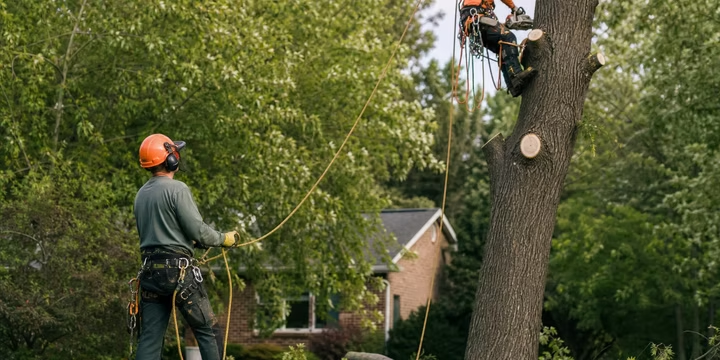
This is the workhorse of residential tree removal. Instead of felling the whole tree at once, a climber ascends the tree and removes it from the top down in manageable sections. Rope rigging systems lower each piece to the ground in a controlled manner.
When it’s safest to use: Near buildings, fences, landscaping, or other trees. This method works in the tight spaces that define most residential yards. Most tree removals in neighborhoods are completed using conventional sectional dismantling: a climber, rope rigging, and a ground crew managing the descent of each piece.
When it’s NOT safe: When the tree is structurally compromised to the point that it cannot support a climber’s weight. Dead trees, trees with severe trunk decay, or storm-damaged trees with hanging limbs (“widow makers”) may be too dangerous for a climber to enter.
Key equipment: Climbing harness and ropes, rigging blocks and pulleys, lowering devices, chainsaw (often smaller top-handle saws for aerial work), ground crew with tag lines.
Sub-term, Rigging System: The collection of ropes, pulleys, slings, and friction devices that allow cut sections to be lowered to the ground rather than dropped. Proper rigging is what separates controlled dismantling from dangerous guesswork. The rigging anchor point, rope diameter, and lowering technique all need to match the weight of each section being removed.
Crane-Assisted Removal
A crane lifts cut sections of the tree away from the work site, minimizing the need for climbing and reducing the time workers spend at height. The crane operator controls tree sections remotely, keeping team members safely on the ground as much as possible.
When it’s safest to use: When there is no viable fall zone for any section of the tree. This is the most common reason a crane becomes necessary, according to practitioners at Sawvell Tree Service. Crane-assisted removal is also preferred for structurally compromised trees that cannot safely support a climber, for extremely large trees where rigging loads would exceed safe limits, and for situations where speed reduces overall exposure time to hazards.
When it’s NOT safe: When site access cannot accommodate the crane (narrow driveways, overhead wires blocking the boom path, soft ground that cannot support outrigger loads). A crane on unstable footing is more dangerous than no crane at all.
Important distinction: Crane-assisted removal is not a premium upgrade for trees that could be handled conventionally. It is a practical solution for specific scenarios where site constraints or tree condition create risks that rope rigging cannot adequately manage.
Key equipment: Crane (typically a hydraulic truck crane), rigging slings rated for the expected loads, chainsaw, ground crew, traffic control if the crane stages on a street.
Chemical Tree Removal
Chemical removal involves applying herbicide to kill the tree before physical removal. The dead tree is lighter, has no live tension wood, and is often easier to dismantle. This is the slowest method and is rarely used for urgent safety situations.
When it’s appropriate: For trees in locations that are extremely difficult to access, trees that need to be removed gradually, or situations where budget constraints allow for a staged approach over weeks or months.
When it’s NOT appropriate: Emergency removals, storm damage response, or any situation where a hazardous tree poses an immediate threat. A dead tree can also become more brittle and unpredictable over time, which creates its own set of falling hazards.
MEWP / Aerial Lift Access
A Mobile Elevated Work Platform (MEWP), commonly called a bucket truck or cherry picker, provides an alternative to climbing. The arborist works from a platform that can be repositioned hydraulically.
Safety advantage: The arborist is secured in the bucket and does not need to rely on the tree itself for support, which matters greatly when working on structurally compromised trees.
Limitation: Requires vehicle access close to the tree and sufficient ground stability to support the truck’s weight and outrigger loads.
Cutting Techniques That Control the Fall
The way a tree is cut matters as much as the removal method chosen. Even a straight felling operation in an open field becomes deadly if the cuts are wrong. When choosing tree removal methods for safety, understanding these techniques helps you evaluate whether an arborist knows what they’re doing.
Notch (Felling Notch)
The notch is a wedge-shaped cut made on the side of the tree facing the intended fall direction. It creates an opening that guides the tree’s fall. There are three main notch types, and the choice between them has real safety consequences.
Conventional Notch (45-Degree)
The most commonly used technique in North American tree felling. The notch opening is approximately 45 degrees. It offers excellent accuracy for most residential and commercial applications.
Safety limitation: The two cut faces close together before the tree reaches the ground, which means the hinge breaks partway through the fall. From that point, the tree is uncontrolled.
Open-Face Notch (70 to 90 Degrees)
Most arborists consider this the safest notch type. The wider opening (70 to 90 degrees) allows the tree to fall all the way to the ground before the two cut faces come together. This maintains the hinge, and the control the hinge provides, throughout the entire fall.
If you’re evaluating an arborist’s approach and they mention using open-face notching, that’s generally a good sign about their safety awareness.
Humboldt Notch
The Humboldt cut keeps the flat face of the notch on the bottom, which preserves more usable log length above the cut. It is often the best option for felling a tree on a slope or when working with notably thick or tall trees. However, it carries the same safety disadvantage as the conventional notch: the log detaches halfway through descent and is uncontrolled from that point.
Bore Cut (Plunge Cut)
When dealing with challenging trees, the bore cut provides the most control of any cutting technique. Instead of cutting straight through from the back, the arborist drills the chainsaw bar directly into the tree’s center first, establishing the hinge before making the release cut. This technique eliminates the risk of a premature or uncontrolled fall during the back cut.
Bore cuts require significant skill and experience. They’re most commonly used on hazardous leaners, trees under tension, or any situation where a conventional back cut could result in the tree sitting back or barber-chairing (splitting vertically up the trunk).
Back Cut
The back cut is made on the opposite side of the tree from the notch, slightly above the notch’s apex. According to ANSI Z133 standards, with a notch opening of 45 to 70 degrees, the back cut should be 1 to 2 inches above the apex of the notch. The back cut releases the tree from the stump while leaving a strip of uncut wood (the hinge) that guides the fall direction.
Hinge Wood
The strip of wood left uncut between the notch and the back cut. This is the single most important structural element in a controlled fell. The hinge acts as a living hinge on a door, guiding the tree’s fall direction. ANSI Z133 specifies that the notch depth should not exceed one-third the diameter of the tree and that the back cut shall not penetrate into the predetermined hinge area. Violating either rule destroys the hinge’s ability to control the fall.
Felling Wedge
A plastic or aluminum wedge driven into the back cut to prevent the tree from settling backward onto the saw (called “sitting back”) and to help tip the tree in the desired direction. Wedges are a simple, essential safety tool that gives the felling team mechanical advantage over the tree’s natural lean.
Safety Zones and Planning Terms
The planning that happens before anyone picks up a chainsaw determines whether a removal goes smoothly or ends in disaster. These terms define the safety framework that competent arborists follow.
Drop Zone (Landing Zone)
The area where the tree, or sections of it, will land. A safe drop zone comes from good planning, visible barriers, clear communication, and the discipline to stop and reset if those controls break down, as noted by ArborTIMES, an industry publication.
For straight felling, the drop zone must accommodate the full length of the tree plus a buffer. For sectional dismantling, each piece needs its own calculated landing area. The drop zone must be cleared of people, vehicles, and anything that could be damaged or could cause cut sections to bounce unpredictably.
Escape Route
The pre-planned path workers take to move away from the tree as it begins to fall. The standard escape route runs at a 45-degree angle from the sides and back on either side of the tree. ANSI Z133 is specific: never move away directly behind the tree. Use the chain brake, walk away at least 20 feet.
Practitioners on the ArboristSite forum reinforce this: ground workers should maintain a distance at least twice the height of the tree being felled, and when the tree begins to fall, they should quickly move away at a 45-degree angle. Exiting directly opposite the direction of fall actually carries its own risks, because a tree can kick backward off the stump.
The 5-15-90 Rule
This is one of the most important safety concepts in tree felling, and it rarely appears in homeowner-facing content. Studies have revealed that 90% of all fatalities or injuries that occur during tree felling happen within 5 feet of the stump or trunk. Further investigation shows these fatalities and injuries occur within the first 15 seconds from when the tree begins to fall.
The takeaway is clear: the most dangerous place during a tree fell is right next to the stump, and the most dangerous time is the first few seconds of the fall. This is why escape routes need to be planned, cleared, and practiced before the first cut.
Job Hazard Analysis (JHA)
A formal or informal assessment of every hazard at the work site before removal begins. A proper JHA covers: tree species and condition, lean direction, overhead utilities, ground slope, soil conditions, wind speed, nearby structures, pedestrian traffic, and crew positioning. In West Texas, where wind gusts frequently exceed 50 mph, wind assessment is not optional. A poorly assessed tree in high wind acts like a sail.
Understanding how regional conditions like freeze events create storm-damage scenarios helps explain why some trees become emergency removals in the first place.
“Stand Clear / All Clear” Protocol
The verbal communication system used during felling operations. Before any cut that will cause wood to move, the felling team confirms that all workers and bystanders are outside the drop zone and escape routes are clear. Only when every team member confirms their position does the operator proceed. This protocol seems simple, but breakdowns in crew communication are a recurring factor in serious tree work injuries.
Post-Removal Methods
Tree removal doesn’t end when the trunk hits the ground. How you handle the stump matters for both safety and future property use.
Stump Grinding
A mechanical process that excavates the stump without removing the root system. A stump grinder chips away the stump to a depth of several inches below grade, leaving fine sawdust as residue. The roots remain in the ground and decompose naturally over time.
Stump grinding is far more economical than full removal, with costs typically ranging from $75 to $400 per stump. Most jobs are completed in 30 to 90 minutes.
When to choose it: Most residential situations. The ground can be filled, graded, and replanted over the remaining roots.
One thing homeowners often overlook: removing a large tree changes how water moves through your yard. Root systems that once absorbed hundreds of gallons per week are no longer active, which can create new drainage problems or areas of standing water.
Stump Removal (Full Extraction)
This method involves excavating the stump along with its root ball. It completely eliminates the tree’s below-ground presence, leaving a large hole that must be backfilled.
When to choose it: When new construction, foundation work, or replanting requires a completely clear, root-free space. Full extraction is significantly more disruptive, more expensive, and more time-consuming than grinding.
Standards, Credentials, and Compliance Terms
When choosing tree removal methods for safety, understanding who is qualified to make these decisions matters as much as understanding the methods themselves.
ANSI Z133
The American National Standards Institute safety standard for arboricultural operations. First established in 1972, ANSI Z133 has been routinely updated (the current 9th edition was released in 2024) through a consensus process involving employers, employees, organized labor, equipment manufacturers, and academia.
Although compliance with this standard is voluntary, Z133 carries the force of law in many instances in the U.S., particularly when OSHA citations reference it as the recognized industry standard of care. When an arborist says they follow ANSI Z133, they’re saying they adhere to the industry’s safety baseline. When you’re vetting tree companies, asking “Do you follow ANSI Z133?” is one of the most useful questions you can ask.
ISA Certified Arborist
A credential issued by the International Society of Arboriculture after passing a comprehensive exam covering tree biology, diagnosis, pruning, safety, and removal. ISA certification requires continuing education to maintain and demonstrates a baseline of professional knowledge.
Why this matters for method selection: a certified arborist has the training to assess a tree’s structural condition, identify the safest removal approach, and execute or supervise the work properly. Forum discussions on Reddit’s r/arborists and r/treelaw regularly surface homeowner horror stories about improper tree work. One commenter warned that work “was done by a ‘handyman,’ not an actual arborist,” noting that improper cutting could damage tree health or create safety hazards if weakened branches fall later.
PPE (Personal Protective Equipment) for Tree Work
The minimum PPE for chainsaw operation and tree removal includes: hard hat with face screen, hearing protection, chainsaw chaps or pants (with cut-resistant fibers), steel-toed boots, eye protection, and work gloves. Climbers add a full-body harness, climbing saddle, and lanyard systems. The absence of proper PPE is a red flag that should make any homeowner question a tree company’s competence.
Line-Clearance Arborist
A specially trained and certified arborist authorized to work within the minimum approach distance of energized utility lines. Property owners can trim their own trees, but they should stay well back from energized lines (typically at least 10 feet for residential lines). Only certified line-clearance arborists are legally permitted within minimum clearance of energized wires.
If your tree is near power lines, contact your utility company first. Many utilities will remove or trim trees threatening their lines at no cost to the homeowner.
How to Choose the Right Method: A Decision Framework
Choosing tree removal methods for safety requires matching the site conditions and tree condition to the appropriate technique. Here is a practical framework.
Open space, no structures nearby, healthy tree with predictable lean: Straight felling is likely appropriate. Confirm a clear drop zone of at least 1.5 times tree height. This is the fastest and least expensive method when conditions allow it.
Near structures, fences, landscaping, or other trees: Sectional dismantling is the standard approach. The climber takes the tree apart from the top down using rigging to lower each piece. This is how most residential trees are removed.
Structurally compromised, storm-damaged, or dead tree: Crane-assisted removal is preferred. A dead or damaged tree may not support a climber’s weight, and unpredictable failure points make rigging calculations unreliable. A crane removes the need for anyone to be in the tree.
No viable fall zone in any direction: Crane-assisted removal is required. If there is nowhere safe for any piece of the tree to land without hitting a structure or utility line, only a crane can lift sections vertically out of the work area.
Tree near utility lines: A line-clearance arborist is required. Contact your utility provider before doing anything. Do not attempt any removal within 10 feet of energized lines.
Non-urgent removal, difficult access, budget constraints: Chemical removal followed by later physical removal may be appropriate, but only for trees that do not pose an immediate hazard.
Texas-Specific Considerations
Texas has no state law requiring a permit to remove a tree on your own property. However, local city ordinances in places like Lubbock may protect trees above certain trunk diameters, so check with your city before proceeding.
In West Texas specifically, wind is a constant factor. A poorly pruned or structurally weak tree acts like a sail during the region’s frequent high-wind events. This makes proactive assessment and proper method selection even more critical than in calmer climates. Trees stressed by drought, soil nutrient deficiencies, or poor irrigation coordination are more likely to develop the structural weaknesses that lead to emergency removals.
The Bottom Line on Method Selection
A certified arborist assessment should always come first. The arborist evaluates the tree’s species, health, structural integrity, lean, root stability, and surrounding hazards, then recommends the safest removal method. Trying to choose a method without this assessment is like choosing a medical procedure without a diagnosis.
For professional tree assessment and removal in the Lubbock and West Texas area, M&M’s certified arborist team brings the dual expertise of arboriculture and irrigation management, which means tree health, soil health, and water management are coordinated through a single provider.
Frequently Asked Questions
What is the safest tree removal method for residential properties?
Sectional dismantling is the safest and most common method for residential properties. It gives the crew control over where every piece of the tree lands, which matters in yards with structures, fences, and landscaping nearby. For trees that are dead or structurally unsound, crane-assisted removal adds a layer of safety by eliminating the need for a climber in the tree.
Can I legally remove a tree on my own property in Texas?
Texas has no state law preventing you from removing your own tree on your property, and no state-level permit is required. However, some Texas cities have local ordinances protecting trees above certain trunk diameters. Always check with your city government before removing a large tree.
What is the 5-15-90 rule in tree felling?
It describes the statistical reality of felling injuries: 90% of fatalities and injuries during tree felling occur within 5 feet of the stump, within the first 15 seconds of the tree beginning to fall. It underscores why escape route planning and maintaining distance from the stump are the most important safety practices during any felling operation.
How do I know if my tree needs crane-assisted removal?
The most common indicator is the absence of any viable fall zone. If there is no direction where even a small section of the tree can safely land without hitting a structure or utility line, a crane is needed. Crane removal is also indicated when a tree is dead, severely decayed, or storm-damaged to the point that it cannot support a climber’s weight.
What is the difference between stump grinding and stump removal?
Stump grinding mechanically chips the stump down below grade level, leaving the root system in place to decompose naturally. It costs $75 to $400 and takes 30 to 90 minutes. Full stump removal excavates the stump and root ball entirely, leaving a large hole that must be backfilled. Full removal is only necessary when construction or replanting requires a completely root-free space.
Why does the type of notch cut matter for safety?
The notch determines how much control the hinge maintains as the tree falls. An open-face notch (70 to 90 degrees) keeps the hinge intact until the tree reaches the ground, giving maximum control. A conventional or Humboldt notch allows the hinge to break partway through the fall, leaving the tree uncontrolled for the final portion of its descent. The notch choice directly affects whether the tree goes where planned.
Should I hire a certified arborist or can a general tree service handle removal?
Hire a certified arborist. TCIA data shows that non-specialist workers performing tree work, such as landscapers and general handymen, account for roughly 25% of all tree care fatalities despite being less involved in the industry overall. An ISA Certified Arborist has passed an exam covering tree biology, structural assessment, safety protocols, and proper removal techniques. The credential exists specifically to distinguish trained professionals from everyone else.
What should I do if a tree is near power lines?
Do not attempt any removal or trimming within 10 feet of energized residential lines. Contact your utility provider first, as many will remove or trim threatening trees at no charge. If you hire a company, confirm that they employ a certified line-clearance arborist, the only person legally permitted to work within the minimum clearance distance of energized wires.