TLDR
Hire a certified arborist when a tree decision is risky, diagnostic, expensive, or irreversible. That means dead limbs over your roof, cracks in the trunk, unexplained canopy decline, drought stress you can’t diagnose, any work near power lines, and any removal of a mature tree. For small ground-level cleanup or basic watering, you probably don’t need one. In Lubbock and West Texas, tree problems are often water problems, so look for a team that evaluates both the tree and the irrigation system.
A certified arborist is a tree-care professional who has passed the International Society of Arboriculture’s comprehensive exam, holds verified field experience, and maintains the credential through continuing education. That’s the textbook answer.
The practical answer is simpler: hire a certified arborist when the consequences of getting it wrong are serious. A bad pruning cut lasts the life of the tree. A missed crack in a trunk can drop a limb on your house. An undiagnosed root problem can kill a shade tree that took 30 years to grow.
Not every tree task requires one. Picking up fallen twigs, watering a new planting, or spreading mulch are straightforward homeowner jobs. But the moment a tree could hurt someone, damage property, or be permanently harmed by the wrong decision, a certified arborist is the right call.
In Lubbock and across West Texas, there’s an added wrinkle. A tree that looks like it’s dying from disease may actually be suffering from sprinkler coverage gaps, a slow leak, or a badly programmed controller. Drought stress, overwatering, and soil compaction can all mimic disease symptoms, and sorting those apart takes someone who understands both trees and water.
What Is a Certified Arborist?
The ISA Certified Arborist credential is not a weekend certificate. Candidates must have at least three years of full-time arboriculture experience (or a qualifying combination of education and field work), then pass a 200-question exam with a 3.5-hour time limit covering tree biology, diagnosis, pruning practices, safety, pest management, and soil science. ISA defines one year of full-time experience as roughly 1,795 hours.
The credential isn’t permanent, either. Recertification runs on a three-year cycle tied to continuing education, which matters because best practices in pruning, risk assessment, pest management, and plant health care evolve.
Why the distinction matters
Anyone can call themselves a “tree guy” or an arborist. In Texas, there is no state licensing board for arborists, which means someone advertising as a “Texas licensed arborist” may be using a title that doesn’t formally exist. Texas Tree Surgeons’ consumer guide warns homeowners to be wary of unverifiable licensing claims and to ask for an ISA certification number instead.
A landscaper handles general yard maintenance. A tree service crew performs pruning and removals. A certified arborist diagnoses tree health, specifies proper care, assesses risk, and makes judgment calls about structure, disease, soil, and preservation. These roles can overlap, but they are not interchangeable.
A practitioner post on LinkedIn from SavATree frames it well: certification matters most when the work requires diagnosis and judgment, not just labor. The exam, verified hands-on experience, and ongoing education requirements exist because tree care decisions are often irreversible.
The Core Rule: Risky, Diagnostic, Expensive, or Irreversible
Most articles list tree services. Fewer give you a decision rule you can actually remember.
Here it is: hire a certified arborist when the tree decision is risky, diagnostic, expensive, or irreversible.
That covers a lot of ground, so let’s break it into practical categories.
Call Immediately for Tree Safety Hazards
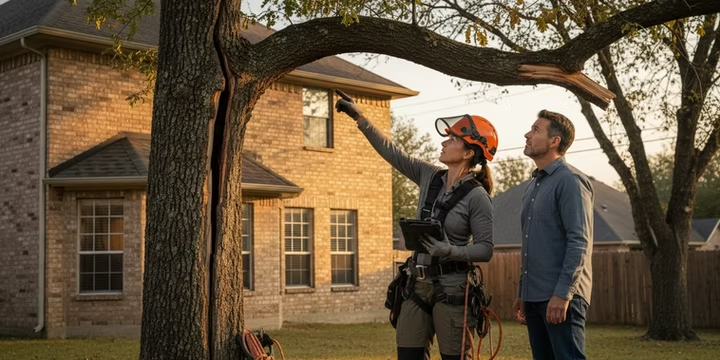
Some situations don’t wait for a convenient appointment. Call a certified arborist (or emergency tree service with certified arborist oversight) right away if you see any of the following:
- A large limb is broken, hanging, or visibly cracked
- A tree or limb has fallen on a structure, vehicle, fence, sidewalk, or street
- The trunk has split at a major branch union
- The tree is leaning suddenly, or the soil near the root plate is lifting or cracking
- A tree is touching or growing into power lines
- Storm damage has left unstable limbs overhead
ISA’s tree-risk resources flag large dead branches, detached or hanging branches, cracks, splits, cavities, and mushrooms near the base as signs that warrant examination by a certified arborist. They also include a direct warning: never prune, pull, climb, or remove branches from or near power lines yourself. Contact your local electricity provider first.
One useful mental shortcut from practitioners on Reddit: “If you’re asking, ‘Could this fall on something?’ call now.” The question itself is the signal. In one thread, the most common advice was that the best time to call is when you have a safety question, not when the calendar says it’s pruning season.
The same defect carries different urgency depending on what’s underneath it. A dead limb over an empty field is less pressing than the same limb hanging over your driveway or a children’s play area. Arborists trained in risk assessment evaluate both the defect and the “target,” meaning whatever the tree could hit if it fails.
Call Soon for Structural Warning Signs
These aren’t emergencies yet, but they shouldn’t wait indefinitely, especially before the next storm season:
- Deadwood high in the canopy
- Cavities, fungal growth, loose bark, or old wounds on the trunk
- Codominant stems (two main trunks growing from the same point) with included bark
- The tree has been topped or lion-tailed in the past
- Major limbs overhang the house, patio, parking area, or sidewalk
- A large tree is close enough to hit a structure if it fails
ISA identifies codominant stems, visible decay, fungal fruiting bodies, wounds, root loss, soil compaction, and previous poor pruning as defects associated with tree risk. A certified arborist can tell you whether the defect is stable, worsening, or needs intervention like pruning, cabling, bracing, or removal. Professional evaluation is the best way to determine the seriousness of these defects.
Call for Diagnosis When the Tree Looks Wrong
Sometimes you know something is off, but you can’t tell whether the tree is dying, stressed, infested, or just going through a rough season. This is where hiring a certified arborist pays for itself, because guessing often leads to the wrong treatment.
Schedule a diagnostic visit when you notice:
- Leaves that are yellow, brown, wilted, scorched, curling, dropping early, or smaller than normal
- Canopy thinning or dieback on one side
- Weak new growth
- Bark with cankers, holes, oozing sap, or insect activity
- Decline that started after sprinkler changes, drought, construction, grade changes, or new hardscape
- Uncertainty about whether the problem is too much water, too little water, soil compaction, nutrient deficiency, disease, insects, or root damage
The Texas Trees Foundation lists canopy dieback, abnormal leaf color, weather and mechanical damage, construction near trees, watering concerns, insects, fungus, and decay as reasons to contact an arborist.
The West Texas water question
For Lubbock homeowners, the diagnosis question often comes down to water. Texas A&M Forest Service notes that during drought, trees commonly show stress through wilting, leaf drop, small or malformed leaves, yellowing, and browning leaf tips. It recommends checking whether a screwdriver can penetrate 6 to 8 inches into the soil as a practical moisture test.
Automatic sprinkler systems designed for turf may not deliver enough deep moisture for tree root zones. And the opposite problem, soggy soil from a leak or poor drainage, can suffocate roots just as effectively as drought.
A certified arborist who understands irrigation can diagnose what a pruning-only company misses: whether the tree is getting the right water in the right place. If your sprinkler system hasn’t had a proper inspection recently, a seasonal maintenance checkup can catch dry spots, leaks, and coverage gaps before they stress your trees further.
Call Before Pruning, Cabling, Bracing, or Removal
Why pruning needs judgment
Pruning is not just cutting limbs. Every cut changes tree structure, wound response, storm performance, and long-term health. ISA’s consumer pruning resource states that every pruning cut can change tree growth and that poor pruning can cause damage lasting the life of the tree.
The Tree Care Industry Association’s ANSI A300 pruning standard defines acceptable pruning objectives: managing risk, managing health, developing structure, providing clearance, managing size, and improving aesthetics. The same standard states that topping and lion’s tailing are not acceptable practices and can injure trees.
Here’s how to use that as a hiring filter:
- If someone recommends “topping” a shade tree as routine height control, ask them to explain the pruning objective and standard they’re following.
- If the proposed work strips most inner branches and leaves foliage only at limb tips, that’s lion-tailing, and it weakens the tree.
- Proper crown reduction is a real technique, but it’s not the same as hacking off the top of a tree.
Community discussions on Reddit consistently call out topping as harmful. Certified arborists in those threads note that topping creates weak regrowth patterns and can actually create future hazards rather than reducing them.
Why removal deserves a second opinion
A certified arborist is especially valuable before removing a mature tree when:
- The removal recommendation came from a company that mainly sells removals
- Two contractors disagree on whether the tree should come down
- The tree is large, historic, sentimental, or provides significant shade
- The homeowner wants to know whether pruning, cabling, watering, or treatment could preserve it
TreesAreGood recommends considering removal when a tree is dead, dying, an unacceptable risk, causing an obstruction that can’t be corrected by pruning, or located where construction requires removal. But they also stress that arborists can help decide whether removal is actually necessary and whether alternatives exist.
Practitioners on Reddit surface a fear that many homeowners share: some companies default to recommending removal because that’s what generates the biggest invoice. Several commenters recommend consulting arborists or TRAQ-qualified professionals when the homeowner wants an independent risk assessment rather than a sales pitch. The practical advice: if your goal is to save the tree, say that upfront and ask for preservation options.
Why does this matter financially? The USDA Forest Service reports that 100 mature trees can catch roughly 139,000 gallons of rainwater per year, and strategically placed trees can save up to 56% on annual air-conditioning costs. Removing a tree that could have been saved isn’t just an aesthetic loss.
Call Before Construction or Landscape Changes Near Trees
This is the most under-appreciated reason to hire a certified arborist.
The cheapest arborist visit is often the one before construction, not the one after a tree starts declining. Roots frequently extend well beyond the visible canopy, and damage from trenching, patio installation, driveway paving, fence posts, grade changes, or utility runs may not show up in the canopy for months or even years.
ISA’s risk checklist specifically flags recent construction, soil-level changes, and pavement installations as risk factors that should be considered when assessing trees. Travis County AgriLife lists construction near trees as a direct reason to hire an arborist.
If you’re planning a new patio, pool, fence, or irrigation system installation near established trees, bring in a certified arborist during the planning phase. Root-zone protection during construction is dramatically cheaper than trying to save a declining tree afterward.
What Time of Year Should You Hire a Certified Arborist?
The short answer: whenever the problem exists.
Waiting for the “right season” while a cracked limb hangs over your garage doesn’t make sense. Safety concerns override seasonal timing every time.
For non-urgent inspections, the best season depends on what the arborist needs to see:
- Leaf-on season (spring through fall): Better for judging canopy vigor, leaf color, dieback patterns, and water-stress symptoms.
- Dormant season (winter): Useful for viewing branch structure, spotting weak unions, and planning larger pruning projects on deciduous trees.
- After storms: Best for damage assessment and risk reduction.
- Before construction: Best for tree protection planning.
- During drought or extreme heat: Best for diagnosing irrigation problems, soil moisture, and stress, but avoid unnecessary pruning of live branches on stressed trees.
The top Reddit timing thread captures this well. A homeowner asks whether to call with leaves off or wait until spring. Commenters explain that some defects are easier to see without foliage, canopy health is easier to judge with leaves on, and a good arborist can identify major issues in any season. The takeaway: season matters less than the reason for the visit.
Timing in West Texas
For Lubbock and surrounding areas, don’t think only in terms of pruning season. Wind damage, freeze recovery, drought stress, and irrigation-related decline are year-round concerns.
Texas A&M Forest Service notes that mature trees may need watering every two to three weeks during extreme drought, while younger or newly planted trees may need water two to three times per week. They also warn against applying high-salt, quick-release fertilizers or pruning live branches off young trees during severe drought, because those branches may be needed once rain returns.
And drought impacts don’t end when the weather changes. Texas A&M reports that the 2011 Texas drought killed an estimated 300 million trees, including 5.6 million urban shade trees, and that stress can linger for years after soil moisture returns. A tree that looks rough today may be showing damage from a dry spell two years ago.
When You Probably Do Not Need a Certified Arborist
Trust goes both ways. Saying you need an arborist for everything would be dishonest. The Arbor Day Foundation puts it plainly: day-to-day tree maintenance may not require an arborist, but tree health and safety issues are where arborists are the best resource.
You can likely handle these yourself:
- Picking up fallen twigs and small debris
- Removing small, reachable dead branches from shrubs or very young trees (no ladder, no chainsaw)
- Spreading mulch (just keep it away from the trunk)
- Watering a newly planted tree on a regular schedule
- Mowing, edging, and general yard cleanup
- Identifying a tree species out of curiosity
A long-running ArboristSite forum thread offers a good rule of thumb from practitioners: if the task involves going up a ladder or climbing a tree with a chainsaw, it should usually be a job for a professional.
Draw the line at safety and permanence. If the work requires ladders, climbing, chainsaws overhead, rigging, large-limb removal, power-line proximity, or cuts on a valuable mature tree, it’s professional tree work.
How to Choose the Right Certified Arborist
Questions to ask
- Are you ISA Certified? What is your certification number?
- Will the certified arborist inspect the tree in person?
- Will a certified arborist be on site or directly supervising the crew during the work?
- Do you carry general liability and workers’ compensation insurance?
- Can you provide a written scope of work before starting?
- What is the pruning objective: risk reduction, clearance, structural development, health, or size management?
- Are you recommending removal, pruning, cabling, treatment, monitoring, or no action? Why?
- Do you evaluate irrigation, soil, and root-zone conditions, or only prune and remove trees?
- If lab testing is needed, what sample will be taken and how will the results change the plan?
Texas Trees Foundation recommends checking professional memberships, verifying ISA credentials, asking for insurance proof, getting multiple estimates when appropriate, being wary of door-to-door bargains, and never choosing based on the lowest bid alone.
The “sales arborist vs. actual crew” problem
This comes up repeatedly in practitioner communities and it’s worth knowing about. A company may have one certified arborist who scopes jobs and sells work, while a non-certified crew makes the actual cuts.
Reddit users specifically advise asking whether the person who assesses the tree will do the work, or whether someone else will be sent. In one pruning-quality thread, commenters recommend asking whether an ISA-certified employee will return to inspect the cuts and supervise corrections.
The question to ask: “Who is making the cuts, and how are they supervised?”
Red flags
- They recommend topping without a clear safety or restoration rationale
- They use climbing spikes on a live tree being pruned (spikes are for removals, not pruning)
- They only quote removal when you asked for diagnosis
- They can’t show ISA credentials or insurance proof
- They push fertilizer without evaluating water, mulch, soil, roots, pests, or disease
- They offer a door-to-door storm discount immediately after severe weather
- They refuse to provide a written scope of work
When you need more than a standard certified arborist
For some situations, a higher level of expertise makes sense:
- TRAQ (Tree Risk Assessment Qualification): For trees near homes, streets, power lines, or commercial areas where risk and liability are central concerns. Practitioners on Reddit recommend TRAQ-qualified arborists specifically for written tree-risk analysis.
- ASCA Consulting Arborist: For second opinions, neighbor disputes, insurance or legal questions, and preservation plans. Consulting arborists are typically independent from removal and pruning operations, which removes the incentive to recommend unnecessary work.
- ISA Board Certified Master Arborist: For complex, high-value, disputed, legal, or municipal tree decisions.
Fertilization and Soil Testing: Diagnosis Before Treatment
One of the most common mistakes is jumping straight to fertilizer when a tree looks stressed. The more credible approach is to diagnose water, soil, compaction, pests, disease, and root conditions first, then fertilize only when testing indicates a deficiency.
Texas A&M Forest Service is direct about this: most landscape trees do not need fertilizer. Watering and mulching are often better priorities. They recommend testing soil before applying fertilizer if nutrient deficiency is suspected, and they warn that too much fertilizer can harm or kill a tree.
They also flag a mistake that’s surprisingly common in West Texas: “weed and feed” products containing broadleaf herbicides can damage trees because trees are broadleaf plants. Symptoms include leaf discoloration, curling, burning, branch dieback, or death.
When soil or tissue testing is warranted, the Texas Plant Disease Diagnostic Lab accepts tree and shrub samples and offers testing for most plant pathogens. Routine diagnoses typically take 11 to 21 days during peak season, with oak wilt testing requiring at least 21 days.
If someone recommends fertilizer without checking water, mulch, soil, roots, and species fit, get a second opinion.
Lubbock and West Texas: Why Tree Care and Irrigation Care Overlap
In much of the country, tree problems and irrigation problems are treated as separate categories handled by separate companies. In West Texas, that separation doesn’t make sense.
Consider how many common tree complaints trace back to water:
- Sprinkler heads don’t reach the root zone, so the lawn is green but the tree is starving
- One side of the tree declines near an irrigation dry spot
- Roots sit in a soggy low spot caused by a leak or poor drainage
- Soil is compacted from vehicles, foot traffic, or construction
- The tree started declining after someone changed the controller schedule
- The homeowner can’t tell whether the problem is overwatering or underwatering
Texas A&M Forest Service says automatic sprinklers may not provide enough deep moisture for trees and recommends checking soil penetration to confirm adequate watering. In a region where drought conditions are a recurring reality (over 70% of Texas experienced extreme or exceptional drought in 2022), getting the water right is foundational to tree health.
M&M Sprinkler and Tree Services was built around this overlap. With two certified arborists, three licensed irrigators, and a TDA chemical applicator on staff, the company can evaluate the interaction between soil, water, trees, and irrigation systems rather than treating them as separate problems. Services include pruning, removal and stump grinding, cabling and bracing, plant health diagnosis and treatments, deep-root feeding and nutrition with ORGANIFEED, and soil and tissue testing through the Texas A&M lab, all coordinated alongside sprinkler repair, maintenance plans, and irrigation design.
That combination means one team can look at a declining tree and determine whether it needs pruning, pest treatment, a soil amendment, deeper watering, a sprinkler head repositioned, or some combination. Fewer handoffs. Better diagnosis.
Need a Certified Arborist in Lubbock?
Not sure whether your tree problem is pruning, disease, drought stress, soil compaction, or sprinkler coverage? M&M Sprinkler and Tree Services can evaluate the tree and the water system together for Lubbock and West Texas properties, including surrounding towns like Littlefield, Levelland, Post, Shallowater, Wolfforth, Brownfield, Plainview, and beyond.
Frequently Asked Questions
Do I need a certified arborist or just a tree trimming company?
If the job is simple cleanup or small-branch removal at ground level, a tree trimming company may be fine. If the tree is mature, near structures, structurally questionable, diseased, declining, storm-damaged, or needs major pruning or removal decisions, hire a certified arborist or a tree company with certified arborist oversight. The key question: will an ISA Certified Arborist inspect the tree and supervise the work?
Is winter the best time to hire an arborist?
Winter can be good for viewing branch structure and planning pruning on deciduous trees, but safety issues should never wait. Leaf-on season is often better for judging canopy health, leaf color, and dieback. The best time to call depends on what the arborist needs to see, not the calendar.
Should I hire an arborist before removing a tree?
Yes, especially if the tree is valuable, mature, close to structures, or disputed. Arborists can determine whether pruning, treatment, cabling, watering adjustments, or soil care is a reasonable alternative to removal. If a company only quotes removal without discussing options, seek a second opinion.
What are signs that a tree is dangerous?
Large dead limbs, hanging branches, trunk cracks, split trunks, cavities, mushrooms at the base, sudden lean, soil heaving near roots, root damage, and major limbs over homes or high-use areas are all warning signs. ISA recommends having trees with these symptoms examined by a certified arborist.
Can a certified arborist save a dying tree?
Sometimes. It depends on the cause, severity, species, site conditions, root health, water availability, pests, disease, and structural integrity. A certified arborist can diagnose whether the tree is treatable, should be monitored, needs structural support, or should be removed. Not every declining tree is a lost cause, and not every treatment works.
Should I fertilize a stressed tree?
Not automatically. Texas A&M Forest Service says most landscape trees do not need fertilizer and recommends soil testing before application. Watering correctly, mulching properly, and correcting soil or root-zone problems are often more important than adding nutrients. Fertilizing a tree that’s actually suffering from overwatering or compaction can make things worse.
Who should trim branches near power lines?
Not you. If tree parts are touching or near power lines, contact your local electric provider or a qualified line-clearance professional. TreesAreGood warns that trees contacting utility lines can injure people, damage property, and cause outages or fires.
How do I verify that someone is actually ISA Certified?
Ask for their certification number and check it through ISA’s online verification tool. In Texas, there is no state arborist license, so “certified arborist” (meaning ISA Certified) is the credential to look for. Also confirm that the certified person will be involved in the actual work, not just the sales visit.