TL;DR
Backflow testing in Lubbock is a required mechanical check of the backflow prevention assembly on your irrigation or commercial water connection. A TCEQ-licensed tester registered with the City of Lubbock connects calibrated gauges to the device and confirms it prevents contaminated water from reversing into the drinking supply. If you received a city notice, confirm you have a backflow assembly, hire a properly credentialed tester, and make sure the test report gets submitted before your deadline.
What Is Backflow Testing?
Backflow testing is not a water quality lab test. It is a mechanical performance check of a specific device on your water line.
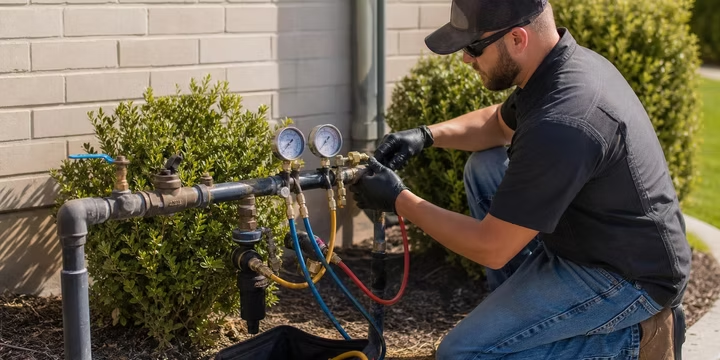
A certified tester attaches calibrated gauges to the test ports (called test cocks) on your backflow prevention assembly and measures whether the internal check valves and relief valve are holding pressure correctly. The results get recorded on TCEQ Form 20700, the official state document for pass/fail status, gauge calibration data, and device information.
Three terms get mixed up constantly:
- Backflow is water flowing the wrong direction, from an irrigation line back into your drinking water or toward the city supply.
- Backflow preventer is the mechanical device that stops reverse flow.
- Backflow test is the inspection verifying that device still works.
A passing test means the assembly functioned within accepted parameters on the day of testing. It does not mean your entire sprinkler system is leak-free or efficient. To understand the device itself, read about how backflow preventers work.
Why Backflow Testing Matters in Lubbock
This is not regulatory busywork. Cross-connections and backflow are documented outbreak factors in U.S. drinking water contamination incidents.
Your lawn sprinkler system is a textbook cross-connection. Once water enters irrigation piping, it sits alongside fertilizer residue, pesticide runoff, soil bacteria, and stagnant water. TCEQ’s consumer guide specifically identifies lawn sprinkler systems as common cross-connection risks because anything in that stagnant water can be drawn into drinking water during pressure changes.
Pressure drops happen more often than most people realize. A water main break, heavy demand during summer watering hours, or a nearby fire hydrant being used can all reduce system pressure enough to create backsiphonage. When that happens, whatever is sitting in your irrigation lines has a path back toward clean water, unless a working backflow preventer blocks it.
That is why backflow testing in Lubbock exists: to verify the mechanical barrier between contaminated irrigation water and the public drinking supply still functions.
Who Is Responsible? Understanding the Three-Party System
One reason backflow testing confuses people is that three separate parties are involved, each with different roles. Understanding this split explains why the city sends you a letter but a private contractor performs the work.
City of Lubbock: Sets and enforces local compliance requirements, tracks which properties have backflow assemblies, sends testing notices, registers testers, and can impose penalties including water shutoff and fines.
TCEQ (Texas Commission on Environmental Quality): Sets statewide cross-connection and backflow rules, licenses BPAT testers, provides the official test report form, and establishes minimum testing standards.
Property owner (you): Pays for installation, maintenance, testing, and any needed repairs. You are responsible for making sure the assembly gets tested on schedule and that records are submitted to the city.
The city does not send someone to test for you. It sets the deadline and expects you to hire a qualified private tester who submits the report.
City of Lubbock Backflow Testing Requirements
Not every Lubbock homeowner needs annual testing. Many websites oversimplify this, and the oversimplification causes real confusion.
Here is what the city actually requires: irrigation systems connected directly to the City of Lubbock water supply must have a backflow prevention assembly, and that assembly requires periodic testing depending on hazard classification and device type. Testing intervals range from one to three years. Health-hazard assemblies require annual testing. Lower-hazard irrigation systems with double check valve assemblies may be on a three-year cycle.
There is no grandfather clause. The city states this explicitly, and TCEQ guidance confirms it. If your property has a backflow assembly on record, it needs testing regardless of how old the system is.
The practical takeaway: follow the date on your notice. Even if your neighbor is on a different schedule, your testing frequency depends on your specific assembly and hazard classification.
For a detailed walkthrough of Lubbock compliance rules and ongoing device care, see our backflow preventer maintenance guide.
Got a Notice but No Sprinkler System?
Practitioners on Reddit report that some Lubbock residents receive notices for properties without irrigation systems. In one thread, a user described paying for an unneeded inspection because the city notice scared them into calling someone before verifying. Several other users in the same thread recommended calling the city first. The better approach: contact the City of Lubbock’s backflow program to confirm the record before hiring anyone. Do not ignore the letter, but do verify.
Sprinklers Turned Off?
If the assembly exists and the city says it is due, testing still applies. The obligation is based on the assembly record, not whether you ran your sprinklers last month. The City of Lubbock notes that an unused system can be properly removed and capped, and the property owner can send verification photos. But until that happens, compliance requirements remain.
Who Can Perform a Backflow Test in Lubbock?
Your tester needs two credentials, not one.
First, a current TCEQ BPAT license. TCEQ requires anyone who tests or repairs backflow prevention assemblies to hold a Backflow Prevention Assembly Tester license. Earning the BPAT requires a high school diploma or GED, qualifying experience, a 40-hour BPAT training course with exam, and 24 continuing education hours for renewal every three years.
Second, registration with the City of Lubbock. A BPAT license alone is not enough. Lubbock’s code requires testers to register with the city before conducting any tests. Registration requires a valid BPAT license, government photo ID, and a current gauge calibration report.
This distinction matters because a general plumber or sprinkler technician is not automatically qualified. Lubbock residents on Reddit repeatedly flag this confusion, with multiple users in recent threads warning that not all plumbers hold backflow certification. Learn more about what a BPAT tester does and why the credential matters.
Before You Book: Questions to Ask
- Are you currently licensed as a Texas BPAT?
- Are you registered with the City of Lubbock?
- Is your gauge calibration current?
- Does your quoted price include submitting the report to the city?
- Will I receive a copy of the report?
- What happens if the device fails?
- Do I need to be home, or just provide access?
How Much Does Backflow Testing Cost in Lubbock?
Some lead-generation websites publish Lubbock “backflow certification” estimates of $150 to $250. That range overstates what many Lubbock homeowners actually pay for a routine residential test.
Local first-hand evidence tells a different story. Lubbock residents on Reddit report paid prices ranging from roughly $65 to $115 for standard residential backflow testing, depending on the provider and timing. At least one local provider advertises a flat $75 rate including inspection and official report submission. The City of Lubbock says test cost varies by tester and depends on device size, location, and type, and recommends calling several certified testers for quotes.
Costs climb for:
- Commercial properties with larger or multiple assemblies
- Devices that are hard to access (buried under soil, behind locked gates)
- Assemblies that fail and need repair plus retesting
- Replacement of damaged, obsolete, or improperly installed devices
An irrigation professional on Reddit mentioned that backflow testing bundled with a sprinkler system checkup or seasonal startup often costs less than a standalone visit, since the tester is already on site. Worth asking about if you also need irrigation work.
What to confirm before agreeing to a price:
- Is the quote for the test only, or does it include city report submission?
- Is retesting included if a minor on-the-spot repair is done?
- What is the estimated cost if the device fails?
What Happens During a Backflow Test?
The appointment is straightforward, usually taking 15 to 30 minutes for a standard residential assembly that is accessible and passes.
Here is the typical sequence:
- The tester locates the backflow prevention assembly (usually in a plastic box near the water meter).
- They verify the device identity, type, and serial number.
- They connect a calibrated differential pressure gauge to the test cocks.
- They test each check valve and, where present, the relief valve to confirm the required pressure differentials hold.
- They record the readings on the official TCEQ test report.
- They submit the signed report to the City of Lubbock.
- You receive a copy for your records.
The paperwork matters as much as the test itself. Texas irrigation rules require results to be provided to the local water purveyor within ten business days. Both the property owner and the tester share responsibility for making sure records reach the city.
How to Prepare for Backflow Testing
A little preparation prevents wasted trips and extra charges.
Find the assembly box. For most Lubbock homes, start near the water meter, which is typically in the alley or by the fence. The backflow device is usually inside a plastic box in the ground.
Clear the area. Remove dirt, mulch, grass, or debris from the lid and around the test ports. If the test cocks are buried or flooded, the tester cannot connect gauges. Texas rules require enough clearance for proper testing.
Unlock gates and secure pets. If the assembly is behind a locked fence, the tester needs access. Keep dogs inside. Reddit users in Lubbock note that some testers can complete the test without the homeowner present if the device is in an accessible, unlocked area.
Have your city notice handy. It may include the assembly record number, device type, or compliance due date. A Texas BPAT practitioner on Reddit noted that testers need the device location, type, and request status to ensure the correct device is tested.
For a complete preparation checklist, see our guide on preparing for backflow inspection.
What If Your Backflow Preventer Fails?
A failed test does not automatically mean the whole assembly needs replacement. It means something inside the device is not holding pressure correctly, and it must be fixed before your property is back in compliance.
The City of Lubbock requires that a failed assembly be repaired or replaced and retested by a certified tester. Lubbock’s code states that defective assemblies must be corrected at the property owner’s expense, and water service may be discontinued until requirements are met.
Common failure causes include worn rubber seals, debris caught in check valves, weak springs, or a relief valve not opening at the correct pressure. Many of these are repairable without replacing the entire assembly.
Practitioners on LinkedIn emphasize that backflow devices can look perfectly fine on the outside while internal components fail silently. A visual glance is not a compliance test, which is exactly why periodic testing exists.
If your device fails, ask your tester:
- Which component failed and what the readings were
- Whether repair is possible or full replacement is necessary
- What repair will cost before you approve any work
- Whether retesting is included in the repair price
One Lubbock Reddit user shared that a neighbor was quoted roughly $1,000 for a full replacement, but after digging out and cleaning their own assembly box, they passed in subsequent years. Not every failure is that simple, but getting a clear diagnosis before approving expensive work is always worthwhile.
If you notice leaking, pooling water, or visible damage before a scheduled test, read about backflow device repair signs.
Penalties for Ignoring a Lubbock Backflow Notice
Do not treat the city notice like junk mail. The City of Lubbock can shut off water service until testing is completed, and the ordinance allows fines up to $2,000 per day for noncompliance. It is far cheaper to schedule a backflow test than to deal with enforcement.
Backflow Testing Terms Lubbock Property Owners Should Know
Backflow. Reverse flow of water or other substances into a potable water system. In Lubbock, this means irrigation water, fertilizer, or soil organisms potentially flowing backward toward your drinking water.
Cross-connection. Any actual or potential link between potable water and a source that could contaminate it. Your sprinkler system connected to the city supply is the most common residential example.
Backflow prevention assembly. A testable mechanical device installed to prevent reverse flow. Residential assemblies in Lubbock are typically in a plastic box near the water meter. Commercial assemblies are often above ground in insulated enclosures.
BPAT. Backflow Prevention Assembly Tester, the TCEQ license required to test and repair these assemblies in Texas.
Registered tester. A BPAT-licensed tester who is also registered with the City of Lubbock and authorized to submit test reports locally. A BPAT license alone does not satisfy the local requirement.
T&M report (Form 20700). The official TCEQ form documenting test results, gauge calibration data, and pass/fail status. The signed original goes to the public water system.
Test cocks. Small ports on the assembly where a tester attaches gauges. If buried or flooded, the test cannot be performed properly.
Gauge calibration. The tester’s differential pressure gauge must be checked for accuracy annually. Lubbock requires a current calibration report as part of tester registration.
RP / RPZ. Reduced pressure principle assembly, a higher-protection device for health hazards or backpressure conditions. Must be installed at least 12 inches above ground with proper drainage.
PVB / SVB. Pressure vacuum breaker and spill-resistant vacuum breaker. These protect against backsiphonage only, not backpressure.
DCVA. Double check valve assembly, used for lower-hazard applications where allowed. Note that ordinary check valves in sprinkler systems are different from testable backflow prevention assemblies.
Health hazard. A connection with potential to introduce contaminants affecting public health. These assemblies require annual testing.
Backsiphonage. Backflow caused by reduced system pressure creating suction (from a main break, hydrant use, or heavy demand).
Backpressure. Backflow caused when downstream pressure exceeds supply pressure (from pumps, elevated piping, or steam pressure).
A Note for Commercial Properties and Property Managers
For HOAs, multi-site businesses, and property managers, backflow testing in Lubbock involves more than a single appointment. Practitioners on LinkedIn who manage commercial portfolios report that the real pain points are tracking due dates across multiple properties, managing different testing schedules, budgeting for surprise repairs, and keeping documentation organized.
If you manage several properties, keep a running list of assembly locations, serial numbers, device types, due dates, and last test reports. Coordinating backflow testing with a seasonal sprinkler checkup can reduce scheduling hassle since the tester is already on site.
Exposed or above-ground commercial assemblies also face freeze risk in West Texas winters. A freeze-cracked assembly will fail its next test and may leak actively. Consider protecting systems from freezing as part of your annual maintenance plan.
Frequently Asked Questions
How often do I need backflow testing in Lubbock?
It depends on your device type and hazard classification. Health-hazard assemblies require annual testing. Lower-hazard irrigation systems with double check valve assemblies may be tested every three years. The most reliable guidance: follow the date on your city notice, because your schedule is tied to your specific assembly record.
Can any plumber do a backflow test?
No. The tester must hold a current TCEQ BPAT license and be registered with the City of Lubbock. A general plumbing or irrigation license does not qualify someone to perform or certify the test.
Do I need to be home for the test?
Not always. If the assembly is in an accessible outdoor location without locked gates, some testers can complete the work without you present. If the device is behind a fence or in the backyard, you need to arrange access.
What if I got a notice but do not have a sprinkler system?
Call the City of Lubbock’s backflow program to verify your property’s record. Do not ignore the letter, but confirm before paying for an unnecessary inspection. Multiple Lubbock residents on Reddit have reported receiving notices for properties without irrigation systems due to outdated city records.
What happens if I ignore the notice?
The city can shut off water service until testing is complete. The ordinance allows fines up to $2,000 per day for noncompliance.
Can I test my backflow preventer myself?
Not for official compliance. TCEQ requires a licensed BPAT to perform the test, and Lubbock requires the tester to be city-registered. Self-certification is not accepted.
What if my device fails the test?
The assembly must be repaired or replaced, then retested by a certified tester. Ask for the specific failed readings and whether repair (rather than full replacement) is possible. Many failures involve worn internal parts that can be fixed without replacing the whole device.
How do I know the city received my test report?
Ask your tester to confirm submission. Texas rules require results to be provided to the local water system within ten business days. You should also request a copy for your own records.
Schedule Your Lubbock Backflow Test
M&M Sprinklers provides certified backflow preventer testing, repairs, and installations for residential and commercial properties in Lubbock and West Texas. The company has an in-house Texas-licensed BPAT and provides written certifications after testing and repairs. Because M&M is also a full irrigation contractor, a single visit can cover compliance testing, leaking assembly repair, and broader sprinkler system issues without scheduling a second contractor.
Call (806) 794-1300 to schedule before your city deadline.