
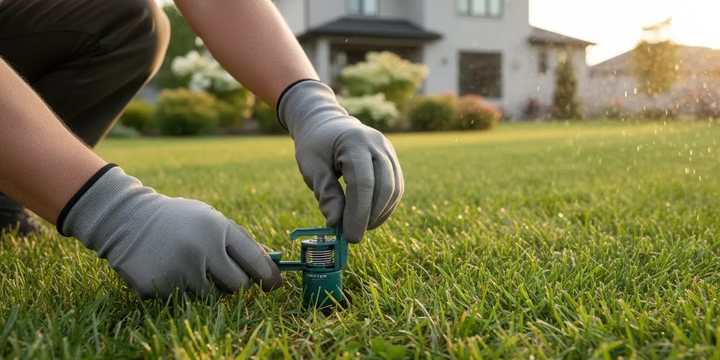
Getting your lawn sprinklers dialed in perfectly can feel like a secret art, but it doesn’t have to be. Adjusting a Hunter sprinkler involves using a special tool to set the spray pattern (arc) and distance (radius) on each head. Properly adjusting a Hunter sprinkler head is one of the best things you can do to get a greener lawn, stop wasting water, and prevent those annoying dry spots or soaked sidewalks.
Whether you’re dealing with a rotor that sprays the fence or a pop up that doesn’t reach the flower bed, a few simple tweaks can make all the difference. This guide walks you through the entire process, from resetting the turret to setting the spray pattern and changing the distance, all in plain English.
If your system needs more than a quick adjustment, M&M Sprinklers offers professional tune ups across Lubbock and West Texas.
First Things First: The Hunter Adjustment Wrench
Before you start adjusting a Hunter sprinkler, you need the right tool. The Hunter adjustment wrench is a small plastic tool specifically designed for this job. It has a hex key (often 3/32 inch) on one end and a plastic key on the other. This single tool handles nearly every task involved in adjusting a Hunter sprinkler, from lifting the pop up riser to tweaking the spray arc and distance.
If a head is cracked or won’t respond to adjustment, a quick sprinkler head replacement may be faster than fighting with it. While you might try other tools, using the official wrench prevents stripping the plastic sockets and makes the entire process much easier.
Practitioners on Reddit report that a flat head screwdriver can work in a pinch for the radius screw, but warn that it’s easy to damage the adjustment socket on the turret cap. The consensus is clear: spend the few dollars on the proper wrench.
The Step Most People Skip: Resetting the Turret Before You Adjust
This is where most DIY sprinkler adjustments go wrong. People jump straight to turning the arc screw without first understanding where the turret is positioned. The result is a head that waters the neighbor’s driveway no matter what arc setting they choose.
Why You Need to Reset the Turret to the Right Stop
Hunter rotors use a fixed right stop as their reference point. Every arc adjustment happens to the left of that fixed edge. If you don’t know where your right stop is before you start making changes, you’re adjusting blind.
Here’s how to find and reset it. With the system off, grasp the nozzle turret (the top part that rotates) and turn it by hand clockwise until it stops. Don’t force it past the stop point. That locked position is your right stop, and it represents the right edge of the watering pattern.
According to Hunter’s own technical documentation, you should always locate the right stop first before making any arc changes. This is true across the PGP, I20, I25, and PGJ rotor lines.
Rotate the Turret to the Left Stop, Then Back to the Right Stop
Once you’ve found the right stop, rotate the turret counterclockwise (to the left) by hand until it reaches the other side. This is the left stop. It shows you the full extent of the current watering pattern.
Now rotate back clockwise to the right stop again. This full sweep accomplishes two things:
- It confirms the current arc setting so you know exactly what you’re working with.
- It verifies the turret mechanism is moving freely and not jammed with dirt or debris.
If the turret feels gritty or won’t rotate smoothly, you likely have a clogged sprinkler head that needs cleaning before any adjustment will hold properly.
One irrigation technician shared in a YouTube walkthrough that he performs this left to right sweep on every single head during service calls, even when the customer only reported one problem head. “Half the time I find heads that have drifted off their stops from mower hits or foot traffic,” he explained.
Aligning the Right Stop to Your Lawn Edge
After completing the sweep, leave the turret sitting on the right stop. Now look at where the nozzle is pointing. Is it aimed at the edge of your lawn, your driveway, or your fence?
If the right stop isn’t aligned with the boundary you want, no amount of arc adjustment will fix the problem. You need to physically reorient the sprinkler body. Do this by carefully digging around the head and twisting the entire body until the right stop lines up perfectly with the edge of your lawn. For some models, you can also unscrew the top and lift the internal assembly out, reposition it, and screw it back in.
Getting this alignment right is the single most important step. Everything else builds on it.
Setting Your Boundaries: Arc Adjustments
With the turret properly reset and the right stop aligned, you’re ready to set the arc.
What is Arc Adjustment?
Arc adjustment means changing the rotation pattern of the sprinkler head. A sprinkler in a corner needs a 90 degree (quarter circle) arc, while one in the middle of the lawn might need a full 360 degree circle. Most Hunter rotors, like the popular I20 model, can be tuned from around 50 degrees up to a full 360 degrees. This flexibility lets you match the spray pattern precisely to the shape of your lawn.
How to Increase or Decrease the Arc
Adjusting the arc is done from the top of the sprinkler head using the plastic end of your Hunter wrench.
- To Increase the Arc: Insert the plastic end into the arc adjustment socket. Turn it clockwise (in the direction of the “+” symbol). Each full 360 degree turn of the wrench typically adds 90 degrees to the watering pattern. You’ll feel a stop or hear a clicking sound when you reach the maximum arc.
- To Decrease the Arc: Insert the tool and turn it counterclockwise (toward the “–” symbol). Most rotors have a minimum arc of about 40 degrees, and the tool will stop turning when you reach this limit.
For a more detailed walkthrough with model specific steps, check out our Hunter head adjustment guide.
A common mistake practitioners on Reddit mention is losing count of how many turns they’ve made. One helpful trick: start from the right stop, note whether you need quarter, half, or full circle coverage, and count your wrench turns accordingly. Four full turns of the wrench equals a full 360 degree arc on most Hunter rotors.
Fine Tuning Your Spray: Radius and Flow Rate
Once your arc is set, you can control how far the water sprays and how much water is being used. This fine tuning is a crucial part of adjusting a Hunter sprinkler for maximum efficiency.
Adjusting the Spray Distance (Radius Adjustment)
The radius is how far the water stream shoots out from the sprinkler head. If your sprinkler is overshooting onto the sidewalk, a quick radius adjustment can fix it. For a deeper dive on setting arc and radius the right way, see the nozzle adjustment guide. Look for a small screw on top of the nozzle.
Using the metal hex end of your Hunter wrench, turn this screw clockwise to reduce the spray distance. Turning it counterclockwise increases the distance. This screw can typically reduce the radius by up to 25 percent. Be careful not to turn it clockwise more than five full turns, as you could dislodge the screw completely.
According to the Irrigation Association, proper radius adjustment is one of the simplest ways homeowners can reduce outdoor water waste. Heads that overshoot onto hardscapes are a leading cause of runoff in residential irrigation systems.
How to Change a Sprinkler Nozzle
If you need to change the spray distance by more than 25 percent, the best solution is to install a different nozzle. Sprinkler heads like the Hunter I20 often come with a set of 12 interchangeable nozzles, giving you plenty of options for different distances and flow rates.
Here’s the basic process for nozzle installation:
- Lift the Riser: Use the plastic end of your Hunter tool to hook into the lifting socket on top of the sprinkler and pull the pop up riser up.
- Loosen the Radius Screw: Use the hex end to turn the radius adjustment screw counterclockwise a few times to make sure it isn’t holding the nozzle in.
- Remove the Old Nozzle: You can use pliers to gently pull the old nozzle out. A pro tip is to briefly turn on the water, which will pop the nozzle out for you (be ready to catch it).
- Insert the New Nozzle: Slide the new nozzle into the socket. The socket is usually angled up about 25 degrees, so push it in firmly until it seats.
- Secure It: Tighten the radius screw just enough to hold the new nozzle in place.
For a step by step walkthrough with photos, see our sprinkler nozzle replacement guide.
Understanding and Adjusting Precipitation Rate
Precipitation rate is how quickly a sprinkler applies water to a given area, measured in inches per hour. Ideally, all sprinklers in a single zone should have a matched precipitation rate. This ensures that a head watering a 90 degree corner puts down the same amount of water over its area as a head watering a 180 degree half circle.
This is achieved by using different nozzles. For example, a half circle nozzle might use 2 gallons per minute (GPM), while a quarter circle nozzle uses 1 GPM. The result is that every part of your lawn gets watered evenly. If you have wet or dry spots in a zone, you may have mismatched rates. The fix is usually a nozzle change.
Using matched precipitation nozzles can lead to significant water savings. The EPA’s WaterSense program estimates that properly matched and adjusted irrigation heads can reduce outdoor water use by 20 to 30 percent compared to poorly configured systems.
If your dry spots persist even after adjusting, the problem might be deeper. Our guide on why sprinklers leave dry spots covers pressure issues, head spacing, and other common causes.
Quick Reference: Hunter Rotor Adjustment Summary
A Pro Feature: Using the Flo Stop Shutoff (Hunter I20 Only)
Some premium Hunter rotors, specifically the I20 series, have a feature called Flo Stop. This allows you to completely shut off the water to a single head while the rest of the zone is still running. It’s a huge convenience for maintenance, as it lets you change a nozzle or make an adjustment without running back to the controller.
You simply use your adjustment tool to turn the Flo Stop control on the head, and the water flow stops for that specific sprinkler. If you need to isolate a problem fast, here’s how to handle emergency sprinkler shutoffs and quick fixes.
Upgrading to a Wi-Fi sprinkler controller gives you similar from your phone convenience across the whole system, not just individual heads.
Common Mistakes When Adjusting Hunter Sprinklers
Based on what homeowners and irrigation professionals share across forums and YouTube, these are the most frequent adjustment errors:
Skipping the turret reset. Jumping straight to the arc screw without first checking and resetting the turret to the right stop is the number one mistake. The head might appear to be set at the right arc, but the entire pattern could be rotated 30 degrees off where it should be.
Over tightening the radius screw. Cranking the radius screw too far clockwise can push it into the nozzle seat and either jam or dislodge entirely. If the screw falls inside the head, you’ll need to pull the riser and fish it out.
Ignoring low pressure. If the stream looks weak or won’t reach its rated distance even with the radius screw fully open, the issue might not be the head at all. Low water pressure from a partially closed valve, a leak elsewhere in the zone, or municipal supply issues will undermine any adjustment you make. Our low pressure troubleshooting guide covers the most common causes.
Adjusting while the system is off. While you can find the stops and set the arc with the water off, you should always run the zone afterward to verify coverage. Small misalignments that seem fine on paper become obvious when you watch the actual spray pattern.
Need a Hand? When to Call a Professional
Adjusting a Hunter sprinkler is a great DIY skill, but sometimes you run into issues that need an expert eye. Persistent low pressure, misaligned heads that require digging, or zones with multiple heads that all need rebalancing can turn a quick Saturday project into a frustrating afternoon.
The team at M&M Sprinklers & Tree Services has been keeping lawns healthy in Lubbock and West Texas since 1987. From a simple sprinkler head adjustment to full system audits and seasonal maintenance plans, they have the tools and expertise to get everything dialed in right.
Frequently Asked Questions About Adjusting a Hunter Sprinkler
Can I adjust a Hunter sprinkler without the special tool?
You might be able to make some adjustments with a small screwdriver or hex key, but it’s not recommended. Using the official Hunter wrench is the easiest way and prevents you from stripping or damaging the adjustment sockets on the sprinkler head.
Why is my sprinkler spraying the sidewalk?
This is usually caused by two things: either the arc is set too wide, or the fixed right stop is misaligned. First, reset the turret to the right stop and check where it’s pointing. If the right stop is aimed at the pavement, you’ll need to physically rotate the entire sprinkler body in the ground. If the right stop is correct but the pattern is too wide, decrease the arc.
How do I know which nozzle to use?
Choose a nozzle based on the distance you need the sprinkler to throw. Nozzle charts (included with new sprinklers or found on Hunter’s website) show the GPM and spray radius for each nozzle at a given water pressure. The goal is to achieve head to head coverage, where the spray from one sprinkler reaches the next one.
What is the difference between arc and radius?
The arc is the side to side spray pattern or angle of rotation (like a 90 degree corner pattern). The radius is the distance the water travels out from the sprinkler head. You adjust both when adjusting a Hunter sprinkler: the arc to fit the shape of the lawn and the radius to control how far the water throws.
Why does my turret feel stuck when I try to rotate it?
Dirt, sand, and grass clippings can work their way into the turret mechanism over time, especially in sandy West Texas soils. Try running the zone briefly to flush debris, then attempt the rotation again. If it’s still stuck, the internal drive mechanism may be damaged and the head might need replacement.
How often should I check my sprinkler adjustments?
Check them at the beginning of each watering season and once mid summer. Sprinkler heads get knocked out of alignment by lawnmowers, foot traffic, and ground settling. A quick check, starting with that turret sweep from left stop to right stop, can prevent problems and save water all season long.