
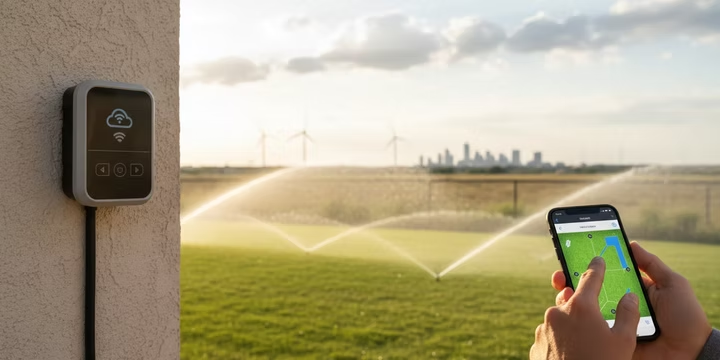
A WiFi sprinkler controller lets your irrigation system connect to the internet, so schedules, weather adjustments, and alerts live in an app instead of on a wall timer. That means easier changes, better timing, and fewer surprises. In Lubbock and West Texas, where wind, sun, and sudden fronts can flip conditions fast, a smart controller can protect plants and reduce water waste.
M and M Sprinklers in Lubbock services and installs smart tech every week, including Hunter X2 paired with the Hydrawise app. If you want a WiFi sprinkler controller that fits your yard and your existing valves, an expert checkup is the fastest path to the right choice. Book a Wellness Check with M and M Sprinklers.
Why Data Quality Drives a Smarter System
Every WiFi sprinkler controller needs accurate inputs to make smart decisions. If the data is off, your yard gets too much or too little water. West Texas microclimates can differ street to street, so the closer your data source is to your property, the better.
Go Beyond Forecasts with On Site Sensors
Weather forecasts are a great starting point, but on site sensors provide ground truth that prevents unnecessary watering.
- Rain and Freeze Sensors: A wireless rain and freeze sensor is a must have in Lubbock. It tells your controller to skip a watering cycle when it’s actually raining or freezing at your house, which is far more reliable than a distant weather station. Getting the right sensor installed correctly matters just as much as the controller itself. Learn more about rain sensor installation.
- Soil Moisture Sensors: For the ultimate in accuracy, soil moisture sensors measure the water content directly in the root zone. These devices ensure you only water when the soil is actually dry, preventing waste from overwatering that can harm plant health. By reading the actual moisture levels, the controller can override a scheduled cycle if the ground is already sufficiently damp.
Key Factors for West Texas Yards
- Source of weather data: A blend of nearby weather stations and on site sensors gives the best results.
- Rain and freeze handling: Real rain shutoff on site beats distant estimates every time. A freeze skip can also protect plants from damage during sudden cold snaps.
- Wind awareness: Sprinkler spray drifts in Lubbock wind, so a controller that supports “cycle and soak” scheduling plus lower precipitation rate nozzles helps water get to the roots.
- Flow feedback: A controller paired with a flow sensor can catch breaks and clogs before they soak a corner or flood a sidewalk. Understanding how flow monitoring works is worth the read if you’re considering this upgrade.
If you want a professional to evaluate your system, ask M and M Sprinklers about weather sensor options.
Top 3 WiFi Sprinkler Controller Picks
Now that you know what to look for in a smart irrigation system, this section spotlights three WiFi controllers that deliver a strong blend of performance, water savings, and ease of use. The Rachio 3, Orbit B hyve, and Rain Bird ST8 2.0 span different budgets and yard sizes. Each is proven, widely supported, and straightforward to install.
1. Rachio 3 (8ZULW C)
Rachio 3 is the set and forget brain Lubbock lawns love. Its Weather Intelligence keeps schedules nimble through sudden blue northers and triple digit heat, trimming waste without starving your turf. Flex or Fixed schedules make it easy to honor watering restrictions, while optional flow monitoring spots leaks early.
Practitioners on Reddit frequently call the Rachio 3 the easiest controller to set up, with several users noting the app walks you through zone configuration in under 15 minutes. Others point out that Flex Daily scheduling can be aggressive about skipping watering days, which works well in climates with unpredictable rain but may need tuning in consistently dry areas like West Texas.
- Weather and Sensor Smarts: Uses forecast data to adjust watering; supports rain, freeze, and soil moisture sensors, plus optional flow monitoring for timely leak alerts.
- Setup, Controls and Integrations: App guided WiFi setup is quick; has onboard buttons plus mobile and web control; works with Alexa and Google.
- Zones, Hardware and Retrofit Notes: Eight zones; indoor rated, so add an outdoor enclosure if needed; retrofits standard 24 VAC valves and a master valve.
2. Orbit B hyve 57950
With a rugged cabinet and 12 zones, Orbit’s B hyve 57950 is built for West Texas swings. WeatherSense skips wasted cycles during rain or freezes, and WaterSense certified programs help rein in those August bills. Even through dust or WiFi hiccups, manual panel controls keep your schedule on track.
- Weather and Sensor Smarts: Smart Watering adjusts runtimes using local forecasts and zone data; supports wired rain and freeze sensors.
- Setup, Controls and Integrations: App streamlines 2.4 GHz WiFi pairing; Bluetooth and panel controls persist if WiFi drops; compatible with Alexa and Google.
- Zones, Hardware and Retrofit Notes: Twelve zones; weather resistant locking cabinet; 24 VAC terminals retrofit existing valves and backflow wiring.
3. Rain Bird ST8 2.0
Rain Bird’s ST8 2.0 squeezes more from Lubbock’s limited watering windows with daily, forecast driven schedules. Freeze skips and rain delays help avoid icy sidewalks and citations while per zone tuning dials in shrubs versus turf. Eight zones and WaterSense efficiency keep landscapes healthy without bloating the bill.
- Weather and Sensor Smarts: Nightly forecasts drive automatic adjustments; supports Rain Bird rain and freeze sensors; no flow sensor input, so no leak alerts.
- Setup, Controls and Integrations: Simple 2.4 GHz WiFi via Rain Bird app; full panel control; works with Alexa and Google.
- Zones, Hardware and Retrofit Notes: Eight zones; available in indoor or IPX4 outdoor variants; retrofits 24 VAC valves, common, and backflow wiring.
Dual Band WiFi Support: Does Your Controller Need It?
Most WiFi sprinkler controllers on the market today connect over the 2.4 GHz band only. That’s actually a good thing for irrigation. The 2.4 GHz signal travels farther and penetrates walls and garage doors better than 5 GHz, which matters because controllers often sit in garages, utility rooms, or exterior walls far from the router.
The catch is that many newer routers ship with a single combined network name for both 2.4 GHz and 5 GHz bands. During setup, the router may try to steer the controller onto 5 GHz, causing the pairing to fail. Practitioners on Reddit report this as one of the most common installation headaches. The fix is usually straightforward: temporarily split the router into separate 2.4 GHz and 5 GHz network names, pair the controller on 2.4 GHz, and then recombine if desired.
A few newer controllers and bridge modules do support dual band connectivity. If your home already runs a mesh network, a dual band controller can latch onto whichever frequency the nearest mesh node serves. For most Lubbock homes, though, a reliable 2.4 GHz connection to your existing router or a WiFi extender positioned near the controller is all you need.
Quick tips for stable connectivity:
- Check your phone’s WiFi signal strength at the controller location before mounting.
- If the signal reads below two bars, add a mesh node or extender nearby.
- Disable band steering during initial pairing, then re enable it.
- Keep the controller’s network name and password saved somewhere accessible for firmware updates (more on that below).
Firmware Updates: Why They Matter and How to Handle Them
A WiFi sprinkler controller is essentially a small computer, and like any computer, it receives firmware updates from the manufacturer. These updates patch bugs, improve weather algorithms, add features, and occasionally close security vulnerabilities. Skipping them means the controller gradually falls behind.
Most current controllers handle firmware updates automatically over WiFi. The Rachio 3, for example, pushes updates overnight so they don’t interrupt active watering. Orbit B hyve updates through the app with a manual confirmation step. Rain Bird ST8 2.0 delivers updates via the Rain Bird app as well, typically requiring you to be on the same local network.
Where things go wrong is when the controller loses its WiFi connection for weeks or months. It still waters on the last saved schedule, but it won’t pull weather data or receive patches. One YouTube walkthrough by a Rachio installer showed a controller that had been offline for four months. It missed a critical update that fixed a scheduling bug causing double watering on certain zone configurations. Once reconnected, the update applied and the issue cleared immediately.
Best practices for firmware:
- Confirm your controller shows “connected” in the app at least monthly.
- Enable automatic updates if the manufacturer offers that setting.
- After a power outage or router change, re check the WiFi connection.
- If your system is on a maintenance plan, your technician can verify connectivity and firmware status during each visit.
User App Training: Getting the Most from Your Controller
The most common complaint about WiFi sprinkler controllers isn’t hardware failure. It’s confusion about the app. A controller that nobody in the household knows how to operate is just an expensive timer.
Each manufacturer structures its app differently. Rachio organizes everything around zones and schedules with a clean interface that most people pick up quickly. Orbit B hyve uses a slightly more traditional layout with program labels (A, B, C) familiar to anyone who’s used a conventional timer. Rain Bird’s app leans into simplicity, though some users on Reddit note that advanced settings like seasonal adjust percentages can be buried in submenus.
A few things worth learning in any controller app:
- Manual zone run: How to start a single zone on demand, useful for checking coverage or troubleshooting dry spots.
- Rain delay: How to pause all watering for a set number of days (helpful during extended wet spells or if you’re having repair work done).
- Zone settings: Soil type, slope, sun exposure, and nozzle type all feed into the controller’s water calculations. Getting these right makes the difference between smart irrigation and guesswork.
- Alert preferences: Turning on push notifications for flow anomalies, skipped cycles, and offline warnings.
- Multi user access: Most apps let you invite a spouse, property manager, or irrigation technician to the account. This avoids the common problem of one person leaving town and nobody else knowing how to adjust the system.
When M and M Sprinklers installs or programs a smart controller, the technician walks through the app with the homeowner on site. That hands on walkthrough covers schedules, sensor status, and manual overrides. It takes about 10 minutes and prevents the most common callback: “I don’t know how to change anything.”
WaterSense Smart Controller Rebates
One financial incentive that many homeowners overlook is the WaterSense rebate. The EPA’s WaterSense program certifies irrigation controllers that meet strict water efficiency criteria. Controllers carrying the WaterSense label, including the Orbit B hyve 57950 and Rain Bird ST8 2.0, have been independently tested to reduce outdoor water use compared to standard timers.
Many water utilities across the country offer rebates ranging from $25 to $200 or more for installing a WaterSense certified smart controller. Availability and amounts vary by provider. In Texas, several municipal water systems have offered rebates as part of broader conservation programs, though specific programs come and go depending on drought conditions and budget cycles. The WaterSense rebate finder is the quickest way to check current offers in your area.
Even without a direct rebate, the water savings from a properly configured WiFi sprinkler controller often pay for the device within two to three seasons. According to the EPA, WaterSense labeled controllers can save an average home nearly 7,600 gallons of water annually. In Lubbock, where water rates reflect genuine scarcity, those savings add up faster than in wetter regions.
To qualify for most rebate programs:
- The controller must carry the WaterSense label (check the product box or the EPA’s product search).
- You typically need a purchase receipt and proof of installation.
- Some programs require the old controller to be a conventional (non smart) timer being replaced.
- Professional installation by a licensed irrigator strengthens some applications and ensures proper programming.
If you’re planning a controller upgrade and want to maximize savings, ask M and M Sprinklers about which WaterSense certified models fit your system and whether current rebate programs apply in Lubbock.
How We Evaluate and What to Look For
A good WiFi sprinkler controller should improve coverage, cut waste, and reduce hassle. These are the criteria used by M and M Sprinklers during an irrigation checkup in Lubbock and nearby towns like Wolfforth and Shallowater.
Core Controller Features
- Simple app that anyone in the household can use.
- Reliable weather sourcing with support for on site rain, freeze, and soil sensors.
- Strong zone by zone controls, including cycle and soak, seasonal adjust, and separate programs for turf, drip, and beds.
- Flow monitoring compatibility for leak and break alerts.
- Works with common valves and wiring already in West Texas systems. Understanding how a sprinkler system works helps you evaluate compatibility.
- Clear alerts and logs to see what ran, what skipped, and why.
- Solid offline behavior, ensuring it runs a safe schedule if WiFi drops.
Installation and Network Considerations
- Check WiFi Signal Strength: Controllers are often installed in garages or basements where WiFi is weak. Before installing, check the signal at the controller’s location. A weak signal can prevent the controller from accessing weather data or receiving commands.
- Consider a WiFi Extender or Bridge: If the signal is poor, a WiFi extender or a dedicated mesh network node can help bridge the gap. Some devices may also use a Bluetooth to WiFi bridge for connectivity. Most smart controllers are designed for the 2.4 GHz band, which offers better range than 5 GHz.
- Professional Installation: A licensed irrigator ensures proper wiring, sensor placement, and zone programming. M and M Sprinklers also performs backflow testing and certification, which is a critical part of a healthy and compliant system.
Local Credentials and Expertise
- M and M Sprinklers has served Lubbock since 1987.
- The team includes three licensed irrigators, two Certified Arborists, and one TDA chemical applicator to align irrigation with total plant and soil health.
- The Gold Plan includes a wireless rain and freeze sensor and seasonal programming.
- The Technology Plan adds live flow monitoring and automatic alerts for leaks.
- Service covers Lubbock and surrounding towns, including Wolfforth, Shallowater, and Plainview.
If you want an expert to evaluate your timer, wiring, and valves, schedule a Wellness Check with M and M Sprinklers.
Conclusion: Picking the Right Controller for Your Yard
The best WiFi sprinkler controller for a West Texas yard is the one that blends accurate local data, solid app controls, and leak aware hardware with a setup that matches your zones. Start by confirming valve and wiring health, add a rain and freeze sensor for reliability, and then enable flow alerts if possible. Factor in practical details too: make sure your WiFi reaches the controller location, keep firmware current, learn the basics of your app, and check whether a WaterSense rebate can offset the cost. That recipe keeps turf green, beds healthy, and bills predictable.
If you want help selecting, installing, or programming a WiFi sprinkler controller, the local team at M and M Sprinklers can handle it. Get started today at M and M Sprinklers.
FAQ
What is a WiFi sprinkler controller and how does it work? It is a smart timer that connects to your home network and uses an app to manage watering zones. A WiFi sprinkler controller can pull weather data, skip watering after rain, and alert you to issues. It replaces a traditional wall timer.
Will a WiFi sprinkler controller lower my water bill in Lubbock? It can, especially when paired with a rain sensor, efficient nozzles, and cycle and soak programming. The biggest savings come from catching leaks early and avoiding unnecessary irrigation. M and M Sprinklers offers a Technology Plan with live flow monitoring to help with this.
Do I still need a rain and freeze sensor with a smart controller? Yes, for most properties. A WiFi controller benefits from on site confirmation of rain or freezing conditions. A wireless sensor adds a local safety net when distant weather stations miss a pop up shower.
Can a WiFi sprinkler controller run drip zones and existing valves? Yes, in most cases. A professional technician can confirm the controller is compatible with your existing valve solenoids and wiring and supports programs suitable for drip irrigation.
What is the difference between a smart controller and a WiFi sprinkler controller? The terms are often used interchangeably. A WiFi sprinkler controller always has app control. A truly smart controller also uses weather data, supports sensors, and can adjust schedules automatically.
Who should install a WiFi sprinkler controller in West Texas? A licensed irrigator is ideal. Proper labeling, sensor placement, backflow checks, and programming make a big difference. You can book installation or a system check with M and M Sprinklers.
How does flow monitoring work? A flow sensor is added to the main irrigation line. The controller learns the normal flow for each zone, then sends an alert if it detects unusually high or low flow, which can indicate a broken head or a stuck valve.
Do WiFi sprinkler controllers need firmware updates? Yes. Most controllers update automatically over WiFi, patching bugs and improving weather algorithms. If your controller goes offline for an extended period, it will miss these updates. Check connectivity monthly and verify the firmware version in your app.
Can I get a rebate for installing a WaterSense certified controller? Many water utilities offer rebates for WaterSense labeled smart controllers. Amounts and availability vary by location and year. Check the EPA’s WaterSense rebate finder or ask your irrigation technician whether current programs apply in your area.
Does my WiFi sprinkler controller need dual band WiFi? Most controllers only use 2.4 GHz, which actually works better at longer range. If your router combines both bands under one network name, you may need to temporarily split them during setup. A few newer models support dual band, but it’s not a requirement for reliable operation.