
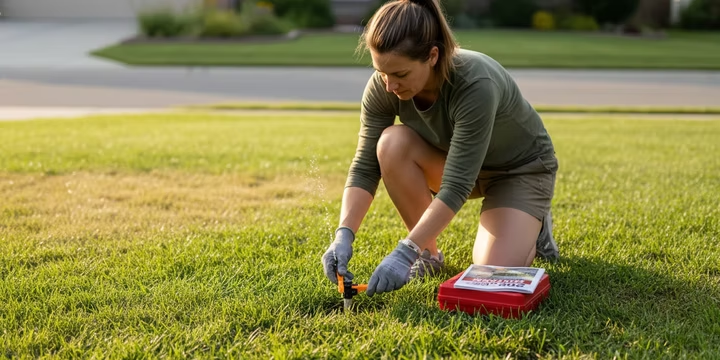
Is your sprinkler system watering the sidewalk more than your lawn? Do you have frustrating dry spots or soggy patches? You’re not alone. Misaligned sprinklers are a massive source of water waste, accounting for a staggering 30 to 60 percent of all wasted irrigation water. The good news is that learning the basics of adjusting a Toro sprinkler head is straightforward. The process involves using a special key or a flathead screwdriver to turn adjustment slots on top of the head, allowing you to set the spray pattern (arc) and distance (radius). This can save you water, money, and help you grow a healthier, greener lawn. See our water‑saving irrigation tips for more quick wins.
This guide will walk you through everything you need to know, from simple tweaks to changing nozzles. Let’s get your sprinkler system dialed in for perfect coverage.
What Does Adjusting a Toro Sprinkler Head Involve?
At its core, adjusting a Toro sprinkler head means fine tuning two key settings: the arc and the radius.
- Arc: This is the rotation pattern the sprinkler makes, like a 90 degree corner or a 180 degree half circle.
- Radius: This is the distance the water sprays from the head.
Getting these two settings right ensures water lands only on your landscape, not on your driveway, fence, or house. Toro designs its rotor heads with simple, built in adjustment features that you can usually manage with a special Toro key or a small flathead screwdriver. Properly adjusting a Toro sprinkler head is one of the most effective ways to improve your system’s efficiency and conserve water.
Mastering Arc Adjustment
The arc defines the watering pattern of your sprinkler. Most Toro rotor heads have a wide range, allowing you to set the arc anywhere from about 40 degrees for a tight corner to a full 360 degrees for open areas.
Each rotor has a fixed left stop and an adjustable right stop. The left stop is your starting point, and the arc adjustment moves the right stop to either widen or narrow the watering pattern. You’ll find an arc adjustment slot on top of the sprinkler turret, often marked with an arrow or a degree scale.
How to Increase the Arc
If you have a dry spot between two sprinkler heads, you may need to increase the arc. This widens the sprinkler’s coverage to create proper overlap.
To increase the arc:
- Insert the Toro adjustment key or a flathead screwdriver into the arc adjustment slot.
- Turn the key clockwise.
- As you turn, you’ll feel it click or see the indicator on top move toward a higher degree marking (for example, from 90 toward 180).
Just be careful not to expand the arc so much that it oversprays onto hardscapes. After making a change, run the zone for a minute to check the new coverage.
How to Decrease the Arc
If your sprinkler is soaking a fence or flooding a flowerbed, you need to decrease its arc. This narrows the watering pattern to keep water where it belongs.
To decrease the arc:
- Insert your adjustment tool into the arc adjustment slot.
- Turn the tool counterclockwise.
- This moves the right stop closer to the fixed left stop, tightening the spray pattern.
Toro rotors have a minimum arc of around 40 degrees, and the tool will stop turning when you reach it. Never force it past this point, as you could damage the internal gears.
Adjusting the Arc While the Sprinkler Is Running
For pinpoint accuracy, you can try adjusting a Toro sprinkler head while the system is running. This lets you see the results of your changes in real time, though you might get a little wet.
Here’s the safe way to do it:
- While the sprinkler is spraying, gently turn the pop up turret by hand in the direction it is already moving.
- Rotate it all the way to its left stop to confirm your starting point.
- Hold it there and insert your adjustment tool into the arc adjustment slot.
- Turn the tool clockwise to increase or counterclockwise to decrease the arc.
- Watch the water stream move to its new right boundary.
This method is perfect for making small, precise tweaks. If this process feels tricky, or if you’d rather stay dry, you can always ask a professional. The experts at M&M Sprinklers handle these fine tuning adjustments during every system checkup in the Lubbock area.
A Closer Look: Adjusting a Toro Mini 8 Sprinkler Head
The Toro Mini 8 is a popular rotor model for residential lawns. It’s the perfect fit for areas too large for a small spray head but too small for a full size rotor, typically covering a radius of 20 to 35 feet.
The good news is that adjusting a Toro sprinkler head like the Mini 8 follows the same principles as other Toro rotors.
- Arc Adjustment: Use the Toro key in the top slot to turn clockwise (increase) or counterclockwise (decrease) the arc between 40 and 360 degrees.
- Radius (Distance) Adjustment: The Mini 8 has a stainless steel radius adjustment screw. Turning this screw clockwise reduces the spray distance by up to 25 percent. This is great for preventing overspray without having to change the nozzle.
The process of adjusting a Toro sprinkler head like the Mini 8 is designed to be straightforward for any homeowner. If parts are worn or damaged, see our Toro sprinkler head repair guide.
How to Insert or Extract a Nozzle
Sometimes, arc and radius adjustments aren’t enough. Changing the nozzle itself is another important part of adjusting a Toro sprinkler head to match your landscape’s needs. The nozzle controls both the flow rate (gallons per minute) and the spray distance.
You might change a nozzle to:
- Increase or decrease the watering distance beyond what the radius screw allows.
- Fix a clogged or damaged nozzle that is causing poor spray patterns.
- Ensure all heads in a zone have matched precipitation rates, which means they apply water evenly regardless of their pattern.
Here is a general guide for changing a Toro rotor nozzle:
- Make sure the sprinkler system is turned off.
- Use the Toro key or pliers to pull the pop up riser out of the ground and hold it up.
- Use a screwdriver to loosen the radius adjustment screw, which often doubles as a nozzle retention screw. Back it out a few turns.
- Pry out the old nozzle with a small tool or the key.
- Push the new nozzle firmly into the socket, making sure it is aligned correctly.
- Tighten the retention screw back down to lock the new nozzle in place. If the body is cracked or won’t hold adjustments, consider a head replacement without digging.
Choosing the right nozzle can be complex. If you’re not sure which one to use, or if your system’s efficiency still seems off, it may be time to call in a professional. For homeowners in West Texas, a consultation with M&M Sprinkler and Tree Services can help ensure your system is equipped and adjusted for maximum efficiency. Start with our Lubbock sprinkler repair guide.
Frequently Asked Questions
What tool do I need for adjusting a Toro sprinkler head?
Most Toro rotors can be adjusted with an official Toro sprinkler key. However, a small flathead screwdriver will often work for both arc and radius adjustments.
How do I adjust the spray distance on my Toro sprinkler?
Most Toro rotors have a radius reduction screw on top of the head near the nozzle. Turn this screw clockwise to decrease the spray distance. Turning it counterclockwise allows for a longer spray, up to the nozzle’s maximum distance.
Can I adjust a Toro sprinkler head without the key?
Yes, in many cases a small, flathead screwdriver can be used in place of the official Toro key to turn the arc and radius adjustment screws.
Why won’t my Toro sprinkler head rotate?
A non rotating head can be caused by several issues. The filter at the base could be clogged with debris, the internal gears could be stripped, or the water pressure in the zone might be too low. Start by cleaning the filter. If that doesn’t work, the head may need to be replaced.
What is the first step in adjusting a Toro rotor?
The first step is always to find the fixed left stop. With the system off, turn the sprinkler turret all the way to the right until it stops, then turn it all the way to the left until it stops. That left position is your fixed starting point for all arc adjustments.