TLDR
Installing deep root irrigation for trees means placing water below the soil surface near the active root zone using stakes, tubes, bubblers, or drip devices. Most tree roots are shallower than people assume, with the majority in the top 18 inches, so “deep” really means “below the surface” rather than “as deep as possible.” A single pipe near the trunk is almost never enough. Good installations distribute water at multiple points across the root zone and run on a separate irrigation zone from turf.
Installing deep root irrigation for trees sounds simple: put water underground where roots can use it. The reality is more complicated. The term covers everything from manufactured root watering canisters and drip stakes to DIY PVC pipes, bubblers, aeration tubes, and professional arborist injection tools. Each works differently, and not all of them solve the same problem.
The concept matters most in hot, dry, windy climates where surface water evaporates or runs off before it soaks in. In West Texas, where Lubbock averages just 18.33 inches of rain per year, getting water to tree roots efficiently is not optional. But “efficiently” does not always mean “install a deep pipe.” Sometimes it means a drip ring, a soaker hose, a dedicated zone, or simply fixing a broken sprinkler zone that was supposed to be watering the tree all along.
This guide explains what deep root irrigation actually involves, when it helps, when it does not, and what a proper installation needs to account for.
Related reading: Integrated irrigation and tree care explains why watering problems and tree health problems are often connected.
What Is Deep Root Irrigation for Trees?
Deep root irrigation is any method that delivers water below the soil surface into or near a tree’s root zone. The goal is to reduce evaporation, prevent runoff, and get water into the soil volume where roots can actually absorb it.
Common systems include:
- Root watering canisters: Manufactured plastic cylinders (like Rain Bird’s RWS or Hunter’s RZWS) that sit vertically in the ground, connected to a bubbler or drip emitter. Rain Bird offers three canister sizes at 10, 18, and 36 inches for different plant sizes.
- Deep drip stakes: Vertical shafts driven into the soil so drip tubing can deliver water at depth. Drip Depot sells 14-, 24-, and 36-inch versions for shrubs through large trees.
- Aeration and watering tubes: Products like the Rootwell Pro-318 that serve double duty as aeration and water delivery devices. These are typically 18 inches long and installed in groups around the tree.
- Bubblers in basins: Low-flow outlets that flood a contained basin or root watering unit, letting water soak down through the root zone.
- Professional lance injection: An arborist uses a pressurized probe to inject water 6 to 8 inches below the surface, sometimes combined with nutrients or soil amendments.
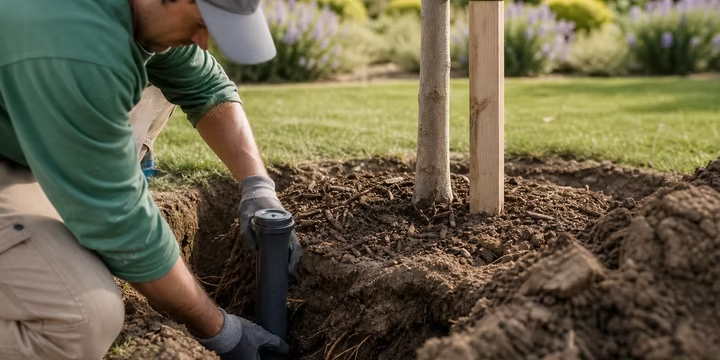
- DIY PVC or gravel tubes: Homemade vertical pipes that channel hose water below grade.
One important distinction: deep root irrigation is not the same as deep root fertilization. Fertilization injects nutrients into the soil profile. Irrigation delivers water. They sometimes happen together, but they address different problems and require different equipment.
Why “Deep” Does Not Mean “As Deep As Possible”
This is the most misunderstood part of installing deep root irrigation for trees. Homeowners picture roots plunging straight down like a carrot. In reality, most tree roots spread laterally and stay much closer to the surface than people expect.
Iowa State University Extension reports that most tree roots are in the top 18 inches of soil, with more than 50% in the top 6 inches. Root systems can spread four to seven times wider than the canopy. UC IPM confirms that about 90% of tree and shrub roots sit in the top 3 feet and recommends wetting soil to about 12 to 18 inches across the entire root zone.
University of Arizona Extension puts typical tree root-zone depth at 18 to 36 inches and recommends watering at the drip line, where many fine absorbing roots concentrate. The takeaway: sending water 3 feet straight down through a single pipe may bypass the feeder roots that matter most.
Practitioners on Reddit’s r/Permaculture make this same point. In a recent discussion about deep-pipe irrigation, commenters pushed back on the assumption that deeper is automatically better, arguing that if water is placed below the active root zone, it does little good. On r/arborists, a commenter identifying as a certified arborist said watering stakes often are not helpful because they affect “only a minute part of the total root zone” and may bypass shallow feeder roots entirely.
A good deep root irrigation system wets the active root zone broadly. It does not just fill one narrow column of soil as far down as possible.
Roots also need oxygen. Saturating the soil too deeply or too often can suffocate roots and cause symptoms that look identical to drought stress, which creates a dangerous cycle of adding more water to an already waterlogged tree.
When Installing Deep Root Irrigation Helps
Deep root irrigation is not something every tree needs. It is a tool for specific situations where surface watering is inadequate or impractical.
Newly planted trees are among the best candidates. They have small root balls, limited root spread, and high water demand during establishment. Texas A&M Forest Service recommends 6 to 8 gallons per trunk-inch per week for newly planted trees, with thorough soaking rather than light, frequent watering. A subsurface watering device placed near the root ball (but not pressed against the trunk) can deliver that water with less evaporation loss.
Trees in restricted or compacted sites also benefit. Parking lot islands, median strips, sidewalk cutouts, and tight hardscape beds force surface water to run off instead of soaking in. Subsurface delivery gets water past the pavement and into the soil where it is needed.
Trees showing drought stress despite lawn sprinklers are a common scenario. The lawn gets watered frequently and shallowly, which keeps grass alive but may never wet the soil deeply enough for tree roots. Iowa State Extension warns that turf and tree watering often conflict because turf irrigation is typically too frequent and too shallow for trees. The same source recommends isolating tree irrigation from turf watering whenever possible.
Other good use cases include trees on slopes where runoff is common, trees in hot and windy sites where evaporation consumes surface water, and high-value specimen trees that justify the investment in precise water delivery.
When Deep Root Irrigation Is Not the Right Fix
Not every tree problem is a water delivery problem. Installing deep root irrigation for a tree that is declining from disease, girdling roots, or poor planting depth will not help and may make things worse.
Iowa State Extension notes that deep soil watering wands can produce incomplete watering and that surface soaking is often more effective for newly planted trees because it wets a broader soil area. A single deep pipe can easily miss the feeder roots where absorption actually happens.
Practitioners on Reddit’s r/Irrigation share these concerns. In one thread, a commenter warned that in-ground tree watering devices “can be nice until they clog or roots overwhelm them,” leaving buried plastic parts in the root plate. Another user explicitly asked whether deep root irrigation has significant advantages, saying they found plenty of marketing claims but little independent research to back them up.
Here are scenarios where deep root irrigation is likely not the best answer:
- The tree is already in saturated or poorly drained soil. Adding more water underground will compound the problem.
- The real issue is planting depth, girdling roots, insects, or disease. Water alone will not fix structural or biological problems. Soil testing through TAMU or tissue analysis may be needed to identify the actual cause.
- A mature tree needs broad wetting across a root zone that may extend well beyond the canopy. One or two stakes near the trunk will not cover it.
- The system cannot be maintained. Buried emitters clog, caps break, and roots invade hardware that nobody checks.
- The tree species or site is sensitive to root-zone saturation.
The takeaway is straightforward: diagnose before you install. Water stress symptoms can be caused by underwatering, overwatering, compaction, nutrient deficiency, or disease. They all look similar from the surface.
Common Installation Methods Compared
No single method works for every tree, budget, or site. Here is how the main options stack up.
Drip Depot’s stake guide recommends 2 to 3 stakes for medium trees and 36-inch stakes spaced 4 to 5 feet apart within the canopy for large trees or palms. It also recommends using a surface emitter alongside the stake to help leach salts from the soil, a detail especially relevant in arid climates where salts accumulate near the surface.
For setups that rely on bubblers, common bubbler problems like clogs and uncontrolled flooding can undermine the system if they go unnoticed.
How to Install Deep Root Irrigation: Basic Principles
A complete installation guide varies by product and site. But regardless of the method, these principles apply to every deep root irrigation project.
Start with the Tree’s Age and Root Zone
A newly planted tree needs water concentrated near its root ball and the soil just beyond it. An established tree needs water distributed farther from the trunk, under and extending past the canopy edge. A large mature tree may need broad wetting across an area several times wider than the canopy.
One LinkedIn practitioner noted that drip placed directly against mature tree trunks is a common mistake because trees absorb much of their water through feeder roots closer to the canopy drip line, not at the base. Concentrating water at the trunk misses the roots that do the work and invites decay at the root collar.
Use Multiple Watering Points
A single deep pipe does not irrigate a tree. It irrigates a small column of soil. Rain Bird’s installation instructions call for three or more RWS units per large tree and two units per small tree or large shrub. Drip Depot gives similar guidance, recommending multiple stakes distributed around the tree rather than one centrally placed device.
The point is distribution. Water needs to reach roots across the root zone, not just one concentrated spot.
Separate Tree Watering from Turf Watering
Trees and grass have fundamentally different watering needs. Grass wants frequent, shallow irrigation. Trees want deep, infrequent soaking. Running both on the same valve forces a compromise that typically fails both plants.
A landscape company on LinkedIn identified trees and shrubs sharing a valve as one of the most common irrigation deficiencies in commercial properties. Rain Bird’s installation documents also specify keeping root watering systems on their own irrigation zone. If the existing system lacks a dedicated tree zone, adding a new zone is often the right step before installing any subsurface hardware.
Check Soil Moisture After Watering
Do not guess. Texas A&M Forest Service recommends pushing a screwdriver into the soil: if it does not slide in easily to 6 to 8 inches, the soil is still too dry. University of Arizona Extension recommends using a soil probe to determine how long the system takes to fill the root zone, then using that time as the baseline for scheduling.
Avoid setting a universal runtime like “30 minutes.” The correct duration depends on flow rate, soil type, root-zone depth, and current weather. Run the system, probe the soil, and adjust.
Locate Utilities Before Digging or Driving Stakes
This step gets skipped too often. Drip Depot’s installation guide specifically warns homeowners to locate gas and water lines before driving any deep stakes. One call to 811 (the national utility locating service) can prevent a dangerous and expensive mistake.
Deep Root Irrigation vs Drip Irrigation vs Soaker Hose
These three approaches overlap, and the best choice depends on tree size, site conditions, and budget.
Deep root irrigation (stakes, canisters, or tubes) delivers water at a specific depth below the surface. It works well for point-source applications in compacted or paved-over sites but can miss the broader root zone if too few devices are installed.
Drip irrigation uses low-flow emitters or inline tubing to water slowly at or near the soil surface. The EPA notes that microirrigation delivers water slowly to the root zone, reducing runoff and evaporation. Texas A&M’s Landscape Survival Guide reports that properly designed drip systems are about 90% efficient compared with 65% for spray irrigation. A drip ring placed halfway between the trunk and canopy edge is one of the simplest and most effective tree-watering setups available.
For those considering drip for trees, planning a drip system from the start avoids common sizing and pressure mistakes.
Soaker hoses are the broadest option. Texas A&M Forest Service lists soaker hoses as a preferred method for large, valuable yard trees during drought because they wet a wide soil area slowly. The downside is evaporation and the need to manually reposition them as the tree grows.
For mature trees with large root zones, a drip ring or soaker hose often outperforms a few deep stakes because it wets more of the soil that matters. For newly planted trees in hardscape, a subsurface canister or stake setup makes more sense. Bubblers fill the middle ground, offering higher flow for larger trees when paired with basin control.
The honest answer: there is no single best method. Many successful tree irrigation setups combine approaches, pairing a drip ring at the surface with one or two deep stakes for supplemental depth.
Lubbock and West Texas Watering Context
Installing deep root irrigation for trees in Lubbock and West Texas is not just about hardware. It is about working within a climate and regulatory framework that penalizes waste.
Wind, heat, and low humidity accelerate evaporation. The City of Lubbock’s 2026 spring and summer irrigation restrictions run April 1 through September 30, limiting landscape irrigation to assigned days with recommended watering windows of midnight to 10 a.m. or 6 p.m. to midnight. City code does include exceptions for subsurface irrigation systems, handheld hoses, and newly installed landscape material for up to three weeks after planting.
These constraints make deep root irrigation attractive because subsurface delivery loses less water to wind and evaporation. But the same restrictions also make efficiency non-negotiable. A poorly designed system that wastes water underground through leaks or oversaturation is worse than a properly scheduled sprinkler zone.
Cycle-and-soak scheduling (running irrigation in short cycles with pauses for infiltration) is especially important in Lubbock’s soils. It prevents runoff and pushes water deeper into the root zone without oversaturating the surface. The city specifically recommends this approach. Homeowners in the area dealing with rehydrating hard, dry ground should expect the initial process to take longer than usual, as a point raised in Houzz forum discussions about deep watering. Once soil is hydrated, it becomes much easier to maintain moisture.
Common Mistakes When Installing Deep Root Irrigation for Trees
Most failures in deep root irrigation come from installation shortcuts, not product defects.
1. Placing the device too close to the trunk. Feeder roots are farther out. Concentrating water at the root collar creates moisture conditions that promote decay and fungal problems.
2. Using one deep pipe for an entire tree. A mature tree’s root zone can extend well beyond the canopy. One point of water delivery barely covers the need. UC IPM recommends wetting the entire root zone to 12 to 18 inches.
3. Assuming deeper is always better. More than half of tree roots are in the top 6 inches. Forcing water below the active root zone wastes it.
4. Running tree irrigation on the lawn schedule. Lawn sprinklers cycle frequently and briefly. Trees need longer, less frequent soaking. Mixing them on the same valve shortchanges both plants.
5. Ignoring soil type. Sandy soil drains fast and may need more frequent watering. Clay absorbs slowly and holds water longer. Neither responds well to a one-size-fits-all runtime.
6. Skipping moisture checks. The screwdriver test takes 30 seconds. Without it, you are guessing whether the system is working.
7. Forgetting maintenance. Drip emitters clog, especially in hard water. Caps break. Roots invade buried hardware. Monthly checks and periodic flushing keep the system functional.
8. Not locating utilities. Driving a 36-inch stake into an unmarked gas line is the kind of mistake that only happens once.
9. Installing during severe drought without planning. Texas A&M warns against digging under a tree canopy during severe drought because root disturbance at that point can accelerate decline rather than help recovery.
10. Confusing irrigation with diagnosis. Leaf drop, browning, and wilt can mean too little water, too much water, compaction, nutrient deficiency, or disease. Adding more water without knowing the cause can kill a tree faster than drought.
Should You DIY or Call a Professional?
DIY may work when:
- The tree is small and recently planted.
- The setup uses a hose-fed stake or soaker hose.
- No digging near utilities, sidewalks, or mature roots is required.
- The homeowner is committed to monitoring soil moisture and adjusting.
Call a professional when:
- The installation ties into an existing irrigation system.
- The tree needs a dedicated zone with correct pressure and flow design.
- You are working near utilities, hardscape, or large established root systems.
- The tree is already declining and needs diagnosis before more water.
- Soil may be compacted, saline, poorly drained, or nutrient-deficient.
- You need an arborist evaluation to determine whether water is even the right fix.
A declining tree is not always a thirsty tree. Overwatering, compaction, planting depth errors, pests, and disease can all produce identical symptoms from the surface. Proper diagnosis often requires soil testing, tissue analysis, and professional assessment before anyone touches the irrigation.
Compare irrigation maintenance plans if you want ongoing system monitoring and seasonal adjustments handled for you.
Putting It All Together
Installing deep root irrigation for trees means adding a below-surface watering method to deliver water into the tree’s active root zone. It works best when water is applied slowly, at multiple points, and across enough soil volume to reach feeder roots throughout the zone. In hot, dry areas like West Texas, it can reduce runoff and evaporation, but it should be designed around tree biology, soil conditions, and local watering rules, not just product specs.
If a tree is declining and the cause is unclear, the first step is diagnosis, not installation. An arborist can determine whether the issue is water delivery, soil health, pests, disease, or structural damage. Learn more about hiring a certified arborist for tree health evaluations.
M&M Sprinkler and Tree Services can evaluate irrigation performance and tree health together because the company has licensed irrigators and certified arborists on staff, along with TAMU lab soil and tissue testing and deep-root feeding services. That combination means one team can determine whether a tree needs better water delivery, soil work, nutrition, pest treatment, or some combination of all four.
Frequently Asked Questions
How deep should deep root irrigation be for trees?
Not as deep as possible. Manufactured systems commonly come in 10-, 18-, and 36-inch sizes, and the useful target is the active root zone. UC IPM recommends wetting soil to about 12 to 18 inches across the entire root zone. University of Arizona Extension lists typical tree root-zone depth at 18 to 36 inches. The right depth depends on the tree species, soil type, and how roots have actually developed at that site.
Does deep root irrigation make tree roots grow deeper?
Deep, infrequent watering can encourage roots to explore a deeper portion of the soil profile, but roots still grow where oxygen, moisture, nutrients, and physical soil conditions allow. Most tree roots remain in the top 18 inches regardless of watering method. Deep root irrigation influences where water is available, not where roots are biologically capable of growing.
Is deep root irrigation better than drip irrigation?
Not always. Deep root irrigation is useful for restricted sites and compacted soils, but drip rings and soaker hoses may wet a broader root zone for less cost and less maintenance. The best method depends on tree size, site conditions, and whether someone will actually inspect and maintain the system over time.
How many deep watering stakes does a tree need?
It depends on tree size and product type. Drip Depot recommends 2 to 3 stakes for medium trees and stakes spaced 4 to 5 feet apart for large trees. Rain Bird recommends three or more root watering units per large tree. One stake is almost never enough for meaningful coverage.
Can I connect deep root irrigation to my sprinkler system?
Yes, but it needs to be designed correctly. Tree watering requires different flow, pressure, and scheduling than turf irrigation. Rain Bird specifies that root watering systems should run on their own irrigation zone. Mixing them with lawn zones creates a scheduling conflict that usually underserves the tree.
How often should trees be deep watered during drought?
There is no universal schedule. Texas A&M Forest Service says mature trees may need water every 2 to 3 weeks during extreme drought, while newly planted trees may need water 2 to 3 times per week. Check soil moisture with a screwdriver or probe rather than relying on a calendar. If the screwdriver slides in easily to 6 to 8 inches, the soil still has adequate moisture.
Is a DIY PVC pipe next to a tree effective deep root irrigation?
It can help for a new planting in dry soil, but a single PVC pipe tends to overconcentrate water in one narrow column while missing feeder roots across the broader root zone. If using PVC, install multiple pipes around the tree and combine them with surface watering for better distribution.
Should I install deep root irrigation or fix my existing sprinkler system first?
Fix the existing system first. A broken zone, leaking valve, or clogged head may be the reason the tree is not getting enough water. Once the irrigation system is working correctly, it becomes much easier to determine whether a tree needs supplemental deep root watering or just better coverage from what is already in the ground.