TL;DR
Deep root fertilization is a professional tree care process where liquid nutrients are injected under pressure into the soil around a tree’s root zone, typically 4 to 8 inches below the surface. It bypasses grass competition, breaks up compacted soil, and delivers nutrients directly to feeder roots. The treatment matters most for urban and suburban trees that no longer benefit from the natural nutrient cycle found in forests. Soil testing should always come first.
A tree care company hands you a quote, and one line item reads “deep root fertilization.” You’ve never heard the term before. Is it a real treatment backed by science, or just an expensive upsell? That question drives thousands of searches every month, and the honest answer is more nuanced than most tree service websites will admit.
This guide breaks down what deep root fertilization actually involves, when it provides genuine value, and when you can skip it.
Already know your trees need help? Learn how coordinating irrigation with deep root feeding protects your investment.
How Deep Root Fertilization Works
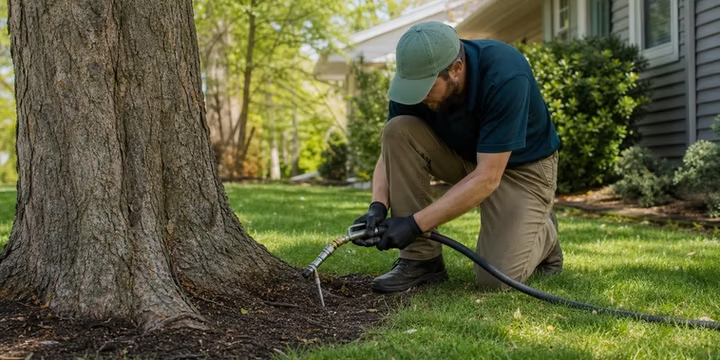
Deep root fertilization (sometimes called deep root feeding or soil injection) uses specialized high-pressure equipment to inject a liquid nutrient solution directly into the soil surrounding a tree. A technician inserts a probe, often called a soil needle, into the ground and pumps a blended fertilizer mix through it under pressure.
Here’s what the process looks like step by step:
- Site assessment. A certified arborist evaluates the tree’s health, species, soil conditions, and any visible symptoms of stress or nutrient deficiency.
- Soil or tissue testing. The best practitioners send samples to a lab before choosing a fertilizer blend. This step determines what’s actually missing rather than guessing.
- Injection grid setup. The arborist works across the tree’s root zone (roughly from the trunk out to the drip line) and inserts the probe every 2 to 3 feet in a grid pattern.
- Pressurized injection. Liquid fertilizer is pumped into the soil at each insertion point, typically 4 to 8 inches deep, where the highest concentration of feeder roots lives.
- Repeat across the root zone. The grid pattern ensures even distribution so no section of the root system gets starved while another gets flooded.
The blend injected varies by provider and tree needs. It can include macronutrients (nitrogen, phosphorus, potassium), micronutrients (iron, manganese, zinc), organic matter, mycorrhizal inoculants, and bio-stimulants. The best formulations are prescription-based, meaning they’re mixed according to what the soil test revealed as deficient.
The Pressure Does Double Duty
Something that often gets overlooked: the pressurized injection itself provides a benefit separate from the nutrients. Forcing liquid into compacted soil creates small fractures and channels that allow air, water, and future root growth into previously sealed ground. Practitioners on ArboristSite forums frequently argue that this aeration effect is the real value of deep root fertilization, with the fertilizer being secondary to the mechanical loosening of soil.
Why Landscape Trees Need Deep Root Fertilization
A tree growing in a forest feeds itself. Leaves fall, decompose on the forest floor, and return nutrients to the soil in a cycle that has sustained woodland ecosystems for millennia. Forest soils are also packed with mycorrhizal fungi, beneficial organisms that attach to roots and extend their nutrient-gathering reach by orders of magnitude.
Yard trees get none of that.
Homeowners rake leaves every fall, bag them, and haul them to the curb. The natural nutrient cycle breaks at step one. On top of that, turf grass surrounding most residential trees is aggressive about intercepting surface-applied fertilizer. Even if you spread granular fertilizer around a tree’s base, the grass roots grab most of it before it ever soaks down to tree roots. Heavy rain washes the rest into storm drains.
Then there’s the compaction problem. Foot traffic, construction activity, vehicles, and even years of mowing compress the soil around tree roots. Compacted soil blocks three things trees need: water infiltration, oxygen exchange, and physical space for roots to grow. Arboriculture research consistently identifies soil compaction as the primary limiting factor on root development in urban settings.
Compacted soil also creates lawn drainage problems that compound stress on your entire landscape, not just trees.
The West Texas Complication
In Lubbock and the broader West Texas region, trees face an extra challenge. The soils here are characteristically alkaline, often with caliche hardpan layers beneath the surface. High soil pH “locks up” essential micronutrients, particularly iron, making them chemically unavailable to roots even when they’re technically present in the ground. This is why iron chlorosis (yellowing leaves with green veins) is so common on red oaks, pecans, and other trees across the region.
Combine alkaline soil with low organic matter, chronic drought stress, and compaction from construction in rapidly growing neighborhoods, and you have a recipe for slow tree decline. Deep root fertilization addresses multiple problems at once: it delivers the right nutrients in a form roots can absorb, introduces beneficial soil biology, and physically loosens compacted ground.
The Honest Debate: Does Deep Root Fertilization Actually Work?
This is the part most tree service websites skip, but it’s the question homeowners are actually asking. A Reddit thread in r/arborists titled “Can we settle this? Deep root fertilization for trees, myth or…” ranks on the first page of Google for this topic precisely because it addresses the trust question head-on.
The Skeptic Position
The International Society of Arboriculture (ISA) has pointed out that most of a tree’s absorbing roots are in the top 8 inches of soil, so you don’t technically need to go “deep” to reach them. A research review by Daniel K. Struve, cited frequently in arboriculture literature, concluded that “little difference has been found among fertilizer application methods.”
In other words, the ISA’s position is that surface-applied fertilizer can reach feeder roots just fine in many situations.
The Practitioner Rebuttal
Experienced arborists on forums push back hard on the “it’s a myth” narrative. Their argument isn’t that deep root fertilization is magic. It’s that the name is slightly misleading, and the real benefits come from factors the ISA position doesn’t fully address:
- Turf competition. Surface-applied fertilizer feeds the lawn first. Injection bypasses the grass entirely.
- Compaction relief. The pressurized injection mechanically loosens soil that surface application can’t penetrate. One veteran arborist on ArboristSite noted that “the greatest benefit of deep root fertilizing is the tree gets a drink of water,” referring to the improved water infiltration that follows soil fracturing.
- Prescription delivery. Injection allows a custom blend (including micronutrients, mycorrhizae, and bio-stimulants) to be placed exactly where it’s needed, something broadcast spreading can’t replicate.
- Reduced runoff. Subsurface injection keeps nutrients in the root zone instead of washing into storm drains.
The Bottom Line
Deep root fertilization isn’t about “going deep.” The name is a holdover from older practices that injected at 12 to 18 inches, well below where most feeder roots live. Modern practitioners inject at 4 to 8 inches. The real value is in bypassing competition, breaking compaction, and delivering a targeted blend based on actual soil deficiencies.
Done without soil testing, using a generic one-size-fits-all blend? It’s probably not worth the money. Done after proper soil testing through the Texas A&M lab with a prescription formulation? It can genuinely transform a struggling tree’s health.
Signs Your Trees May Need Deep Root Fertilization
Not every tree needs supplemental fertilization. ANSI A300 Part 2, the national standard for tree care, is clear that soil and foliar nutrient analysis should be used to determine whether fertilization is necessary at all. The City of Austin’s urban forestry guidance goes further, stating that “fertilizer should never be added to soil without confirmation that some nutrient is needed.”
That said, certain symptoms suggest your trees would benefit from evaluation:
- Chlorosis. Yellowing leaves with green veins, especially on red oaks, pecans, and other iron-sensitive species. This is extremely common in alkaline West Texas soils.
- Stunted new growth. Shorter-than-expected annual twig growth, small leaves, or thin canopy development.
- Early leaf drop. Leaves falling well before autumn, or sparse canopy through the growing season.
- Dieback. Dead branch tips, especially in the upper canopy.
- Post-construction stress. Any tree whose root zone was compacted, graded, or paved over during building work.
- Chronic drought stress. Trees that struggle despite adequate irrigation may have root systems trapped in compacted soil.
Some of these symptoms overlap with disease and pest problems. If you’re noticing branch dieback or canopy thinning, it’s worth reading about signs your trees need professional pruning to distinguish between structural issues and nutritional deficiency.
Common Misconceptions
“Deep root fertilization needs to go very deep.” The name is misleading. Most feeder roots concentrate in the top 2 to 8 inches of soil. Modern injection targets this zone, not the 12-to-18-inch depths some older practices used. Going too deep actually misses the roots you’re trying to feed.
“All trees need it every year.” Healthy trees in nutrient-rich soil with adequate organic matter may not need supplemental fertilization at all. ANSI A300 standards cap application rates at 1 pound of actual nitrogen per 1,000 square feet annually and require soil testing first. Overfertilizing can harm soil biology and push excessive vegetative growth that makes trees more vulnerable to pests.
“Any fertilizer blend works.” Applying nitrogen to a tree suffering from iron chlorosis won’t fix the problem. Soil testing determines what’s actually deficient, and the formulation should match. Blindly applying a generic NPK blend can worsen soil imbalances, especially in alkaline soils where pH management matters as much as nutrient content.
“DIY fertilizer spikes are the same thing.” Retail fertilizer spikes concentrate nutrients in a few spots, creating hotspots that can burn roots while leaving the rest of the root zone unfed. Professional injection distributes nutrients across the entire root zone in a grid pattern, and the pressurized delivery provides compaction relief that spikes cannot.
“It’s just about feeding the tree.” Modern deep root fertilization is increasingly about restoring soil biology. Mycorrhizal inoculants, beneficial fungi that form symbiotic relationships with tree roots, extend a root system’s effective reach and improve nutrient uptake long after the treatment. Disturbed urban soils are typically depleted of these organisms. Nutrient deficiency can also make trees susceptible to diseases and secondary infections that compound the damage.
When Is the Best Time for Deep Root Fertilization?
Deep root fertilization is generally recommended once or twice per year. The two optimal windows are spring and fall.
Spring (March through May). Fertilizing in spring fuels new growth, healthier root expansion, and improved canopy development heading into summer. This is especially important in West Texas, where trees need to be prepared for brutal July and August heat.
Fall (September through November). After a long, hot summer, trees are depleted. Fall fertilization replenishes nutrient reserves and supports root growth during the cooler months when trees direct energy underground rather than into canopy growth. In Lubbock, fall timing is particularly valuable because it prepares trees for winter dormancy while the soil is still warm enough for root activity.
Timing should also account for your irrigation schedule. Overwatering right after fertilization can leach nutrients out of the root zone, while underwatering prevents nutrient uptake. This is one reason coordinating irrigation with tree health matters.
How Much Does Deep Root Fertilization Cost?
Professional deep root fertilization typically costs between $100 and $350 per tree. The variation depends on tree size, the formulation used, whether soil testing is included, and the number of trees treated in a single visit.
Larger trees require more product and more injection points across a wider root zone, which pushes costs toward the higher end. Properties with multiple trees often get per-tree pricing that’s lower than treating a single specimen.
One thing to watch for: extremely cheap quotes (under $75 per tree) often signal a provider using generic fertilizer without soil testing. That approach may waste money or actively harm your trees. As one forum arborist wrote, “In a perfect world, fertilizers would only be applied as needed after a soil or plant tissue analysis.”
Who Should Perform Deep Root Fertilization?
This is not a DIY project. The equipment (high-pressure pumps, tanks, soil injection probes) is specialized and expensive. More importantly, the diagnostic work that should precede any fertilization requires training most homeowners don’t have.
The best candidates to perform deep root fertilization are:
- ISA-certified arborists who can diagnose tree health issues and distinguish between nutrient deficiency, disease, pest damage, and structural problems.
- Practitioners who conduct soil or tissue testing before treatment. This aligns with ANSI A300 Part 2 standards and ensures the formulation matches what your soil actually lacks.
- Licensed applicators for any treatments involving regulated chemicals or soil amendments. In Texas, this means holding a TDA (Texas Department of Agriculture) chemical applicator license.
When comparing providers, ask three questions: Do you test soil before fertilizing? What’s in your fertilizer blend? And can you explain why my specific trees need this treatment? If the answer to any of those is vague, keep looking.
Looking for professional tree nutrition services in Lubbock? Learn about soil testing through the TAMU lab as the first step toward prescription-based tree care.
The Role of Mycorrhizae and Soil Biology
Traditional deep root fertilization focused almost entirely on NPK numbers: nitrogen, phosphorus, potassium. Modern arboriculture has shifted toward a soil biology approach that treats the soil ecosystem as a whole rather than just dumping nutrients into it.
Mycorrhizal fungi are a central part of this shift. These beneficial organisms colonize tree roots and extend hair-thin filaments called hyphae far beyond where roots alone can reach. The fungi trade mineral nutrients and water access in exchange for carbohydrates the tree produces through photosynthesis. Forest soils are loaded with diverse mycorrhizal communities, but urban soils, especially those disturbed by construction, grading, or chemical treatment, are often stripped of them.
Adding mycorrhizal inoculants during deep root fertilization reintroduces these organisms. Combined with probiotics and microbial food sources, the treatment can rebuild a soil food web that sustains the tree long after the immediate nutrient boost fades.
This is the difference between a sugar rush and a healthy diet. Generic NPK injections give trees a temporary boost. Restoring the soil biology creates lasting, self-sustaining improvement.
Understanding how water interacts with this soil biology matters too. If you’re choosing between drip irrigation and sprinkler systems, the delivery method affects how nutrients move through the root zone after treatment.
Deep Root Fertilization vs. Surface Fertilization
Surface fertilization has its place for lawns and shallow-rooted plants. But for established trees in compacted urban soil, especially in alkaline conditions like those across West Texas, deep root fertilization solves problems that granular products simply cannot reach.
Related Terms
- Soil injection. A broader term for any subsurface liquid application, not limited to fertilizer.
- Root zone. The area of soil occupied by a tree’s root system, typically extending to or beyond the drip line.
- Translocation. The process by which absorbed nutrients move through a tree’s vascular system from roots to leaves and growing tissue.
- Mycorrhizae. Beneficial fungi that form symbiotic relationships with plant roots, dramatically expanding nutrient and water uptake.
- Soil food web. The ecosystem of organisms (bacteria, fungi, protozoa, nematodes) that cycle nutrients in soil.
- ANSI A300 Part 2. The national standard for soil management in arboriculture, covering fertilization practices, rates, and testing requirements.
- Iron chlorosis. A nutrient deficiency condition common in alkaline soils where iron becomes unavailable to roots, causing yellowing between leaf veins.
Frequently Asked Questions
How deep does deep root fertilization actually go?
Despite the name, modern deep root fertilization targets 4 to 8 inches below the surface, where the highest concentration of feeder roots lives. Older practices injected at 12 to 18 inches, but arborists now know that most absorbing roots occupy the top portion of the soil profile.
Is deep root fertilization worth the money?
It depends on whether the treatment is based on actual soil analysis or just a generic application. When a soil test reveals specific deficiencies and the formulation addresses them, deep root fertilization provides genuine value, especially for trees in compacted or alkaline soils. Without testing, you might be paying for nutrients your tree doesn’t need.
Can I do deep root fertilization myself?
Not practically. The equipment is professional-grade and expensive, and the diagnostic work (soil testing, species-specific formulation, proper injection depth and spacing) requires training. DIY fertilizer spikes are not equivalent, as they concentrate nutrients in a few spots rather than distributing them across the entire root zone.
How often should trees receive deep root fertilization?
Most arborists recommend once or twice per year, in spring and fall. ANSI A300 standards cap nitrogen application at 1 pound of actual N per 1,000 square feet annually, so more frequent treatments risk overfertilizing.
Does deep root fertilization help with drought stress?
Yes, in two ways. The pressurized injection loosens compacted soil so roots can access water more effectively. And improved nutrient uptake helps trees maintain cellular functions that resist drought damage. In West Texas, where summer heat regularly exceeds 100°F, this combination matters.
What’s the difference between deep root fertilization and deep root watering?
Deep root watering delivers water to the root zone without any nutrients. Deep root fertilization delivers a nutrient solution under pressure. Some providers combine both, and coordinating irrigation schedules with fertilization timing ensures nutrients don’t leach away or sit unused in dry soil.
Should I get a soil test before deep root fertilization?
Absolutely. ANSI A300 Part 2 standards state that soil and foliar nutrient analysis should be used to determine the need, formulation, and rate of any fertilizer application. Applying nutrients without knowing what’s deficient is guesswork that can harm soil biology and waste money. A TAMU lab soil test gives you a precise starting point.
Will deep root fertilization save a dying tree?
It depends on why the tree is dying. If the cause is nutrient deficiency, soil compaction, or depleted soil biology, deep root fertilization can make a significant difference. If the tree is suffering from severe root rot, structural failure, or advanced disease, fertilization alone won’t be enough. A certified arborist should diagnose the problem before any treatment plan is developed.