
TL;DR
The Toro Super 700 is a legacy gear-drive rotor sprinkler that is effectively discontinued, with many core assemblies marked “no longer available” in Toro’s own parts catalog. For most homeowners, the best Toro Super 700 sprinkler head replacement is a modern 3/4-inch rotor (Hunter PGP Ultra, Rain Bird 5004, or Toro T5 RapidSet) that matches the old head’s inlet size, radius, flow, pressure, and arc. Do not replace by brand name alone. Replace by fit, flow, and coverage.
A Toro Super 700 sprinkler head replacement usually starts the same way. A homeowner notices a puddle around an old rotor, a zone that barely pops up, or a patch of dead grass that keeps getting worse. They find the head, try to adjust it, maybe Google the model number, and quickly realize the Super 700 is not something they can just grab off the shelf at a hardware store.
That is the central problem. The Toro Super 700 was a solid rotor in its time, but “its time” was years ago. Hunting for exact replacement parts is usually a dead end, and rebuilding a worn-out S700 with aftermarket seals is rarely worth the trouble when three widely available modern rotors can do the job better.
This guide covers what the Super 700 actually is, which parts are still available (and which are not), what modern rotors fit, and how to avoid the most common mistakes during replacement.
Wondering what a replacement might cost? Here is a breakdown of sprinkler repair costs for Lubbock homeowners.
What Does “Toro Super 700 Sprinkler Head Replacement” Mean?
A Toro Super 700 (also called the S700) is an older Toro gear-drive rotor sprinkler used in residential and light-commercial irrigation systems. Toro made several S700 body styles: Lawn, Commercial, Shrub, and High Pop. The Toro parts page still recognizes the “Super 700 Series” as a product and links assembly drawings for each version.
“Replacement” can mean three different things depending on the situation:
- Replacing just the nozzle. Swapping the small insert that controls how much water flows and how far it throws.
- Replacing a seal or internal part. Fixing a specific failure like a worn wiper seal or broken spring, if the part is still available.
- Replacing the entire rotor body. Removing the old S700 from the ground and installing a new, modern sprinkler head.
For most people searching for Toro Super 700 sprinkler head replacement, option three is the practical answer. The reason comes down to parts availability, which is covered next.
A rotor, by the way, is a sprinkler head that rotates a stream of water across a larger area than a fixed spray head. If you are unfamiliar with how different types of irrigation heads compare, that distinction matters when choosing a replacement.
Toro Super 700 Quick Specs
Before shopping for a replacement, you need to know what you are replacing. The S700 installation manual lists these key specifications:
Two details trip people up. First, the part-circle arc adjustment uses a fixed left stop. The left reversing point does not move. Only the right side adjusts. Many homeowners assume they can set both sides freely, which leads to heads watering the wrong direction. Second, the S700 HP model has a 10-3/8-inch pop-up and a body over 16 inches tall, so a standard 4-inch replacement rotor will not fill the same hole.
Is the Toro Super 700 Still Available?
The short answer: not in any practical sense for most repairs.
Toro still hosts the Super 700 on its parts website. But the official parts catalog tells a different story. Multiple core S700 assemblies are listed as “No longer available,” including the spring, riser assembly, stator assembly, and body for the S700 Lawn model. For the S700 Commercial version, the riser seal, retraction spring, riser assembly, stator assembly, and body are all marked no longer available. Many nozzle assembly items are marked “Not serviced separately.”
Some S700 nozzle kits still have part numbers in the catalog (like 89-0893L-SK for the 1.5 GPM nozzle and 89-0896L-SK for 4.5 GPM), but having a part number listed does not guarantee the part is in stock anywhere.
Retailer evidence confirms the broader picture. Sprinkler Supply Store’s S700 page states that S700 rotors are “discontinued and are no longer available from Toro.”
The bottom line: if your Super 700’s body, riser, spring, or stator has failed, there is no realistic path to an identical factory replacement. A modern rotor matched to the old head’s specs is the way forward.
Should You Repair the Super 700 or Replace the Whole Head?
Not every old Super 700 needs to be ripped out. Here is a quick decision guide:
Practitioners on Reddit’s r/Irrigation forum reinforce this. In one thread, users identified a leaking old rotor as a Super 700 and recommended replacing it with a Rain Bird 5004 or Hunter PGP Ultra. Another commenter noted the leak was from the wiper seal, and a third pointed out that a head set too low allows debris into the seal area, accelerating failure.
If a leaking Super 700 is causing low water pressure across the rest of the zone, replacement is urgent. One bad head can rob pressure from every other head on the same zone, preventing them from fully popping up.
Compatible Modern Replacement Options
A Toro Super 700 replacement is not about finding the same old head. It is about matching the old rotor’s hydraulics and physical fit with a current, widely available 3/4-inch rotor.
Three modern rotors cover most residential Super 700 replacement scenarios. A fourth option exists for larger turf, but it is not the default.
Hunter PGP Ultra
The Hunter PGP Ultra is probably the most common replacement recommendation across forums, and for good reason. It uses a 3/4-inch NPT inlet, covers 17 to 46 feet of radius, flows 0.36 to 14.8 GPM, operates at 25 to 70 psi (recommended), offers 34 nozzle choices, and adjusts from 50 to 360 degrees. That range covers most residential S700 layouts comfortably.
Hunter also publishes a specific nozzle cross-reference for Toro Super 700 heads, which makes the transition straightforward. If you go this route, the Hunter head adjustment guide walks through setting the arc and radius on your new rotor.
Rain Bird 5004 Plus
The Rain Bird 5004 Plus is another strong candidate. It has a 3/4-inch inlet, 25 to 50 feet of coverage radius, 0.73 to 9.63 GPM flow, 25 to 65 psi operating pressure, and a 40- to 360-degree reversing arc. The top-adjust arc design and Rain Curtain nozzles make it easy to set up and maintain. It also offers up to 25% radius reduction through the radius adjustment screw.
Toro T5 RapidSet
For homeowners who want to stay with Toro, the T5 RapidSet is the closest modern match. It has a 3/4-inch inlet, 25 to 50 feet of radius, 0.74 to 9.70 GPM, 25 to 75 psi operating pressure, a 40- to 360-degree arc, and a 5-inch pop-up height. It is the natural Toro-brand successor for medium-radius residential rotor zones.
Why the Toro T7 Usually Does Not Fit
The Toro T7 is built for sports fields, municipal turf, and large commercial areas. It has a 1-inch inlet (not 3/4-inch), low-flow radius of 38 to 53 feet, high-flow radius of 46 to 83 feet, and flow ranges that far exceed most residential zone budgets. Unless the original Super 700 was installed on a large commercial property with high flow capacity, the T7 is not the right replacement.
Replacement Comparison Table
Toro Super 700 to Hunter Nozzle Cross-Reference
Hunter publishes a residential rotor replacement guide that directly maps old Toro Super 700 nozzle sizes to Hunter PGP Ultra/I-20 blue nozzles. This is one of the most useful practical resources for anyone doing a Super 700 replacement with Hunter rotors.
A caution: this cross-reference is a starting point, not a guarantee. The installer still needs to verify that the replacement nozzle delivers the right radius and precipitation rate for each head’s position and arc. A corner head and a full-circle head should not blindly use the same nozzle.
How to Choose the Right Replacement Head
Screwing in a new rotor that physically fits the old connection does not mean the replacement will actually water the yard correctly. A Super 700 replacement needs to match on four levels.
1. Mechanical Fit
Most S700 models use a 3/4-inch FNPT inlet, so most modern 3/4-inch rotors can physically thread onto the existing riser or swing joint. But verify the condition of the buried fitting before buying. Practitioners on Reddit warn that if dirt collapses into the hole (especially with high-pop S700 models), reconnecting to the buried male fitting becomes difficult. Dig wide enough to see what you are working with.
2. Hydraulic Fit
The replacement rotor’s pressure range and flow rate need to work within the zone’s available water supply. The Super 700 operated at 25 to 50 psi (25 to 60 psi for the commercial version). All three recommended replacements fall within similar pressure ranges. If a zone was already marginal on pressure, adding a rotor with a stiffer spring could make things worse. One Reddit commenter cautioned that some higher-end heads with stiffer springs can struggle on low-pressure systems.
3. Coverage Fit
This is where most DIY replacements go wrong. A replacement rotor must match the head spacing, not just thread on. If heads are spaced 35 feet apart, a rotor throwing 25 feet will leave dry gaps. If heads are spaced 30 feet apart, a rotor throwing 50 feet will overshoot and waste water.
Even more important: match the nozzle to the arc. A 90-degree corner head, a 180-degree side head, and a 360-degree full-circle head should not all use the same GPM nozzle. A SprinklerTalk user with Toro Super 700 heads discovered that nearly every head in the system had the same nozzle regardless of coverage area, which explained exactly why some zones were too dry and others were fine.
If your system has persistent dry or wet spots, the issue goes beyond one head. A full guide to uneven sprinkler distribution can help diagnose whether it is a nozzle, spacing, or pressure problem.
4. Local Compliance Fit
In Lubbock, a broken sprinkler head is more than a lawn problem. City code specifically treats broken or missing sprinkler heads, controllable leaks, misting from excessive water pressure, and significant runoff as irrigation violations. A replacement that leaks, mists, or oversprays can create compliance issues during Lubbock’s restricted watering season.
How to Replace a Toro Super 700 Sprinkler Head: Step by Step
This process covers a standard S700 Lawn or Commercial rotor replacement. High-pop models require extra planning around body depth.
- Turn off the irrigation zone and controller. Do not work on a pressurized line.
- Mark the old arc and spray direction before you remove anything. Use a stake, flag, or phone photo so you know where the replacement should point.
- Dig a wide hole around the head. Go at least 6 inches wider than the body on all sides so dirt does not fall onto the fitting below.
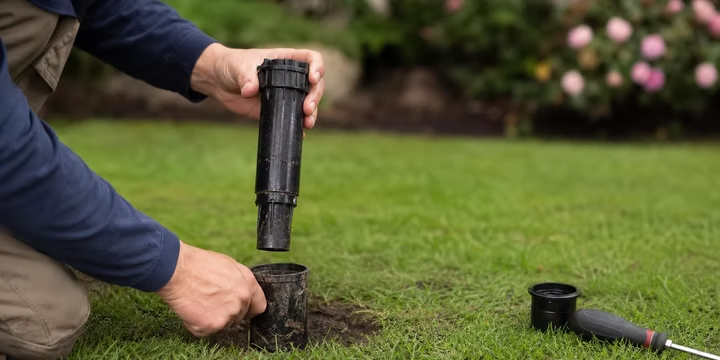
- Unscrew the old head from the riser, swing joint, or funny pipe adapter. Turn counterclockwise. If it is stuck, use channel-lock pliers on the body (not the riser).
- Inspect the fitting below. Check for cracks, corrosion, or stripped threads. If the old system uses a swing joint or flexible connection, confirm it is intact.
- Flush the line. Turn the zone on briefly (5 to 10 seconds) to push out any dirt or debris that settled in the pipe. Turn it off.
- Thread the new rotor onto the fitting. Use Teflon tape on the male threads. Hand-tighten, then snug with pliers. Do not overtighten.
- Set the head at finished grade. The top of the new rotor body should be flush with or very slightly above the surrounding soil surface. A head set too low will not clear the grass when it pops up.
- Install the correct nozzle based on the head’s position (corner, side, or full circle), the old head’s throw distance, and the zone’s flow budget. Use the nozzle cross-reference table above if switching to Hunter.
- Set the arc and radius. Follow the manufacturer’s adjustment instructions for your specific replacement model.
- Run the zone and inspect every head. Check for leaks at the new connection, pressure loss at other heads, overspray onto hardscape, misting, and dry gaps between heads.
- Adjust the controller schedule. In Lubbock, irrigation is limited to two assigned days per week based on your address, with watering allowed only between 6 p.m. and 10 a.m. during spring and summer.
If you cannot locate all the heads in your zone during this process, this guide on finding buried sprinkler heads can save time.
Common Mistakes When Replacing a Toro Super 700
Buying by Brand Instead of Specs
A modern Toro head is not automatically the right Toro Super 700 sprinkler head replacement. The Toro T5 is a plausible match for many residential S700 zones because it shares the 3/4-inch inlet and medium-radius performance range. The Toro T7 is not, because it uses a 1-inch inlet and is designed for much larger turf areas. Buying “Toro” without checking specs leads to mismatched zones.
Using the Same Nozzle on Every Head
This is one of the most common problems with older Super 700 systems, and it often carries over into replacement if the homeowner just installs the nozzle that comes in the box without thinking about it. A quarter-circle head covers one-fourth the area of a full-circle head. If both use the same GPM nozzle, the quarter-circle area gets four times the water per square foot. That creates soggy corners and dry middles.
Installing the New Head Too Low
A head buried below the turf line fails to clear grass blades when it pops up, which reduces throw distance and creates uneven coverage. It also allows dirt and debris to sit near the wiper seal, which accelerates leaks. Forum users flag this repeatedly as a cause of premature failure on both old and new heads.
Ignoring Pressure
Excessive pressure causes misting and fogging instead of a clean stream. The EPA notes that high sprinkler pressure can cause misting, fogging, and uneven coverage, wasting significant water. Lubbock code specifically cites misting from excessive water pressure as a violation. If misting appears after a Toro Super 700 sprinkler head replacement, the system may need a pressure regulator or a pressure-regulated rotor body.
Replacing One Head When the Whole Zone Needs Attention
If several old Super 700 heads are underperforming, the root cause may not be any single head. It could be low zone pressure from a leak elsewhere, mismatched nozzles across the zone, poor head spacing, or a valve that is not opening fully.
Not sure if the problem is one head or the whole system? Consider scheduling a system check to catch issues before they multiply.
Lubbock Note: Why Replacement Should Stop Waste, Runoff, and Overspray
Lubbock homeowners with old Super 700 systems face more than just lawn care decisions. The city’s irrigation rules create real consequences for broken or inefficient sprinkler heads.
The City of Lubbock’s spring/summer watering guidance limits residential irrigation to two assigned days per week (based on the last digit of the address), recommends watering only between midnight and 10 a.m. or 6 p.m. to midnight, and calls for 1.5 inches of water per zone per week using cycle-and-soak intervals of 3 to 4 minutes, repeated 4 to 5 times. No watering is allowed on Sundays.
Beyond the schedule, Lubbock code makes specific equipment failures a compliance issue. Operating a system with broken or missing heads, controllable leaks (including leaking valves or broken pipes), misting from excessive pressure, or significant runoff can all constitute violations.
Practitioners on Lubbock’s Reddit community confirm that enforcement is not just theoretical. Residents have discussed receiving letters from the city about watering outside allowed windows, and conversations around enforcement and smart-meter monitoring are active.
A Toro Super 700 sprinkler head replacement is not cosmetic. In Lubbock, it is a water stewardship and compliance repair. Old heads that leak, mist, or create runoff should be replaced before peak watering season, not after the city sends a notice.
For a leak that is harder to spot, flow monitoring technology can detect breaks and slow leaks that visual inspection misses.
High-Pop Super 700: Do Not Assume a Standard Rotor Will Fit
This point deserves its own section because it catches people off guard. The S700 HP (High Pop) model has a 10-3/8-inch pop-up height and a 16-1/2-inch overall body height. That is a completely different animal from the standard S700 Lawn rotor at 6-7/8 inches tall.
A standard 4-inch pop-up replacement will not clear tall turf or groundcover the way the original high-pop head did, and the body will sit far above the bottom of the existing hole. In one Reddit thread, a user with what was identified as a tall Super 700-style high-pop rotor was warned that dirt collapsing into the deep hole makes reconnection to the buried fitting very difficult. The practical advice: dig down carefully, expose the connection, confirm the fitting size (still 3/4-inch FNPT on most S700 HP models), and consider a 12-inch pop-up replacement like the Rain Bird 5012 if the application actually requires that much clearance.
Measure the body depth and pop-up height before ordering anything. Getting this wrong means a second trip to the store and a second round of digging.
How to Identify a Toro Super 700 in Your Yard
Many homeowners do not actually know what model sprinkler head they have. The Super 700 has been in the ground for decades in some systems, and the markings may be worn off. A few clues:
- The S700 is a gear-drive rotor (it rotates, not a fixed spray pattern).
- The body is typically brown or dark-colored.
- It uses a 3/4-inch threaded connection at the base.
- Part-circle models have a fixed left stop and adjustable right stop.
- The cap may have “Toro” or “S700” molded into it, though this can be hard to read after years underground.
Reddit users frequently post photos of old heads they cannot identify, and experienced irrigators on r/Irrigation often recognize a Super 700 on sight. If you are unsure, pull the head out of the ground and look for any remaining markings on the body or turret before shopping for a replacement.
One more thing to watch for: older Toro systems sometimes contain a mix of legacy Super 700 heads and newer replacements installed over the years. That mismatched setup can create pressure, precipitation rate, and arc conflicts that no single head swap will fix.
Frequently Asked Questions
What is the best replacement for a Toro Super 700 sprinkler head?
The best replacement is a modern 3/4-inch rotor that matches the old head’s radius, flow, pressure, pop-up height, and arc. Common candidates are the Hunter PGP Ultra, Rain Bird 5004 Plus, and Toro T5 RapidSet. The “best” option depends on your zone’s spacing and available flow, not on brand preference alone.
Can I still buy Toro Super 700 parts?
Some nozzle kit part numbers appear in Toro’s official parts catalog, but many critical S700 assemblies (riser, spring, stator, body) are marked “No longer available” or “Not serviced separately.” Retailer evidence also indicates S700 rotors are discontinued. Old-stock parts may exist somewhere, but building a repair plan around them is not reliable.
Can I replace a Toro Super 700 with a Hunter PGP Ultra?
In most cases, yes. The PGP Ultra uses a 3/4-inch inlet (same as the S700), covers 17 to 46 feet of radius, and operates at 25 to 70 psi. Hunter publishes a direct nozzle cross-reference mapping old Super 700 nozzle sizes to PGP Ultra nozzles, making it one of the most straightforward replacement paths.
Can I replace a Toro Super 700 with a Rain Bird 5004?
Often, yes. The Rain Bird 5004 Plus has a 3/4-inch inlet, 25 to 50 feet of radius, and 0.73 to 9.63 GPM flow range. If the zone spacing and flow match those specs, the 5004 is a practical swap.
Is the Toro T7 a good replacement for the Super 700?
Usually not for residential systems. The T7 has a 1-inch inlet and much larger radius and flow ranges than most residential Super 700 zones can support. It is designed for sports fields, large commercial turf, and municipal applications.
Why is my Toro Super 700 leaking from the top?
The most likely cause is a worn wiper seal or debris around the riser, especially if the head was set too low in the turf. Reddit users discussing this exact problem recommend replacement rather than trying to source a new seal for an obsolete head. For more on this issue, see this guide on sprinkler head leak causes.
Why did my new replacement head make the coverage worse?
The new head may not match the old nozzle’s flow, radius, or arc setting. It is also possible the new head uses a nozzle that is too large for the zone’s available pressure, which reduces throw distance. Always match the nozzle to the specific head position (corner, side, or full circle) rather than using whatever nozzle comes installed.
Should I replace all Super 700 heads at once or just the broken one?
If only one head has failed and the others are working well, replacing just the bad one is fine as long as the replacement nozzle matches the zone’s precipitation rate. But if multiple heads are leaking, stuck, or producing dry spots, inspect the entire zone. Old same-nozzle layouts, buried heads, and mixed rotor types often contribute to poor coverage that one head swap will not solve.
Old Toro Super 700 heads are common in Lubbock’s older irrigation systems. When one replacement turns into low pressure, persistent dry spots, or runoff problems, the issue usually goes deeper than a single head. Before peak watering season arrives, a full zone inspection can catch mismatched nozzles, hidden leaks, and scheduling problems in one visit. Here is a spring startup checklist to help you prepare.