TL;DR
Licensed backflow testing is a calibrated diagnostic procedure performed by a state-certified tester who uses a differential pressure gauge to verify that your backflow preventer’s internal check valves and relief valve (if applicable) still create enough pressure separation to keep contaminated water out of the public supply. In Texas, testers must hold a TCEQ-issued BPAT license. In Lubbock, they must also register with the city, and property owners face fines up to $2,000 per day for noncompliance. The whole process takes 15 to 30 minutes.
You got a notice from the city telling you to get your backflow preventer tested. Or maybe you’re watching a technician hook up hoses to that green valve box near your meter and wondering what exactly is happening. Either way, understanding how licensed backflow testing is performed step by step gives you a clearer picture of what you’re paying for, why it matters, and what to expect before, during, and after the appointment.
This guide breaks down the entire procedure in plain language: the licensing requirements behind the person doing the work, the equipment they use, what the pressure readings mean, and what happens if your device fails. If you’re in Lubbock or West Texas, pay particular attention to the local compliance sections, because the penalties here are real.
For a broader explanation of the device itself, see our guide on what a backflow preventer does and why every irrigation system needs one.
What “Licensed” Actually Means for Backflow Testing
Not just anyone can test a backflow preventer. In Texas, the person performing the test must hold a Backflow Prevention Assembly Tester (BPAT) license issued by the Texas Commission on Environmental Quality (TCEQ). This isn’t a weekend certification. The requirements include:
- Completing a 40-hour TCEQ-approved training course
- Having at least 2 years of approved water-related work experience
- Holding a high school diploma or GED
- Passing a criminal background check
- Paying the $111 application fee
- Passing the state written exam at a TCEQ-authorized testing center
To keep the license active, testers must complete 24 hours of continuing education every three years, with at least 8 of those hours being hands-on practical training.
Lubbock Adds Another Layer
In the City of Lubbock specifically, holding a state BPAT license is necessary but not sufficient. Testers must also register with the city before performing any tests within city limits. This double-gating exists because Lubbock takes cross-connection control seriously and wants accountability for every test filed with the Water Compliance Department.
Why Gauge Calibration Matters
Beyond licensing, the tester’s equipment must meet strict accuracy standards. EPA regulations require annual inspection and certification of backflow test gauges, calibrated to an accuracy of ±0.2 PSI. The TCEQ further requires that all testing follow methods described in the University of Southern California’s Cross-Connection Control Manual (USC-CCM).
Here’s a practical tip most guides skip: you have every right to ask your tester to show you their current gauge calibration sticker. A reputable tester will have it visible on the kit. If the sticker is expired, the test results may not be accepted by your water purveyor.
Types of Backflow Assemblies and Why They’re Tested Differently
Before walking through how licensed backflow testing is performed step by step, you need to know which type of assembly you have. The testing procedure changes depending on the device.
The Four Main Types
Reduced Pressure Zone Assembly (RPZ): The highest level of protection. Contains two check valves and a relief valve that discharges water if internal pressure drops too low. Required for high-hazard connections like chemical feed systems or commercial fire lines. Testing involves three separate measurements.
Double Check Valve Assembly (DCVA): Two independent check valves in series, without a relief valve. Used for non-health-hazard connections. Testing involves two measurements.
Pressure Vacuum Breaker (PVB): Protects against backsiphonage only (not backpressure). Has an air inlet and a single check valve. Common for residential irrigation in many states, though Lubbock residential systems more often use DCVAs.
Atmospheric Vacuum Breaker (AVB): The simplest type. Not testable with a gauge because it relies on gravity and atmospheric pressure. It must be installed correctly to function, but there’s no annual field test procedure.
What Lubbock Residential Irrigation Systems Typically Use
In the Lubbock area, most residential and general commercial landscape irrigation systems use a DCVA. These assemblies are usually installed underground in a standard rigid meter box, sitting 10 to 16 inches below the box lid. Based on water pressure and the number of sprinkler heads per station, they’re typically 1-inch or 1.5-inch assemblies.
This matters because a DCVA test is simpler (two parts) than an RPZ test (three parts), but the underground installation can make access more difficult, especially if soil, roots, or debris have accumulated in the box.
A failing backflow preventer doesn’t just create a compliance problem. It can also increase pressure loss beyond the device’s normal range, starving your downstream sprinkler zones. If you’ve been noticing weak coverage or dry spots, a compromised backflow device might be part of the issue. Our guide on low sprinkler water pressure covers the full range of causes.
The Step-by-Step Testing Procedure
Here’s exactly what happens when a licensed BPAT tester arrives at your property. The sequence follows standardized methods from the USC Cross-Connection Control Manual, though minor procedural variations exist between assembly types.
Step 1: Visual Inspection and Device Identification
The tester starts by locating the assembly and recording its make, model, serial number, and size. This information goes on the official test report. They’ll also perform a visual inspection, checking for leaks, corrosion, physical damage, or anything that might affect the test.
If the assembly is buried in an underground box (common for Lubbock DCVA installations), the tester may need to clear dirt, standing water, or insects before they can even read the nameplate. This is one reason it helps to clear access to the box before your appointment.
Step 2: Isolate the Assembly
The tester closes the downstream shutoff valve first, then the upstream valve. This sequence matters. Closing downstream first prevents water hammer and allows the assembly to hold its internal pressure for testing. With both valves closed, water flow through the device stops entirely.
This is the point where you’ll temporarily lose water to the irrigation system (and potentially to the building, depending on where the assembly is installed). The interruption usually lasts 15 to 30 minutes.
Step 3: Connect the Test Kit
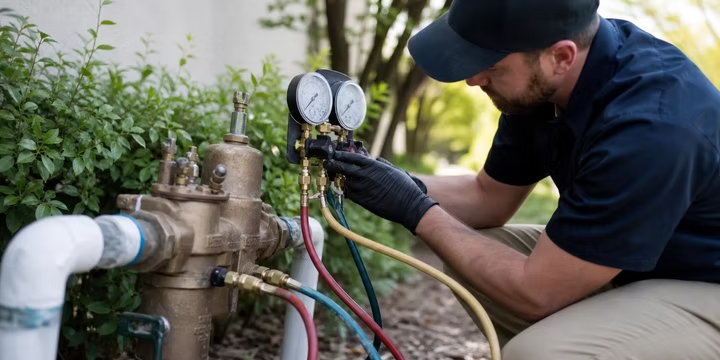
Using a calibrated differential pressure gauge kit, the tester connects hoses to the test cocks on the assembly. A complete test kit includes the differential pressure gauge, needle valves, test cock fittings, hoses, and carrying case. The gauge alone can’t perform the test without these supporting components.
After connecting, the tester bleeds air from the hoses to ensure accurate readings. Air pockets trapped in the lines will produce false pressure differentials and invalid results.
Step 4: Test Check Valve #2 (Downstream Check)
The tester opens specific needle valves on the kit to measure the pressure differential across the second (downstream) check valve. This valve is the last line of defense against backflow.
For a DCVA, this check must hold a minimum of 1 PSID (pounds per square inch differential). For an RPZ, the second check must also hold at least 1 PSID.
The reading appears on the differential pressure gauge. If the needle holds steady at or above the threshold, that check passes.
Step 5: Test Check Valve #1 (Upstream Check)
Next, the tester measures the pressure differential across the first check valve, the primary barrier. For a DCVA, the minimum passing threshold is 1 PSID. For an RPZ, the first check must hold at least 5 PSID.
This higher threshold for RPZ first checks exists because RPZ assemblies protect against health hazards. The first check needs a larger pressure cushion to ensure the relief valve functions correctly if either check begins to fail.
Step 6: Test the Relief Valve (RPZ Only)
This step only applies to Reduced Pressure Zone assemblies. The tester slowly reduces pressure in the intermediate zone by opening a low-side control valve on the test kit until the relief valve begins to discharge water. The pressure reading at the moment the valve opens is called the Relief Valve Opening Point (RVOP), and it must be at least 2 PSID to pass.
If you have a DCVA on your irrigation system (as most Lubbock residential properties do), this step doesn’t apply to your test.
Step 7: Restore Flow and Document Results
After all measurements are recorded, the tester disconnects the gauge kit, reopens the upstream valve first, then the downstream valve, restoring normal water flow. They complete the test report on-site, noting each reading, the pass/fail determination, the tester’s license number, and gauge calibration information.
In Lubbock, the tester must use the City of Lubbock Test and Maintenance Form. The original form must be mailed or delivered to the Water Compliance Department within 10 days of the test.
Pass/Fail Criteria Quick-Reference Table
These thresholds are established by the USC Cross-Connection Control Manual and enforced through TCEQ testing standards. A reading even slightly below the minimum means the component fails, triggering repair and retest requirements.
What Happens If Your Backflow Test Fails
A failed test is not a catastrophe. It’s actually quite common, and in many cases, the repair is straightforward and affordable.
Common Failure Causes
The most frequent reasons for failure include:
- Debris trapped inside check valves or the relief valve (sand, pipe scale, small rocks)
- Worn internal parts like rubber seals, O-rings, springs, or poppets
- Mineral buildup from hard water, which is particularly relevant in West Texas
- Freeze damage from unprotected above-ground assemblies
- Incorrect installation or missing components
- Age-related wear (backflow preventers typically last 5 to 10 years, though well-maintained units can reach 25 years)
Practitioners on industry forums note that failure rates run surprisingly high even on brand-new assemblies because construction debris gets forced into the device during installation, causing check valves to leak immediately.
Repair Is Usually Fast and Inexpensive
Most failures involve worn rubber seals, O-rings, or springs that can be replaced with repair kits costing $15 to $30 in parts. A qualified BPAT tester is authorized to perform repairs on-site and then retest. The assembly must pass a full retest before a passing certification can be issued.
For a detailed breakdown of what repairs typically cost in this area, including parts and labor, check out our backflow preventer repair cost guide.
If you’re unsure whether your device needs attention before the tester arrives, our guide on signs your backflow device needs repair walks through the warning signs.
When Replacement Makes More Sense
If the assembly body itself is corroded, cracked, or structurally compromised, repair kits won’t solve the problem. Replacement is also worth considering when a device has failed multiple tests in consecutive years, suggesting that the internal components are degrading faster than repair intervals can keep up with.
Lubbock Compliance: What Property Owners Need to Know
Understanding how licensed backflow testing is performed step by step is only half the equation. In Lubbock, the paperwork and timeline requirements carry real consequences.
Testing Frequency
The City of Lubbock requires testing upon installation and at least once every three years for non-health-hazard conditions. When the city or building official classifies the potential backflow as a health hazard, testing becomes annual or more frequent.
The 10-Day Filing Window
Once a test is completed, the original City of Lubbock Test and Maintenance Form must reach the Water Compliance Department within 10 days. Missing this window can put your property out of compliance even if the device passed the test.
Penalties Are Significant
Noncompliance in Lubbock can result in fines up to $2,000 per day, and the city has the authority to shut off water service. The property owner, not the city, bears all costs associated with testing, repair, and replacement.
A related concern: some property owners who find the testing requirement burdensome consider removing their backflow preventer entirely. This creates serious legal and safety risks that far exceed the cost of periodic testing.
Why This Isn’t Optional Theater
One water industry professional put it bluntly in a Bogleheads forum discussion: “If you understood all the different ways that a cross connection could occur and the possible public health concerns involved, you would likely understand the need for testing. People take safe drinking water for granted, but it takes a lot of work to deliver it. Relying on thousands of homeowners who have their own ideas on plumbing and zero training on preventing (or even identifying) cross connections isn’t going to work.”
This captures the core argument well. The backflow preventer on your irrigation system sits between your sprinkler zones (which may contain fertilizer, herbicide, or stagnant water) and the public drinking water supply. The test confirms, with NIST-traceable instruments accurate to ±0.2 PSI, that the barrier still works.
How to Prepare for Your Backflow Test
A little preparation on your end makes the process faster and prevents complications.
Clear access to the assembly. If your DCVA is in an underground box, remove any dirt, mulch, or landscaping fabric covering the lid. Trim back any grass or roots growing over it. The tester needs to open the box, read the nameplate, and connect hoses to the test cocks.
Know your assembly type and location. If you have your last test report, keep it accessible. It tells the tester the make, model, and previous readings, which helps them spot trends.
Expect a brief water shutoff. The test requires isolating the assembly, which stops water flow through the device. Most tests take 15 to 30 minutes total, so plan accordingly.
Ask to see credentials. A licensed tester should be able to provide their TCEQ BPAT license number and show a current calibration sticker on their gauge kit. This isn’t rude; it’s responsible.
Combine with seasonal maintenance. Many Lubbock property owners schedule backflow testing alongside their spring sprinkler startup, which is an efficient way to handle both in one visit.
If you want a step-by-step preparation walkthrough, our dedicated guide on how to prepare for a backflow inspection covers everything in detail.
How Backflow Testing Connects to Irrigation Performance
Most articles about how licensed backflow testing is performed step by step treat it purely as a compliance exercise. But the test also reveals information about your irrigation system’s health.
Every backflow preventer creates some pressure loss. Under normal conditions, a DCVA drops 3 to 8 PSI, a PVB drops 5 to 10 PSI, and an RPZ drops 10 to 15 PSI. When internal components get clogged with mineral deposits or debris, that pressure loss increases. The downstream sprinkler zones don’t get enough pressure, heads don’t pop up fully, coverage shrinks, and you start seeing brown patches.
A backflow test that shows check valves barely meeting the minimum threshold can be an early warning sign that the device needs cleaning or repair before it actually fails and before your lawn starts suffering. This is why testers who understand irrigation systems (not just plumbing) bring additional value to the process.
If you’re already dealing with weak zones or uneven coverage, our sprinkler system troubleshooting glossary can help you narrow down whether the backflow preventer is the culprit or if something else is going on.
Glossary of Key Terms
BPAT: Backflow Prevention Assembly Tester. The state-issued license required to perform backflow tests in Texas.
TCEQ: Texas Commission on Environmental Quality. The state agency that issues and regulates BPAT licenses.
PSID: Pounds Per Square Inch Differential. The unit of measurement for the pressure difference across a check valve or relief valve during testing.
Differential Pressure Gauge: The precision instrument used to measure PSID across backflow assembly components. Must be calibrated annually to ±0.2 PSI.
Test Cock: A small valve port built into the backflow assembly where the tester connects gauge hoses. Most assemblies have four test cocks.
Check Valve: An internal one-way valve that allows water to flow in one direction only. Backflow assemblies contain one or two check valves.
Relief Valve: Found only in RPZ assemblies. Opens to discharge water to the atmosphere if internal pressure drops too low, preventing contaminated water from reaching the supply.
Cross-Connection: Any physical connection between a potable water supply and a non-potable source. Your irrigation system’s connection to the water main is a cross-connection.
Backsiphonage: Backflow caused by negative pressure (a vacuum) in the supply line. Can occur during water main breaks or heavy demand periods.
Backpressure: Backflow caused by downstream pressure exceeding supply pressure. Can occur from pumps, thermal expansion, or elevation changes.
RVOP: Relief Valve Opening Point. The specific pressure differential at which an RPZ relief valve begins to discharge. Must be ≥2 PSID to pass.
Frequently Asked Questions
How long does a backflow test take?
Most residential tests take 15 to 30 minutes from start to finish, including setup, testing, and paperwork. If the assembly is hard to access (buried under dirt, for example), add extra time for locating and clearing the test cocks.
Can I test my own backflow preventer?
No. In Texas, only a TCEQ-licensed BPAT can perform the test and sign the certification. Performing a test without certification can carry legal consequences, and the results won’t be accepted by your water purveyor.
How often does Lubbock require backflow testing?
At minimum, every three years for non-health-hazard classifications. For health hazard connections, testing is required annually or more frequently. Your compliance notice from the city will specify your required frequency.
What does a backflow test cost?
Residential testing in the Lubbock area typically runs $50 to $65, with commercial tests around $75. If the device fails and needs repair, parts usually cost $15 to $30, with total repair and retest costs ranging from $150 to $400 depending on the assembly type and extent of wear.
My backflow preventer failed. Does that mean I need a new one?
Usually not. Most failures are caused by worn rubber seals, debris, or mineral buildup, all of which can be repaired on-site. The tester replaces the worn components, then performs a full retest. Replacement is typically only necessary when the assembly body itself is cracked, corroded, or structurally compromised.
Why does the tester close the downstream valve before the upstream valve?
This sequence prevents water hammer and allows the assembly to maintain internal pressure for accurate gauge readings. Closing in the wrong order can create pressure surges that damage components or produce unreliable test results.
What if I don’t get my backflow preventer tested?
In Lubbock, the city can fine property owners up to $2,000 per day for noncompliance and has the authority to disconnect water service. Even outside city enforcement, an untested device means you have no verification that your irrigation system isn’t contaminating the public water supply.
Does the tester file the paperwork, or do I?
In Lubbock, the tester completes the City of Lubbock Test and Maintenance Form on-site. The original form must be delivered to the Water Compliance Department within 10 days. Confirm with your tester that they handle the filing, as some testers leave it to the property owner.
Staying on top of backflow testing keeps your property compliant, protects your community’s water supply, and can catch irrigation performance issues before they become expensive problems. If your testing is overdue or you’ve received a city notice, our backflow testing guide for Lubbock covers costs, scheduling, and local requirements in full.