TL;DR
Most residential backflow preventer repairs cost between $100 and $500, depending on the device type, the severity of the damage, and where you live. Minor fixes like replacing seals or springs run $75 to $250, while major overhauls can push past $800. In Lubbock, TX, where the city enforces strict testing schedules and can fine noncompliant property owners up to $2,000 per day, understanding these costs before you call a contractor is worth your time.
What Is a Backflow Preventer?
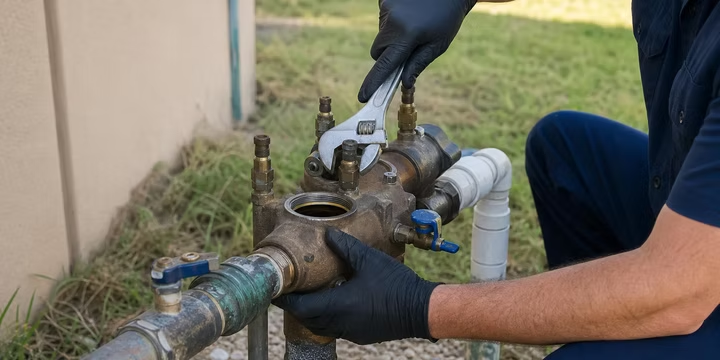
A backflow preventer is a mechanical device installed on your plumbing or irrigation system that stops water from flowing backward into the public drinking water supply. Think of it as a one-way gate. Water flows out to your sprinklers or fixtures, but if pressure drops or reverses for any reason, the preventer keeps contaminated water (fertilizer, pesticides, stagnant irrigation water) from siphoning back into the potable supply.
These devices are typically installed at the connection point between your irrigation system and the main water line. Every city that cares about water safety requires them. Lubbock is no exception.
If you’re unfamiliar with how these devices work, our RPZ backflow preventer guide covers the mechanics in detail.
The reason backflow preventer repair cost matters so much is that the device isn’t optional. When it fails a test or starts leaking, you have to fix it. The question is never “should I repair it?” but rather “how much will this repair cost and is it worth it compared to replacement?”
Types of Backflow Preventers and How They Affect Repair Cost
Not all backflow preventers are built the same, and the type installed on your property is the single biggest factor in what you’ll pay for repairs. Here are the four most common types:
PVBs are the most common backflow preventers on residential irrigation systems in Lubbock and across Texas. They’re relatively simple in design, easy to maintain, and the cheapest to repair. If you need a vacuum breaker replacement, parts and labor costs stay manageable.
RPZ assemblies sit at the opposite end. They have the most complex internal components, require specialized knowledge to service, and cost the most to repair. They’re also the only devices that Lubbock requires to be tested every single year.
DCVAs fall in the middle. They’re the most common approved device for underground or in-line installations, with moderate repair costs and moderate complexity.
AVBs are the simplest and cheapest. An anti-siphon valve installation or repair is usually a straightforward job.
Backflow Preventer Repair Cost Breakdown
Here’s what specific repairs tend to cost, based on data from multiple industry sources:
For parts alone, expect to pay $150 to $700 depending on the valve type and quality. Labor typically adds another $150 to $800, with the wide range reflecting differences in device complexity, accessibility, and local rates.
Simple repairs like replacing worn seals or springs, the kind that address minor leaks or small pressure drops, typically fall in the $150 to $400 range. These are the most common fixes after a failed test.
Commercial backflow preventer repair costs run higher, generally $200 to $700, because commercial devices are larger and installations are more complex.
Testing itself is a separate line item. Nationally, annual backflow testing ranges from $70 to $350. In Lubbock, the market is more defined: local providers like BlueSeal Backflow advertise flat rates around $75 including the inspection and official report submission, while competitors charge around $85 including tax and city filing. Practitioners on Reddit’s r/Lubbock forum confirm that $75 to $100 is what locals consider a reasonable testing price.
For related pricing context, our sprinkler valve repair cost guide breaks down what other irrigation component repairs typically run.
What Drives Repair Costs Up (or Down)
The range between a $100 repair and an $800 repair is wide enough to matter. Here’s what pushes the number in either direction:
Device type and complexity. An RPZ rebuild costs more than a PVB seal replacement every time. More internal parts means more labor and more expensive components.
Age of the unit. Backflow preventers generally last 10 to 20 years. Older units can be harder to source parts for, and aged components tend to fail in clusters rather than one at a time.
Accessibility. An above-ground PVB that a technician can walk up to is a quick job. A buried DCVA that requires excavation adds time and cost. Our above-ground backflow preventer guide explains why installation location matters for long-term maintenance.
Severity of damage. A single failed check valve is a different job than a device with cracked housing, corroded internals, and multiple failed components.
Emergency vs. scheduled service. Calling on a Saturday because your yard is flooding will add $50 to $150 to the bill. Scheduling during regular business hours saves real money.
Whether pipe or fitting work is needed. If the repair reveals corroded connections or damaged piping around the device, the scope (and cost) expands quickly.
Local labor rates. West Texas labor rates differ from those in Dallas or Houston. Lubbock tends to be slightly lower than major metro areas, but specialized TCEQ-licensed work commands a premium over general plumbing.
Repair vs. Replace: When to Stop Fixing
This is the decision that trips up most property owners. The rule of thumb cited consistently across the industry is simple: if the repair costs exceed 50% of what a full replacement would cost, replace the unit.
Full replacement costs vary by device type:
- AVB replacement: $50 to $200
- PVB replacement: $200 to $500
- DCVA replacement: $300 to $800
- RPZ replacement: $800 to $2,500
The national average for a backflow preventer replacement sits around $500, though RPZ devices push well above that.
Age matters here too. Units over 15 years old often justify replacement even when the immediate repair cost seems manageable. A 17-year-old RPZ that needs a $400 repair will likely need another repair within a year or two. At that point, you’re throwing good money after bad.
Replacement also brings benefits beyond fixing the immediate problem: modern code compliance, better protection ratings, and lower long-term maintenance costs. A new device starts a fresh 10 to 20 year clock.
Permit fees for replacement run $20 to $100 in most jurisdictions.
Backflow Preventer Testing and Repair Requirements in Lubbock, TX
Lubbock has some of the clearest (and strictest) backflow enforcement in West Texas. The City of Lubbock requires commercial plumbing backflow systems to be inspected annually, while residential irrigation devices follow a schedule based on device type:
- RPZ assemblies: Tested every year
- PVB devices: Every 3 years
- Double check valves: Every 3 years (unless on a fire sprinkler system, which requires annual testing)
- Spill-resistant vacuum breakers: Every 3 years
All testing must be performed by a backflow tester licensed with the Texas Commission on Environmental Quality (TCEQ) and registered with the city water purveyor. You can’t hire just any plumber for this.
If your device fails the test, you’ll need to repair or replace it and then retest. The property owner bears all costs: installation, maintenance, and testing. The city is explicit about this.
The enforcement teeth are real. If a Lubbock property owner declines to have their backflow prevention assembly tested, water services can be shut off. On top of that, the property owner faces fines of up to $2,000 per day for noncompliance.
For a deeper look at testing logistics, scheduling, and what to expect during the process, see our backflow testing Lubbock guide.
Posts on Lubbock’s Nextdoor community show first-time homeowners confused by city notices, using language like “I have no clue where to start.” That confusion is understandable. The letter arrives, it mentions potential water shutoff, and suddenly you need to find a TCEQ-licensed tester, understand what device you have, and figure out what it should all cost.
Freeze Damage and Backflow Preventers in West Texas
West Texas gets hard freezes. The 2021 and 2022 winter storms caused widespread backflow preventer damage across the state, and Lubbock is no exception. When temperatures drop below freezing, water inside the device can expand and crack the housing or destroy internal components.
Freeze-damaged backflow preventers often can’t be repaired. A cracked brass housing means full replacement, which pushes costs into the $300 to $2,500 range depending on device type. What would have been a routine $150 seal replacement becomes a $1,200 RPZ replacement because nobody winterized the system.
Prevention is cheap by comparison:
- A thermostatic freeze relief valve costs about $100
- Insulated covers run $20 to $60
- Professional winterization, which includes draining the backflow preventer, protects the entire system
Our guide on how to winterize a backflow preventer in Texas walks through the process step by step. For broader system protection, the sprinkler winterization guide covers everything from controllers to mainlines.
Skipping winterization in Lubbock is a gamble that doesn’t pay off. Even in years without a named storm, overnight temperatures regularly dip into the 20s from December through February.
Signs Your Backflow Preventer Needs Repair
Catching problems early is the cheapest path forward. Here’s what to watch for:
Visible leaks or dripping. Water pooling around the device body, dripping from the relief valve, or seeping from connections. Some relief valve discharge is normal on RPZ devices during use, but continuous dripping when the system is off signals a problem.
Unusual noises. Hissing, whistling, or banging sounds suggest trapped air or valve issues that shouldn’t be ignored. These often indicate an internal component that’s partially failed.
Pressure changes. Drops or surges in your sprinkler system can point to clogged valves, broken springs, or internal leaks within the backflow device. If you’re also noticing low water pressure in your sprinkler system, the backflow preventer should be one of the first things checked.
Rust or visible corrosion. Corrosion on the device body weakens the housing and accelerates internal component failure.
Failed test. The most definitive sign. If your certified tester reports a failure, repair or replacement is required before retesting.
Discolored or foul-smelling water. This could indicate that backflow is actually occurring, meaning the device has already failed its primary job. This is a health hazard that demands immediate attention.
For a more detailed diagnostic walkthrough, see our guide on how to tell if your backflow device needs repair.
How to Save on Backflow Preventer Repairs
Backflow preventer repair costs aren’t fully in your control, but several strategies can keep the bill lower than it needs to be.
Schedule during regular business hours. Emergency surcharges of $50 to $150 are avoidable if the repair isn’t urgent. A slow leak that appeared yesterday doesn’t require a weekend emergency call.
Bundle testing and repair with the same provider. If you’re already paying $75 to $85 for a Lubbock backflow test, having the same technician handle the repair saves a second service call fee. Providers who test, repair, and install without subcontracting offer the most streamlined (and usually cheapest) process.
Invest in regular testing. Catching a $75 seal issue during a routine test is dramatically cheaper than discovering a $600 problem after your system has been bypassing contaminated water for months.
Winterize your system. Spending $100 on freeze prevention beats spending $1,500 on an RPZ replacement every time. This is especially relevant in Lubbock, where freezes are guaranteed and protecting your sprinkler system from freezing should be part of every fall routine.
Get multiple quotes. Lubbock testing prices are fairly standardized at $75 to $100, but repair quotes can vary more widely. Two or three estimates from TCEQ-licensed testers will give you a clear picture of fair pricing.
Consider a maintenance plan. Ongoing service plans that include backflow status checks during system inspections catch problems at the earliest, cheapest stage.
M&M Sprinklers employs Texas-licensed Backflow Prevention Assembly Testers (BPAT) who handle testing, repair, and installation without subcontracting, and provide written certifications after each service. For Lubbock property owners who want testing and repair handled by a single accountable provider, contact M&M for backflow services.
Key Takeaways
- Residential backflow preventer repair: $100 to $500 for most jobs
- Commercial repair: $200 to $700
- Minor fixes (seals, springs): $75 to $250
- Full rebuild or overhaul: $400 to $800+
- Full replacement: $280 to $2,500 depending on device type
- Annual testing in Lubbock: $75 to $85 from local providers
- Noncompliance penalty in Lubbock: Water shutoff and fines up to $2,000/day
- The 50% rule: If repair costs exceed half the replacement price, replace the unit
- Freeze damage prevention: Worth every penny in West Texas
Understanding backflow preventer repair cost before you get that city notice or failed test result puts you in a much stronger position. You’ll know what’s reasonable, when to repair vs. replace, and how to find qualified help fast.
Frequently Asked Questions
How much does it cost to repair a backflow preventer?
Most residential repairs cost $100 to $500. Minor fixes like seal or spring replacement run $75 to $250, while major overhauls involving multiple components can reach $500 to $800 or more. The device type, damage severity, and whether emergency service is needed all affect the final price.
How often does Lubbock require backflow testing?
It depends on the device. RPZ assemblies must be tested annually. PVBs, DCVAs, and spill-resistant vacuum breakers require testing every 3 years. Commercial plumbing backflow systems need annual inspection regardless of type. All testing must be done by a TCEQ-licensed tester registered with the city.
When should I replace a backflow preventer instead of repairing it?
Apply the 50% rule: if the repair estimate exceeds half the cost of a new device, replacement is the better investment. Also consider replacement for units over 15 years old, devices with cracked housings, or any unit that has needed multiple repairs in recent years.
What happens if I ignore the City of Lubbock backflow testing notice?
The city can shut off your water service and impose fines of up to $2,000 per day for noncompliance. The property owner is responsible for all costs associated with testing, repair, and maintenance of the backflow prevention assembly.
Does homeowners insurance cover backflow preventer repair?
Generally, no. Standard homeowner policies don’t cover wear-and-tear maintenance items like backflow preventer repairs. If freeze damage destroyed your device during a named weather event, some policies may cover it, but you’d need to check your specific coverage. The safe assumption is that you’re paying out of pocket.
Can any plumber test my backflow preventer in Texas?
No. Texas requires that all backflow testing be performed by a tester licensed with the Texas Commission on Environmental Quality (TCEQ). In Lubbock, that tester must also be registered with the city water purveyor. General plumbing licenses don’t qualify.
How long do backflow preventers last?
Most devices are designed to last 10 to 20 years with proper maintenance. PVBs and AVBs tend toward the shorter end of that range, while well-maintained RPZ and DCVA units can last closer to 20 years. In West Texas, freeze exposure and mineral-heavy water can shorten lifespan if the device isn’t properly winterized and maintained.
Is backflow preventer repair cost higher for RPZ devices?
Yes. RPZ assemblies are the most complex and expensive backflow preventers to repair. They have more internal components, require specialized knowledge, and their parts cost more than those for simpler PVB or AVB devices. Expect RPZ repairs to run $250 to $600 or more, compared to $100 to $300 for a typical PVB repair.