TL;DR
A backflow preventer is a device installed between your irrigation system and the city water supply that stops contaminated water from flowing backward into your drinking water. Lubbock requires backflow prevention assemblies on all irrigation systems connected to city water, with testing every three years for residential properties and annually for commercial ones. Skipping the test can result in water shutoff and fines up to $2,000 per day. If you received a letter from the city, you need a TCEQ-licensed tester to inspect your device and submit a passing report.
What Is Backflow? The Problem Your Preventer Solves
Backflow is exactly what it sounds like: water flowing in the wrong direction. In a properly functioning plumbing system, water moves from the city main into your home and out to your sprinkler heads. Backflow reverses that flow, pulling water from your yard back into the municipal supply.
This matters because your irrigation water is officially classified as a health hazard, not just a nuisance. Your yard contains fertilizers, pesticides, animal waste, bacteria, and stagnant water sitting in pipes. If any of that gets pulled back into the city’s drinking water system, it contaminates the supply for you and your neighbors.
Backflow happens through two mechanisms. Back-siphonage occurs when a sudden vacuum forms upstream, often from a water main break or an open fire hydrant, and sucks water backward through your system. Back-pressure happens when downstream pressure exceeds supply pressure, forcing water in reverse. In West Texas, where summer drought increases water pressure fluctuations and fire hydrant use, both scenarios are more common than most homeowners realize.
The consequences are real. According to EPA data, 459 documented backflow incidents between 1970 and 2001 resulted in roughly 12,093 cases of illness. The City of Durham estimates backflow events occur about 100,000 times per year across the United States. In one well-known 1991 incident, 2.5 gallons of the herbicide TriMec backsiphoned into a Utah water system serving 2,000 homes, including a nursing home and day-care facility.
How a Backflow Preventer Works
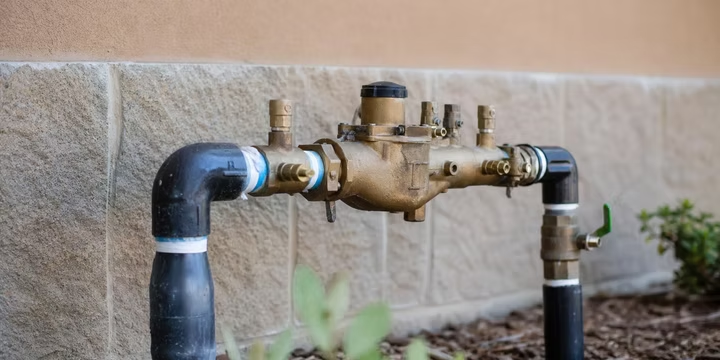
A backflow preventer acts as a one-way gate. It allows water to flow from the city supply into your irrigation system but physically blocks any return flow. The device sits between your water meter and your sprinkler system’s main line, and it uses internal check valves (and in some models, a relief valve) to stop reverse movement.
One important point that catches homeowners off guard: the zone valves that turn your sprinklers on and off are not backflow protection. Every valve eventually leaks or fails. The backflow preventer exists precisely for those moments when a valve breaks down and the only thing standing between your yard’s contaminated water and your kitchen faucet is that device.
As one irrigation expert explains, your yard has all kinds of things in it that will make you sick if you drink them. Irrigation water isn’t merely unpleasant. It’s hazardous. The backflow preventer is the last line of defense.
If you’ve noticed water pooling around your device, that’s a sign something may have already failed. Learn about backflow device leak causes before it becomes a compliance issue.
Types of Backflow Preventers
Understanding what a backflow preventer does and why it matters starts with knowing which type you have. Not all devices provide the same level of protection, and your local water authority dictates which ones are acceptable.
The RPZ provides the strongest protection available. It has two independent check valves and a relief valve that automatically dumps water whenever pressure conditions become unsafe. RPZ assemblies are typically required for high-hazard applications and are the standard for most commercial irrigation in Texas.
PVBs are the most common residential device in Lubbock. They handle multi-zone systems well but must be installed at least 12 inches above the highest sprinkler head in the system. For a deeper look at installation requirements, see our above-ground backflow preventer guide.
Picking the wrong type can mean a failed inspection or, worse, a real contamination risk.
Why Backflow Prevention Matters in Lubbock
This is where understanding what a backflow preventer does and why it matters becomes personal for Lubbock homeowners.
The City of Lubbock’s Ordinance Sec. 28.10.053 requires backflow prevention assemblies on all irrigation systems connected to city water. The testing schedule is straightforward: residential irrigation devices must be tested every three years, and commercial systems require annual testing.
The penalties for noncompliance are steep. If you choose not to have your backflow prevention assembly tested, the city can shut off your water. Property owners can also face fines up to $2,000 per day.
Why You Got That Letter
If you recently received a letter from the City of Lubbock’s backflow department, you’re not alone. Practitioners on Reddit report the same confusion. In a June 2025 r/Lubbock thread (which currently ranks on the first page of Google for backflow-related searches), a new resident posted about receiving a letter stating their property hadn’t submitted the required TCEQ test. The thread is full of Lubbock homeowners wondering what to do next.
The reason for the sudden enforcement push: KCBD reported that the city’s water department was recently inspected by its state regulatory authority, TCEQ, which found Lubbock deficient in recordkeeping and compliance for backflow prevention testing. The city is now catching up aggressively.
Lubbock’s Director of Water Utilities addressed the confusion directly: “Some people may ask well what could contaminate your water supply from my yard. Well people have animals and they do things in their yards, you also put down chemicals.”
TCEQ requires every municipality in Texas to maintain a backflow prevention program. This isn’t a Lubbock-only rule. It’s state law. But Lubbock is enforcing it more actively now than in previous years.
If your system needs a full evaluation, consider scheduling a system checkup to address backflow testing and overall irrigation health at the same time.
What Happens During a Backflow Test
Knowing what a backflow preventer does and why it matters is one thing. Knowing what to expect during the actual test removes the mystery.
A TCEQ-licensed Backflow Prevention Assembly Tester (BPAT) performs the inspection, which typically takes 20 to 30 minutes for a residential system. Here’s what they do:
- Verify the device. The tester records the serial number, manufacturer, and model of your backflow preventer.
- Inspect shut-off handles. Both the upstream and downstream isolation valves must open and close properly.
- Test with a differential pressure gauge. A specialized gauge kit connects to the test ports on your device. The tester checks that each internal check valve holds the correct pressure and prevents reverse flow.
- Check for leaks and corrosion. Physical damage, worn seals, and visible corrosion can cause a device to fail.
- File the report. The tester submits results directly to the City of Lubbock, typically within 10 days.
If your preventer fails the test, you must have it repaired or replaced and retested by a certified tester before the city considers you compliant.
Testing generally costs between $30 and $300 per device, depending on location and complexity. HomeGuide estimates put a new backflow preventer at $200 to $1,000 installed, depending on type and size.
The cost of not testing is far higher. According to ABPA survey data, water system operators spend an average of 494 hours per incident mitigating backflow events. Adjusted for inflation, that works out to roughly $24,000 per event in 2022 dollars.
The West Texas Freeze Factor
Most generic backflow content ignores climate entirely, but in Lubbock this is a critical concern. Above-ground backflow preventers (PVBs and RPZs) are exposed to hard freezes every winter. Water trapped inside the device expands when it freezes, cracking the body, splitting check valve seats, and destroying the relief valve on RPZ assemblies.
A device that was perfectly functional in October can be broken by January. If you don’t drain or insulate your backflow preventer before the first hard freeze, you may face both a failed test and a costly replacement come spring.
Seasonal maintenance that includes backflow preventer care prevents compliance surprises. Our guide on how to winterize your backflow preventer walks through the steps, and for full-system preparation, see our resource on protecting your sprinkler system from freezing.
Common Questions Lubbock Homeowners Ask
Community discussions on Reddit, Nextdoor, and local news comment sections reveal the same questions coming up repeatedly. Here are the answers.
“I don’t even use my sprinkler system. Do I still need a test?” Yes. If the backflow preventer is installed and connected to city water, the city requires testing regardless of whether the system is active.
“Can I test it myself?” No. Texas law requires a TCEQ-licensed BPAT tester. This is not a DIY task, and self-submitted results won’t be accepted.
“How do I find a licensed tester?” The city maintains a list of registered testers but cannot recommend specific companies. You can also contact a licensed irrigation company that employs BPAT-certified technicians.
“What if my device fails?” You must have it repaired or replaced by a qualified professional and retested before submitting a passing report to the city.
“Will the city remind me?” Yes. Lubbock’s backflow department sends a first notice, a mid-month reminder, and (if needed) a final door sticker. But don’t wait for the sticker. By that point, you’re running out of time.
“What does the city letter actually mean?” It means your property’s records show no current passing test on file. The recent enforcement push, prompted by a TCEQ audit of Lubbock’s compliance program, means the city is contacting every property that’s overdue.
Protecting Your Investment Year-Round
Understanding what a backflow preventer does and why it matters goes beyond passing a single test. The device protects your family’s drinking water every day, but only if it’s maintained.
Annual inspections catch worn seals and early corrosion before they cause failures. Spring is a natural time to combine backflow testing with a sprinkler system startup, since both tasks involve pressurizing the system and checking for problems.
A failing backflow preventer is also one of several signs your sprinkler system needs repair. If your device is leaking, corroded, or struggling to hold pressure, the rest of your system likely needs attention too.
M&M Sprinklers employs Texas-licensed BPAT testers who can test, repair, and certify your backflow preventer without subcontracting the work. After every test or repair, you receive a written certification and the report is filed directly with the city.
Schedule your Lubbock backflow test and system checkup to get compliant and keep your system running right.
FAQ
What does a backflow preventer actually do?
A backflow preventer is a mechanical device that allows water to flow in one direction only, from the city supply into your irrigation system. It blocks contaminated water (containing fertilizers, pesticides, bacteria, and other hazards) from reversing back into the municipal drinking water supply.
How often does Lubbock require backflow testing?
Residential irrigation backflow preventers must be tested every three years. Commercial systems require annual testing. These frequencies are set by City Ordinance 28.10.053 and enforced by the city’s backflow department.
What happens if I ignore the city’s backflow letter?
The city can shut off your water service. Beyond that, you can be fined up to $2,000 per day for noncompliance. The enforcement has intensified recently because TCEQ found Lubbock’s backflow compliance program deficient during a state audit.
Can I test my own backflow preventer in Texas?
No. Texas law requires that all backflow prevention assembly testing be performed by a TCEQ-licensed BPAT tester. Self-testing is not legally valid, and the city will not accept results from an unlicensed individual.
How much does backflow testing cost?
Testing typically runs between $30 and $300 per device. If the device fails and needs repair or replacement, a new backflow preventer costs $200 to $1,000 installed, depending on the type and size.
Which type of backflow preventer do I need in Lubbock?
For most residential irrigation systems, a PVB (Pressure Vacuum Breaker) is the standard. Commercial properties and high-hazard applications typically require an RPZ (Reduced Pressure Zone) assembly. Your water authority and TCEQ regulations determine the minimum acceptable device for your property.
Does freezing weather damage backflow preventers?
Yes. Above-ground devices like PVBs and RPZs are vulnerable to Lubbock’s hard winter freezes. Water trapped inside can expand and crack the device body or destroy internal components. Draining and insulating before the first freeze is essential.
Why is Lubbock suddenly enforcing backflow testing?
The city’s water department was audited by TCEQ and found deficient in compliance recordkeeping. As a result, Lubbock is now actively contacting every property with an overdue or missing backflow test report. This isn’t a new rule, but enforcement is stricter than it has been in years.