How Sprinkler System Works: Step-by-Step Guide (2026)
TL;DR
A lawn sprinkler system moves water through a straightforward chain: your water source feeds a backflow preventer, which connects to zone valves controlled by a timer (the controller), which then pushes water through underground pipes to pop-up sprinkler heads on your lawn. The system divides your yard into zones so it can water each area without overwhelming your water supply. Understanding how a sprinkler system works helps you spot problems early, cut water waste, and keep your lawn healthy, especially in hot, windy climates like West Texas.
A quick note: This article covers lawn and landscape irrigation sprinkler systems, not fire suppression sprinklers. If you’re looking for fire sprinkler information, this isn’t the page for you.
An automatic sprinkler system is really just a network of underground pipes, valves, and spray heads coordinated by a controller. When everything works correctly, the result looks effortless: your lawn gets watered on schedule without you lifting a finger. But beneath the surface, several components need to work together in a precise sequence.
Understanding how a sprinkler system works matters more than most homeowners realize. According to the EPA, a household with a poorly maintained irrigation system can waste up to 25,000 gallons of water annually. In arid regions like West Texas, where outdoor watering can account for 60% or more of total household water use, that waste hits your wallet hard.
If your system is already giving you trouble, a sprinkler repair cost guide can help you understand what fixes typically run.
The Water Flow Path: How a Sprinkler System Works Step by Step
Every irrigation system follows the same basic sequence, regardless of brand or size. Here’s the path water takes from your utility connection to your grass:
Water Source — Your municipal water supply (or well) feeds water into a mainline pipe that branches off to your irrigation system.
System Shutoff Valve — This valve lets you isolate your irrigation from household plumbing. It’s your emergency stop.
Backflow Preventer — Sits between your water supply and the irrigation system, preventing contaminated water from flowing back into your drinking water.
Main Line — PVC pipe carries pressurized water from the backflow preventer to a series of zone valves.
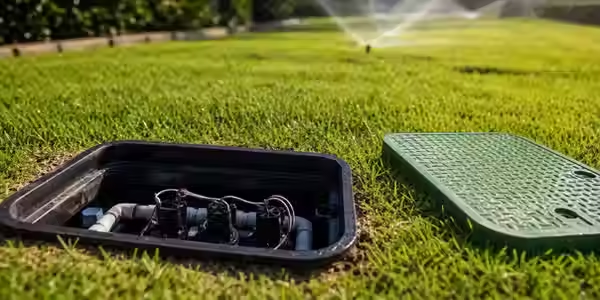
Zone Valves — Each valve controls one group (zone) of sprinkler heads. They open and close based on electrical signals from the controller.
Controller (Timer) — The brain of the operation. It tells each valve when to open and for how long.
Lateral Pipes — After the valve, smaller pipes (PVC or poly tubing) carry water to individual sprinkler heads.
Sprinkler Heads — The endpoints. Water pressure pushes pop-up heads above ground level, and they distribute water across your lawn.
Zone Cycle Completes — When the programmed runtime ends, the controller signals the valve to close, water pressure drops, and the sprinkler heads retract. The process repeats for the next zone.
That’s the whole cycle. The controller steps through each zone one at a time until every area of your landscape has been watered.
Glossary of Core Components
This section defines each major part of your sprinkler system, explains how it works in practice, and covers what typically goes wrong. Think of it as your reference guide.
Water Source and Main Line
What it is: Your starting point. Whether connected to a municipal water utility or a private well, the water source feeds your mainline, which is the primary pipe running from your meter or pump to the rest of the irrigation system.
How it works: The mainline branches off from your household plumbing (after the meter) and runs to the backflow preventer, then continues to your zone valves. It stays pressurized whenever your main shutoff is open.
What can go wrong: Tree roots are one of the most overlooked threats. Practitioners on irrigation forums regularly report pipe crimping and cracking caused by invasive tree roots pushing against buried lines. This is especially common when pipes weren’t trenched deep enough or when weaker fittings were used. If you notice a sudden drop in pressure across your whole system, a mainline break could be the cause.
For properties with mature trees near irrigation lines, coordinating tree care with irrigation maintenance can prevent plant stress and avoid costly pipe repairs.
System Shutoff Valve
What it is: A manual valve that lets you turn off water to the entire irrigation system without affecting your house plumbing.
How it works: It’s usually located near the backflow preventer or where the irrigation line splits from the main household supply. Turn it clockwise to shut off water.
What can go wrong: Shutoff valves can seize up from lack of use. Test yours periodically so you can actually close it in an emergency, like a burst mainline.
Backflow Preventer
What it is: A mechanical device that stops water from flowing backward out of your irrigation system and into your clean drinking water supply.
How it works: Irrigation water can pick up fertilizer, pesticides, and soil bacteria. Without a backflow preventer, a sudden drop in city water pressure could suck that contaminated water back into your potable supply. The device uses check valves or an air gap to block reverse flow.
Types: The three most common backflow devices are the Pressure Vacuum Breaker (PVB), Reduced Pressure Zone assembly (RPZ), and Double Check Assembly (DCA). PVBs are the most common and least expensive for residential systems. RPZs offer higher protection and are often required for commercial properties.
What can go wrong: Internal seals wear out over time, causing visible leaks or test failures. Many Texas cities require annual backflow testing and certification. If yours hasn’t been tested recently, you may want to learn how to prepare for a backflow test. A failing device can also mean repair costs that vary depending on the type installed.
Pro tip: In West Texas, exposed backflow preventers are vulnerable to winter freezes. Insulating yours before the first hard freeze can prevent cracked housings and expensive replacements.
Controller (Timer)
What it is: The brain of the sprinkler system. It’s the box mounted in your garage, on an exterior wall, or inside a control closet that tells each zone when to run and for how long.
How it works: The controller sends a low-voltage electrical signal (typically 24V AC) through buried wires to a solenoid on each zone valve. When the signal fires, the solenoid opens the valve and water flows. When the timer reaches the end of the programmed runtime, it cuts the signal and the valve closes. Then the controller moves to the next zone.
Residential controllers typically handle 4 to 12 zones. Commercial systems can manage hundreds.
What can go wrong: The most common controller problem isn’t a malfunction. It’s “set it and forget it” behavior. A schedule programmed in April becomes wasteful by July and potentially damaging by November. Seasonal adjustment is critical, especially in climates with extreme temperature swings.
If a zone isn’t running at all, the problem could be a bad solenoid, broken wire, or controller fault. A troubleshooting guide can help you narrow it down.
Zone Valve and Solenoid
What it is: A valve that controls water flow to one zone of sprinkler heads. The solenoid is the small cylindrical component on top that converts the controller’s electrical signal into mechanical action.
How it works: When the controller says “water zone three,” the solenoid on valve three lifts a plunger inside the valve body, allowing water to flow through to that zone’s sprinkler heads. All other valves remain closed. This ensures your water supply isn’t split too thin across too many heads at once.
What can go wrong: A stuck-open valve creates soggy spots and runs up your water bill. A stuck-closed valve means a dead zone with no water. Solenoids can fail electrically (no response to the controller signal) or mechanically (plunger stuck). Understanding what a solenoid does in your irrigation system helps you diagnose these problems faster.
Zone (Station)
What it is: A group of sprinkler heads connected to the same valve and controlled as a single unit.
How it works: Zones exist because your water supply has a limited flow rate, measured in gallons per minute (GPM). You simply can’t run every head on your property at once without tanking the water pressure. So the system groups heads into zones that each demand a safe share of available flow. The controller cycles through each zone sequentially.
Design principles: Good zone design groups heads by type (spray heads together, rotors together), plant watering needs, sun exposure, and soil type. Mixing head types in a single zone is one of the most common DIY mistakes because spray heads and rotors have very different precipitation rates. Running them together means one area gets overwatered while another stays dry.
Pipes (Mainline and Lateral Lines)
What it is: The underground plumbing that carries water throughout the system. The mainline runs from the water source to the valves. Lateral lines run from each valve to the sprinkler heads in that zone.
How it works: PVC pipe is standard for everything before the valve (mainline). After the valve, you’ll find either PVC or flexible polyethylene (poly) tubing, sometimes called “funny pipe,” especially for the final connections to individual heads. Pipes are typically buried 6 to 12 inches deep.
What can go wrong: Leaks from cracked fittings, root intrusion, or freeze damage. A broken lateral line often shows up as a soggy patch that never dries out, even when the system is off. A mainline break is more dramatic and can spike your water bill fast. If you suspect a hidden leak, finding it requires a systematic approach.
Swing Joint
What it is: A flexible fitting made of short threaded risers and elbows that connects the lateral pipe to the sprinkler head.
How it works: The swing joint allows the head to be adjusted up or down relative to the soil surface. It also absorbs impact, so when a mower clips a head, the joint flexes rather than cracking the pipe below.
What can go wrong: Repeated impacts or soil settling can cause swing joints to leak at the threaded connections. If a single head weeps water when the zone is off, the swing joint fittings are a likely suspect.
Sprinkler Head
What it is: The endpoint of the system that distributes water onto your landscape. Most residential heads are “pop-up” style, rising above ground when pressurized and retracting when the zone shuts off.
How it works: When the valve opens and water flows through the lateral pipe, pressure pushes the head’s riser up, typically 3 to 4 inches above ground. The nozzle on top of the head shapes the water stream into a specific pattern and throw distance.
Types of sprinkler heads:
Fixed Spray Heads — Produce a fan-shaped spray pattern. Short throw distance (up to about 15 feet). Best for small or narrow zones like side yards and garden borders.
Gear-Drive Rotors — Rotate a single stream across a wide area. Longer throw (15 to 50+ feet). Best for large, open lawn sections.
Rotary Nozzles (MP Rotators) — Shoot multiple rotating streams at a lower precipitation rate. More wind-resistant than standard spray heads, which makes them particularly useful in windy areas like Lubbock and the surrounding plains.
Drip Emitters — Deliver water slowly and directly to the root zone. Ideal for flower beds, shrubs, and trees where broadcast spraying would waste water.
For a deeper comparison, the guide on types of irrigation heads covers the strengths and weaknesses of each.
What can go wrong: Clogged nozzles (from dirt, sand, or hard water deposits) are the single most common sprinkler head problem. The result is weak spray, uneven coverage, or heads that don’t pop up fully. Broken heads from foot traffic or mowers are a close second. One broken sprinkler head can waste up to 25,000 gallons per year.
Nozzle
What it is: The removable insert at the top of a sprinkler head that determines the spray pattern, distance, and flow rate.
How it works: Nozzles are color-coded or numbered by the manufacturer to indicate their radius and arc. Swapping a nozzle is one of the simplest ways to change how far or wide a head sprays, without replacing the entire head body.
What can go wrong: Using the wrong nozzle size throws off the precipitation rate for that zone, leading to dry spots or runoff. Nozzles also clog, especially in areas with sandy soil. Cleaning or replacing them is straightforward and covered in a nozzle replacement guide.
Head-to-Head Coverage
What it is: The fundamental design principle that every sprinkler head should throw water all the way to the next head in each direction. In other words, 100% overlap.
Why it matters: Sprinklers are intentionally designed this way because a single head delivers less water at the edges of its radius than near the center. Overlapping coverage ensures every square foot of lawn receives a uniform amount of water. The most common design flaw in sprinkler systems is a lack of head-to-head coverage, which creates persistent dry spots, brown patches, or overwatered areas.
Pro tip: If you have a recurring brown patch in the same spot every summer despite adequate watering time, the heads in that area likely aren’t spaced for proper overlap. Adding a head may be the only real fix.
Water Pressure (PSI)
What it is: The force pushing water through your irrigation system, measured in pounds per square inch. Most residential water supplies deliver 40 to 80 PSI.
How it works in irrigation: Different head types need different operating pressures. Rotors work best around 45 PSI (range of 25 to 65). Spray heads operate at about 30 PSI (range of 15 to 30). Drip lines run at roughly 20 PSI. The system is designed around these ranges.
Expect about 15 PSI of pressure loss between your water meter and the sprinkler head, spread across the backflow preventer, valves, pipes, fittings, and elevation changes. Irrigation professionals sometimes call this the “5-4-3-2-1 rule of thumb” for estimating pressure drops through each component.
What can go wrong: Pressure that’s too high causes misting, where water leaves the nozzle as a fine fog that blows away in the wind and evaporates before reaching the grass. This is a significant problem in West Texas, where steady winds are the norm. Consistently high pressure also accelerates wear on heads and makes the system more prone to breaks. Pressure that’s too low produces weak, short spray and poor coverage. Either direction is bad.
For detailed testing and fixes, see the water pressure guide.
Flow Rate (GPM)
What it is: The volume of water your supply can deliver per minute, measured in gallons per minute. Flow rate determines how many sprinkler heads can run simultaneously in a single zone.
Why it matters: If you put too many heads on one zone, there isn’t enough water to go around. Heads will barely pop up, spray patterns will be distorted, and coverage will suffer. Zone sizing is built around available GPM.
Rain and Freeze Sensor
What it is: A small device (mounted to a fence post, eave, or exterior wall) that interrupts the controller signal when rain or freezing temperatures are detected.
How it works: A rain sensor uses hygroscopic discs that swell when wet, triggering a switch that tells the controller to skip the scheduled watering cycle. A freeze sensor monitors temperature and prevents watering when conditions could create ice, which damages plants and creates slippery hazards. Combined rain/freeze sensors handle both.
What can go wrong: Sensors can stick or lose their connection to the controller, especially if wiring degrades. Without a working sensor, your system will happily water during a rainstorm or a freeze, wasting water or causing damage. In Lubbock, where winter freezes are a regular occurrence, a functioning freeze sensor is not optional.
Smart Controller
What it is: A Wi-Fi connected controller that automatically adjusts watering schedules based on real-time weather data, soil moisture, or evapotranspiration (ET) calculations rather than running a fixed clock-based schedule.
How it works: The controller pulls in local weather data (temperature, humidity, wind speed, solar radiation) and calculates how much water your landscape actually lost that day. It then adjusts runtime up or down accordingly. Many smart controllers also offer smartphone apps for remote monitoring and manual overrides.
Why it matters: The EPA estimates that replacing a clock-based controller with a WaterSense-labeled smart controller can reduce irrigation water use by up to 30% and save an average home approximately 15,000 gallons annually. Across the country, more than 28 million homes use in-ground sprinkler systems with traditional clock-based controllers, which means the potential for savings is enormous.
In arid climates, smart controllers are especially valuable because they can factor in high wind days (skipping cycles that would just blow away) and adjust for the rapid evaporation that comes with summer heat.
How Zones Work and Why They Matter
New homeowners often wonder why their system doesn’t just turn on all the heads at once. The answer comes down to flow rate.
Your water supply can only deliver so many gallons per minute. If every sprinkler head on your property opened simultaneously, the pressure would drop so low that nothing would work properly. Zones solve this by dividing the system into manageable groups, each drawing a safe portion of your available flow.
A typical residential system has 4 to 12 zones. Each zone is built around similar conditions: same head type, similar sun exposure, and comparable plant watering needs. Your front lawn rotors might be zones 1 and 2. Side yard spray heads might be zone 3. Flower bed drip emitters might be zone 4.
The controller cycles through these zones one at a time. Zone 1 runs for its programmed duration, then the valve closes and zone 2 opens, and so on down the line until every area has been watered.
Smart Controllers vs. Traditional Timers
Traditional controllers run on a fixed schedule. You program the days, start times, and zone runtimes, and the system executes that program whether it rained all night or the temperature dropped to 28°F.
Smart controllers change the equation. Instead of blindly following a clock, they pull in local weather data and adjust watering automatically. Features typically include:
Weather-based scheduling that increases runtimes during hot spells and reduces them after rain
Rain, wind, and freeze skip that cancels cycles when watering would be wasteful or harmful
Cycle-and-soak programming that splits long runtimes into shorter intervals with pauses, allowing water to absorb into the soil rather than running off (particularly important for Lubbock’s sandy soils, which drain quickly)
Smartphone control for on-the-fly adjustments from anywhere
EPA data consistently shows 30% water savings from smart controllers. In a region where outdoor watering can consume over half of household water, that’s a meaningful number on your monthly bill.
Common Signs Something Isn’t Working
Once you understand how a sprinkler system works, you can decode its symptoms:
Dry spots or brown patches — Usually a coverage gap from broken heads, clogged nozzles, or heads that aren’t spaced for head-to-head overlap.
Soggy areas that never dry — Likely a pipe leak or a valve stuck in the open position.
Misting or fog instead of droplets — Water pressure is too high. The fine mist blows away in the wind and evaporates before reaching the ground. This wastes a surprising amount of water.
Weak, short spray — Pressure too low, clogged nozzles, or too many heads on one zone.
Unexplained spike in your water bill — A leak somewhere in the system. Even a small underground leak can waste thousands of gallons before you notice visible symptoms.
A zone that won’t turn on — Possible valve failure, solenoid burnout, or wiring issue between the controller and the valve.
According to industry estimates, 30 to 60% of irrigation water is wasted due to leaks, broken heads, and poor scheduling. That statistic underscores why understanding your system’s normal behavior helps you catch problems before they become expensive.
If something seems off, a system checkup is the fastest way to identify and address issues before they escalate.
Why Regular Maintenance Matters
A sprinkler system isn’t a set-and-forget appliance. It’s a mechanical system buried in the ground, exposed to soil movement, root pressure, freeze-thaw cycles, and constant water flow. Things wear out.
Seasonal adjustments are particularly important in West Texas. Summer runtimes need to be significantly longer than spring runtimes because of high evaporation rates and persistent wind. Come fall, those runtimes need to drop again. And before the first hard freeze, exposed components like backflow preventers need to be insulated or drained.
The EPA estimates that as much as 50% of outdoor water use is lost to wind, evaporation, and runoff caused by inefficient systems and poor scheduling. Regular maintenance, including head inspection, nozzle cleaning, pressure checks, and controller reprogramming, prevents your system from quietly wasting water month after month.
Frequently Asked Questions
How does a sprinkler system know when to turn on?
The controller (timer) is programmed with specific days, start times, and zone runtimes. At the scheduled time, it sends an electrical signal to the first zone’s valve, opening it and allowing water to flow. Smart controllers can also adjust or skip cycles based on weather conditions.
Why is my sprinkler system divided into zones?
Your water supply has a limited flow rate (GPM). Running all heads at once would drop pressure to the point where nothing works correctly. Zones divide the system into groups that each use a safe portion of available flow, and the controller runs them one at a time.
What is a backflow preventer and do I really need one?
A backflow preventer stops potentially contaminated irrigation water from flowing backward into your drinking water supply. It’s required by building codes in most cities, including many Texas municipalities that also mandate annual testing. Yes, you really need one.
What’s the difference between a smart controller and a regular timer?
A regular timer runs a fixed schedule regardless of weather. A smart controller uses real-time weather data, soil moisture readings, or evapotranspiration calculations to automatically adjust watering. The EPA says smart controllers can save up to 15,000 gallons per household per year.
Why are some spots in my yard always dry even though the sprinklers run?
The most likely cause is a lack of head-to-head coverage, meaning the sprinkler heads aren’t spaced closely enough for their spray patterns to overlap. Other possibilities include clogged nozzles, a broken head, or the wrong nozzle type installed.
Can tree roots damage my sprinkler system?
Absolutely. Tree roots can crush, crimp, or crack underground pipes and fittings over time. This is one of the most common causes of hidden leaks in yards with mature trees, and it’s often worse when pipes were originally trenched too shallow.
How much water does a broken sprinkler system waste?
A single broken sprinkler head can waste up to 25,000 gallons per year. An entire system that’s poorly maintained can waste a similar amount from a combination of leaks, poor scheduling, and inefficient heads.
How often should I have my sprinkler system inspected?
At minimum, twice a year: once at spring startup and once before winter. Quarterly inspections are better, especially in climates with extreme heat and freeze cycles. Seasonal reprogramming of your controller should happen with each inspection.


Comments