
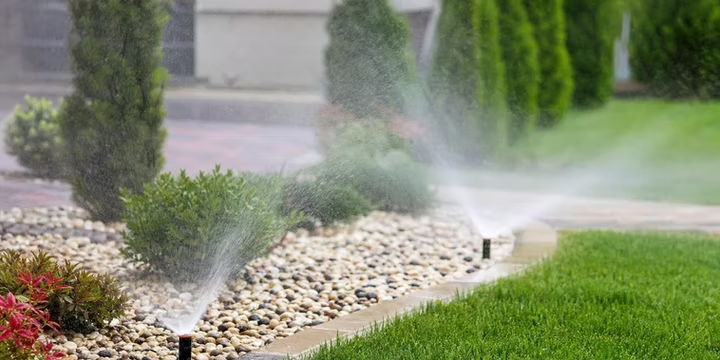
TL;DR: Next generation sprinkler technology refers to the combination of smart controllers, weather-based scheduling, sensors, flow monitoring, pressure regulation, and efficient nozzles that replace basic clock-based sprinkler timers. It is a system-level upgrade, not a single gadget. EPA estimates that switching to a WaterSense labeled weather-based controller can save an average home nearly 7,600 gallons per year. In Lubbock and West Texas, the most valuable upgrades respect local watering restrictions, reduce wind-driven misting, program cycle-and-soak watering, and detect leaks before they run up the water bill.
The phrase “next generation sprinkler technology” gets used by manufacturers, contractors, and marketing teams, but what it actually means is rarely spelled out clearly. Is it a fancy Wi-Fi timer? A flow sensor? An entire new system?
The short answer: it is not one thing. Next-generation sprinkler technology is a stack of upgrades that work together to make an irrigation system water more accurately, waste less, and catch problems faster than a traditional clock-based timer. Some of those upgrades live in the controller. Others are in the ground, at the sprinkler head, or on a sensor buried in the soil.
This guide defines each piece of the next-generation sprinkler puzzle, explains what genuinely saves water, identifies what matters most in Lubbock and West Texas, and clarifies where marketing claims outrun reality.
Wondering where your current system falls on the smart spectrum? Start with a smart irrigation checklist to see which upgrades apply to your setup.
What Does Next Generation Sprinkler Technology Actually Mean?
Next generation sprinkler technology is the modern upgrade path from a clock-based sprinkler timer to an irrigation system that adjusts watering based on data, detects faults, delivers water more efficiently, and gives the homeowner or contractor remote visibility.
In practical terms, it can include any combination of:
- Smart scheduling based on weather, evapotranspiration (ET), or soil moisture
- Site sensors such as rain/freeze sensors, soil moisture probes, and on-site weather stations
- Flow monitoring to detect leaks, broken heads, and stuck valves
- Pressure-regulated heads and high-efficiency nozzles for better water delivery
- Drip irrigation for beds, trees, and areas where spray heads waste water
- Remote access through phone, tablet, or web dashboard
- Compliance programming for local watering restrictions
EPA defines weather-based irrigation controllers as systems that use local weather data and site conditions to tailor the amount, frequency, and timing of watering, rather than running a fixed clock schedule. Replacing a standard timer with one of these WaterSense labeled controllers can save an average home nearly 7,600 gallons of water per year.
An important distinction: “smart,” “Wi-Fi,” and “next generation” are not the same thing. A Wi-Fi controller that never adjusts based on weather or sensor input may still overwater exactly like a traditional timer, just with a nicer app.
Traditional Sprinkler Timer vs. Next-Generation Setup
Understanding the gap between a traditional timer and a next-generation sprinkler system explains why the upgrade path exists in the first place.
A traditional timer can water a lawn perfectly well on any given day. The problem is that it waters the same way every day, whether the soil is soaked from rain, the temperature dropped 30 degrees, or a sprinkler head snapped off underground. Next-generation irrigation technology adds the ability to adapt and report.
Core Glossary of Next-Generation Sprinkler Terms
Smart Irrigation Controller
A smart irrigation controller adjusts watering based on weather data, sensor input, or site conditions instead of running the same fixed schedule every week. The University of Florida’s IFAS Extension describes smart controllers as devices that use sensor feedback or regional weather data to modify irrigation duration or frequency, reducing watering in cooler months and increasing it during hot, dry periods.
A basic timer waters Zone 3 for 15 minutes every Tuesday and Friday no matter what. A smart controller may reduce, skip, or extend that run time depending on recent rainfall, temperature, wind, humidity, and the zone’s programmed soil and plant details.
A contractor on YouTube comparing the Rachio and Hydrawise platforms made a practical point: the important decision is what the customer wants, not what the installer prefers. Some homeowners want app simplicity. Others want deep diagnostic control. Practitioners on Reddit echo this, with one recent r/Irrigation thread summarizing a common field view: Rachio tends to suit homeowners who want a clean, simple interface, while Hydrawise draws users who want granular system control and professional-grade diagnostics.
Wi-Fi Sprinkler Controller
A Wi-Fi sprinkler controller connects to a home network so it can be accessed by phone, tablet, or web browser. It allows remote start/stop, schedule changes, and notifications. Many advanced controllers support shared access so a contractor can adjust seasonal settings without a site visit.
The confusion worth clearing up: Wi-Fi gives convenience, but it does not guarantee smart watering. A Wi-Fi controller that never receives weather data or sensor input is just a remote-controlled clock.
Practitioners on Reddit frequently make this distinction. In one r/Irrigation thread comparing smart controllers, a user said their non-negotiables were remote management while traveling and the ability to monitor water use, not just app control for its own sake. They were also skeptical of relying entirely on nearby weather stations because actual property conditions did not always match station data.
Weather-Based Irrigation Controller (WBIC)
A weather-based controller adjusts watering using weather data and programmed site conditions. It may pull forecast temperature, rainfall probability, wind speed, humidity, or historical ET data from local or virtual weather stations.
If cooler, cloudy weather lowers plant water demand, the controller reduces runtime. If rain is expected, it may skip irrigation entirely.
One real concern: weather data quality varies. Forum users and practitioners repeatedly question whether the weather station a controller selects is close enough to represent conditions at the actual property. A forum user described how nearby stations can be miles away and may receive rain the home never sees. DOE independently supports this concern, noting that the location and accuracy of weather data are vital and that microclimates may call for on-site sensors.
Evapotranspiration (ET)
Evapotranspiration is the combined water lost from soil evaporation and plant transpiration. Smart controllers use ET estimates to calculate how much water a zone has lost since its last irrigation cycle.
Hot, windy, dry days increase ET. Cooler, humid, overcast days decrease it. In Lubbock, the Texas A&M TexasET Network shows historic reference ET reaching 7.73 inches in June and 7.63 inches in July, which is why a spring watering schedule left unchanged through summer will fall badly short of actual plant water needs.
Soil Moisture Sensor (SMS)
A soil moisture sensor measures moisture in the root zone and tells the controller whether irrigation is needed. Oklahoma State Extension explains that SMS-based controllers use belowground sensors to estimate volumetric water content and can trigger or prevent irrigation when moisture crosses a user-defined threshold.
Sensor placement matters more than most homeowners realize. The same guide warns that sensors should go in a representative turf area, away from sprinkler heads, tree roots, sidewalks, and walls. A sensor buried next to a walkway will read drier than one placed in open lawn, and that mismatch will skew every watering decision the controller makes.
Rain and Freeze Sensors
A rain sensor interrupts watering during or after rainfall. A freeze sensor interrupts irrigation when temperatures drop low enough that watering could create icy surfaces or damage plants. Oklahoma State Extension notes that rain sensors alone are not considered smart technology. They act as shutoff switches, not scheduling brains.
In Lubbock, freeze sensors matter because cold snaps can arrive quickly in late fall and early spring. Sprinkler runoff on sidewalks and driveways becomes a slip hazard, and watering frozen turf does nothing useful.
Flow Sensor and Flow Meter
A flow sensor measures how much water moves through the irrigation system. It can track each zone’s normal flow rate and flag abnormalities. If Zone 4 normally uses 8 gallons per minute and suddenly uses 15, that may indicate a broken head or cracked pipe. If water flows when no zone should be running, it may signal a leak or a valve stuck open.
A critical limitation that vendors often gloss over: a flow sensor detects abnormal flow, but it cannot stop water by itself. Practitioners on Reddit emphasize that flow monitoring becomes far more valuable when a flow meter is paired with a master valve capable of suspending irrigation. Without that shutoff capability, the sensor alerts you to a problem but water keeps running until someone acts.
One user on a Florida homeowner forum described a monitored, flow-meter-equipped system where the provider received a usage spike alert and dispatched a technician the same day to replace a sprinkler head. That story illustrates the difference between owning smart hardware and having someone respond to what it detects.
Want to understand how flow data catches hidden problems? Learn how flow monitoring detects leaks in a working irrigation system.
Leak Detection Alert
A leak detection alert is a notification triggered by unexpected water flow. Hunter’s Hydrawise documentation notes that leak detection alerts require a compatible flow meter installed and configured correctly. Alerts are generated after the zone finishes watering and the system checks for residual flow.
False alarms happen. Hunter’s own support documentation warns that residual water passing through the flow meter can trigger false alerts if baselines or thresholds are not set correctly. Getting leak detection to work reliably takes proper setup, not just plugging in hardware.
Master Valve
A master valve controls water supply to the entire irrigation system. It is often the missing piece that makes flow monitoring truly useful. Think of it this way: the flow sensor is the “eyes.” The master valve is the “hand” that can actually shut things down.
Without a master valve, flow-alert systems can tell you something is wrong. With one, the controller may be able to suspend irrigation automatically and send a push notification. These are very different outcomes when a pipe bursts at 2 a.m.
Pressure-Regulated Sprinkler Body
A pressure-regulated sprinkler body controls water pressure at each individual head so the nozzle operates closer to its design pressure. High pressure causes excessive flow, misting, fogging, and uneven coverage. WaterSense labeled pressure-regulated bodies maintain consistent flow at the nozzle and improve distribution uniformity. EPA estimates these bodies can save a household operating at or above 60 psi nearly 5,600 gallons annually.
This upgrade is especially relevant where water pressure problems cause visible issues. If spray heads are misting into the wind instead of throwing larger droplets onto turf, pressure regulation may be the fix.
High-Efficiency and Rotary Nozzles
High-efficiency nozzles apply water more slowly and evenly than standard fixed spray nozzles. Multi-stream rotational nozzles, the most common type, throw multiple rotating streams at lower precipitation rates. DOE research found these nozzles reduced precipitation rates from over 2 inches per hour to about 1 inch per hour and improved uniformity by 45% compared to traditional nozzles.
One thing to understand: rotary nozzles need longer run times because they apply water more slowly. That does not mean they waste more. It means they deliver water at a rate the soil can actually absorb, reducing runoff. If you are swapping nozzles, your schedule needs to change too. A guide to replacing sprinkler nozzles covers the mechanical side of this swap.
Cycle and Soak
Cycle and soak means splitting one long watering period into several short cycles with pause time between them. Instead of running a zone for 20 straight minutes and watching water roll into the street, the system runs it for 4 minutes, pauses, then repeats.
The City of Lubbock explicitly recommends this approach: water 3 to 4 minutes per cycle, 4 to 5 times, to reduce runoff and encourage deeper root growth. Most next-generation controllers can program cycle-and-soak by zone, which means you can apply it to problem zones (slopes, clay soil, compacted turf) without affecting zones that absorb water fine.
Zone-by-Zone Programming
Zone-by-zone programming means each irrigation zone is set up according to its own plant type, soil, sun exposure, slope, and sprinkler type. Turf in full sun, shrubs in mulched beds, and drip around trees should not share the same watering schedule.
This concept matters because most water waste happens when every zone runs the same program. A system with mixed zones often needs separation so each area receives water matched to its actual needs.
Distribution Uniformity and Precipitation Rate
Distribution uniformity describes how evenly water lands across a zone. Precipitation rate is how fast a zone applies water, measured in inches per hour. These two numbers together determine whether a zone waters effectively or creates dry spots and puddles in the same pass.
Poor distribution uniformity forces the controller to overwater the wet spots just to keep the dry spots alive. No smart controller can fix this. It is a head-spacing, nozzle-selection, and pressure problem.
Head-to-Head Coverage
Head-to-head coverage means sprinkler heads are spaced so the throw from one head reaches the next head. When heads are too far apart, you get dry strips between them that no amount of extra runtime can fix. This is one of the most basic irrigation design principles, and it is the one most commonly violated in older systems.
What Actually Saves Water?
The biggest savings usually come from fixing the whole system, not installing one smart box. Here is what the evidence shows.
Weather-based scheduling can save an average home nearly 7,600 gallons per year, according to EPA. But DOE/FEMP’s review of third-party studies shows a real-world range: 15% to 40% water-use reduction, with controlled research averaging around 50% and actual home installations averaging closer to 30%. The gap exists because real homes have mismatched weather stations, wrong soil settings, ignored alerts, and sprinkler problems that controllers cannot fix.
Pressure regulation can save nearly 5,600 gallons per year for homes operating at high pressure, per EPA.
Efficient nozzles can save approximately 2,400 gallons per year by reducing misting and improving uniformity, based on EPA’s draft nozzle specifications.
Cycle-and-soak programming reduces runoff, which means more of the water you pay for actually reaches the root zone.
Flow monitoring does not save water directly, but it catches leaks, broken heads, and stuck valves that can waste thousands of gallons before anyone notices.
Fixing broken heads, clogged nozzles, and poor coverage is arguably the highest-impact upgrade of all, because no controller, sensor, or app can compensate for a system that physically delivers water unevenly.
The position worth taking: if you are choosing between a $250 smart controller and a $250 system inspection that fixes three broken heads, replaces clogged nozzles, and programs cycle-and-soak, the inspection will often save more water. The best path is doing both.
Regular inspections are what keep the whole stack working. Here is why sprinkler system maintenance matters even after upgrading to smart technology.
What Matters Most in Lubbock and West Texas
National guides about smart irrigation tend to assume moderate climates with regular rainfall. Lubbock is different.
Watering restrictions are real. The City of Lubbock limits landscape irrigation to two assigned days per week based on address, with no irrigation on Sundays. Spring and summer restrictions run April 1 through September 30. Next-generation sprinkler controllers should be programmed around these rules, not in spite of them. Practitioners on r/Lubbock have discussed enforcement letters and smart meters, showing that residents take compliance seriously and want tools that help rather than create new violations.
Summer ET is extreme. The TexasET Network shows Lubbock’s historic reference ET at 7.73 inches in June and 7.63 inches in July. A schedule that works fine in April will fall badly short by mid-June. Weather-based controllers handle this shift automatically, but only when they are connected to accurate weather data and properly configured with the right plant, soil, and zone settings.
Wind makes everything harder. Low humidity, high temperatures, and persistent wind increase evapotranspiration and scatter spray patterns. Texas A&M research confirms that these conditions amplify water loss. Pressure-regulated heads and larger-droplet rotary nozzles help because they resist wind drift better than standard high-pressure spray heads.
Cycle-and-soak is not optional here. Lubbock’s guidance recommends 3 to 4 minutes per cycle, repeated 4 to 5 times, to prevent runoff on the heavy soils common in the area. Any next-gen sprinkler controller used in this market should support zone-by-zone cycle-and-soak programming.
Trees, turf, and beds need different water. A Lubbock home with full-sun Bermuda, mulched shrub beds, and mature shade trees should not run every zone the same way. Turf may need short, frequent cycles. Shrub beds may perform better on drip. Trees often need deeper, less frequent soaking. Smart irrigation should support plant health across the whole property, which is why integrated irrigation and tree care can prevent stress that shows up as dying branches or thinning canopy.
In Lubbock, “smart” should not mean watering whenever an app wants. It should mean watering within the City’s assigned-day rules, using cycle-and-soak to reduce runoff, adjusting seasonally for high ET, and catching leaks before water runs down the street.
Common Myths About Smart Sprinkler Technology
Myth: Wi-Fi Means Smart
Wi-Fi gives remote access. Smart watering requires weather data, ET calculations, soil moisture input, flow monitoring, or another mechanism that changes irrigation behavior based on real conditions. Plenty of Wi-Fi controllers sit in garages running the same fixed schedule they were set to on installation day.
Myth: A Smart Controller Fixes Dry Spots
Dry spots are almost always caused by clogged nozzles, sinking heads, bad spacing, low pressure, or wrong nozzle selection. A smart controller adjusts timing, but it cannot change why sprinklers leave dry spots. If the system physically cannot distribute water evenly, the controller will overwater some areas trying to compensate.
Myth: Leak Detection Is Automatic With Any Smart Controller
Leak detection requires a compatible flow meter, correct configuration, baseline flow learning, and often a master valve for shutoff. A smart controller without a flow meter has no way to know whether water is flowing when it should not be.
Myth: Weather-Based Controllers Always Save Water
Savings depend on programming, weather data quality, zone settings, and system condition. DOE research shows real-world results range from 15% to 40%, and systems with poor configuration or faulty hardware may save little. A developer on LinkedIn described building a custom dashboard for a family property because the controller’s native data tracking was limited, free users had restricted history access, and there was no easy way to export usage data over time. The lesson: the technology is only as useful as the data you can see and act on.
Myth: More Technology Means Less Maintenance
Technology changes the maintenance workflow from guessing to monitoring. Heads still break. Valves fail. Wires corrode. Nozzles clog. Sensors need correct placement and occasional recalibration. A smart system catches problems faster, but someone still has to fix them.
How to Decide Which Upgrades Your System Needs
Not every system needs every piece of next-generation sprinkler technology. The right upgrades depend on the problems you are trying to solve.
For shrub beds, trees, and ground cover where spray heads waste water, adding drip irrigation to existing zones is often the most practical upgrade.
What Next-Generation Technology Cannot Fix
Every glossary page about smart irrigation talks about what these systems can do. Fewer mention what they cannot do.
- Bad head spacing. If heads are 20 feet apart but only throw 12 feet, no controller can fill the gap.
- Broken or sinking heads. A head buried under sod or cracked at the riser will not spray correctly regardless of programming.
- Clogged nozzles. Debris in a nozzle changes the spray pattern and precipitation rate in ways no schedule adjustment can correct.
- Leaking valves and wiring problems. These need physical repair, not better scheduling.
- Mixed plant types on one zone. Turf and shrubs with different water needs on the same valve will always compromise one plant type.
- Poor water pressure. A controller cannot add pressure the water supply does not have.
- Wrong soil settings. If the controller thinks the soil is sandy loam but it is heavy clay, soak time and precipitation rate assumptions are wrong.
- Weak Wi-Fi. A controller that cannot maintain a connection cannot pull weather data or send alerts.
- Bad weather station selection. A station five miles away that gets rain when your property does not will cause incorrect skip decisions.
DOE/FEMP is clear on this point: actual performance depends on site conditions, and irrigation managers should expect to fine-tune advanced controls for each specific property.
Questions to Ask Before Upgrading
Before buying any next-gen sprinkler hardware, get answers to these questions:
- Does the controller support local watering restrictions and assigned days?
- Can it run cycle-and-soak programming by individual zone?
- Does it use reliable weather data for this specific address?
- Is an on-site sensor needed because of microclimates, shade, or slope differences?
- Can the system connect to a flow meter for leak detection?
- Is there a master valve, or does one need to be added for automatic shutoff?
- Can a contractor access the system without taking over the homeowner’s account?
- What happens to scheduled watering if Wi-Fi goes down?
- Are alerts and advanced features free, or do they require a paid subscription?
- How much water-use history is stored, and can it be exported?
- Can the controller handle the current number of zones, plus any future additions?
- Are the existing heads, nozzles, and pressure already efficient enough for smart scheduling to matter?
That last question is the most important. A smart controller layered on top of a system with broken heads, high-pressure misting, and mixed zones will deliver disappointing results.
When to Call a Professional
Some next-generation upgrades are straightforward for a handy homeowner. Others require diagnosis, wiring, plumbing, and programming that go wrong fast without experience. A first-person smart irrigation review on SHG Living argued that a contractor can be excellent at installing pipes, heads, and zones but still struggle with smart-controller setup, Wi-Fi integration, and app configuration. Installer tech skill is a real differentiator.
Call a professional when:
- Zones skip, fail to turn on, or refuse to shut off
- Pressure is too low or too high across part of the system
- Heads mist, fog, or spray into streets and sidewalks
- Dry spots persist after schedule changes
- Water bills rise unexpectedly
- You want flow monitoring, leak alerts, or controller programming tied to Lubbock watering rules
- You are adding drip, adding zones, or separating plant beds onto dedicated valves
- Trees show stress that may be irrigation-related
The most effective upgrade is usually a system-level approach: controller, sensors, pressure, heads, nozzles, valves, and maintenance working together.
Considering a system upgrade or expansion? An in-ground sprinkler cost guide can help set realistic expectations before the first conversation.
Bottom Line
Next generation sprinkler technology is best understood as a smarter irrigation system, not a single smart device. The controller matters, but so do the sensors, the pressure, the heads, the nozzles, the flow monitoring, the zone design, and the person programming and maintaining it all.
The next generation of irrigation is not automation for automation’s sake. It is measured watering plus fast problem detection. In Lubbock, the best upgrades are the ones that help a system water within local restrictions, reduce runoff and misting, adjust for West Texas weather, and catch leaks before they damage the yard or waste thousands of gallons.
Frequently Asked Questions
What is next generation sprinkler technology?
Next generation sprinkler technology is the combination of smart controllers, weather-based scheduling, sensors, flow monitoring, pressure-regulated heads, efficient nozzles, and remote access that makes an irrigation system more accurate and responsive than a traditional clock-based timer. It is a system-level concept, not a single product.
Is a Wi-Fi sprinkler controller the same as a smart controller?
No. Wi-Fi means the controller can be accessed remotely through a phone or web browser. A smart controller goes further by adjusting watering based on weather data, ET, soil moisture, or other measured conditions. EPA’s definition of weather-based controllers centers on using local weather and site conditions to tailor irrigation, not just providing app access.
Does smart sprinkler technology actually save water?
It can, but results depend on the full system. EPA estimates nearly 7,600 gallons per year for an average home switching to a WaterSense labeled weather-based controller. DOE research shows real-world reductions of 15% to 40%. Systems with incorrect settings, poor hardware, or missing sensors will save less.
Can a smart sprinkler system detect leaks?
Yes, if it has a compatible flow meter installed and configured correctly. The flow meter measures water movement and flags abnormal patterns. For automatic shutoff, the system typically also needs a master valve. Without one, the alert notifies you, but water keeps flowing until someone intervenes.
What is cycle-and-soak watering?
Cycle and soak splits a long watering period into several short runs with soak time between them. Instead of 20 continuous minutes that cause runoff, the zone runs for 3 to 4 minutes, pauses, then repeats. The City of Lubbock recommends this method to reduce runoff and help water reach the root zone.
What next-gen sprinkler features matter most in Lubbock?
Weather-based scheduling, cycle-and-soak programming, pressure regulation, and efficient nozzles matter most. Lubbock’s two-day-per-week watering restrictions, high summer ET, persistent wind, and heavy soils make these features more impactful here than in milder climates. Flow monitoring is also valuable for catching leaks during high-demand summer months.
Do smart controllers fix dry spots?
No. Dry spots are usually caused by physical problems: clogged nozzles, sinking heads, poor head spacing, low pressure, or wrong nozzle type. A smart controller adjusts when and how long zones run, but it cannot fix how water leaves the sprinkler head. Those problems need a coverage audit and hardware repairs.