
TL;DR
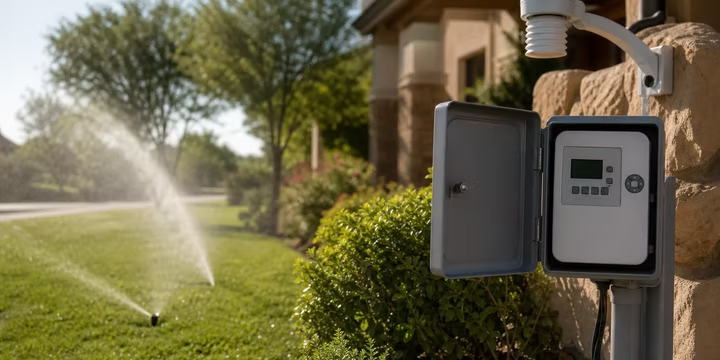
A smart irrigation system adjusts watering automatically based on weather, soil moisture, or flow data, rather than running on a fixed timer. Most Lubbock systems have at least a rain/freeze sensor (city code requires it), but that alone doesn’t make them truly smart. This guide defines every key term you need to understand smart irrigation, walks you through a self-assessment checklist, and explains why the distinction matters for your water bill and your landscape.
The question sounds simple enough: is your irrigation system smart? But the answer is rarely a clean yes or no. “Smart” isn’t a single feature you either have or don’t. It’s a spectrum of technologies that, when combined, let your sprinkler system respond to the real world instead of blindly following a clock.
Most homeowners have some piece of the puzzle. Maybe a rain sensor. Maybe a Wi-Fi controller they never fully set up. The goal of this guide is to give you the vocabulary to understand what each component does, assess where your system falls on the smart spectrum, and figure out whether an upgrade is worth pursuing.
If you’ve already noticed signs your sprinklers need repair, it’s worth addressing those issues first. No controller, no matter how intelligent, can compensate for broken heads or leaking pipes.
What Makes an Irrigation System “Smart”?
The dividing line is straightforward. A traditional irrigation controller (often called a “timer” or “clock”) runs your sprinklers on a preset schedule. It has no idea whether it rained last night, whether it’s 105°F or 40°F outside, or whether a pipe just burst in your front yard. It turns zones on at the programmed time, runs them for the programmed duration, and shuts off. That’s it.
A smart irrigation controller monitors weather conditions, soil moisture, evaporation rates, and plant water use to automatically adjust the watering schedule to match the actual conditions at your site. Instead of watering the same amount every Tuesday and Friday regardless of a thunderstorm rolling through, a smart system skips or shortens runs when water isn’t needed and extends them during heat waves.
Two core approaches exist:
- Weather-based (ET) controllers that pull temperature, wind, solar radiation, and humidity data to calculate how much water your landscape lost since the last irrigation cycle.
- Soil moisture-based controllers that use a sensor buried in the root zone to directly measure how wet or dry the ground actually is.
Both methods accomplish the same thing: they replace guesswork with data.
Quick Self-Assessment: Is Your System Smart?
Answer these questions about your current setup:
0-1 “Yes” answers: Your system is not smart. It’s running on a fixed schedule with minimal safeguards.
2-3 “Yes” answers: Partially smart. You have some sensor integration, likely rain/freeze sensors, which is the minimum Lubbock city code requires on newer installations.
4-5 “Yes” answers: Smart. Your system responds to conditions and gives you remote visibility.
6-7 “Yes” answers: Fully smart ecosystem. Your system adjusts, monitors, alerts, and protects automatically.
Core Glossary of Smart Irrigation Terms
Smart Irrigation Controller
The brain of the operation. Unlike a traditional timer that simply executes a fixed program, a smart controller continuously evaluates conditions and modifies watering schedules accordingly. It might pull weather data from the internet, receive signals from soil sensors in your yard, or both.
The practical difference is enormous. Research published in the ASCE Journal of Water Resources found that timer-controlled systems apply, on average, 47% more water than necessary. Smart controllers consistently reduce water demand by 15% among general users and more than 40% among homeowners who were previously over-watering heavily.
Practitioners on the LawnSite contractor forum have strong opinions about which brands work best. One irrigation professional noted that for systems above 16 zones, they install Hunter Hydrawise controllers, but for smaller residential setups, they recommend Rachio because “the app is much more intuitive to navigate for the homeowner.” Another contractor managing hundreds of systems called Hydrawise “the controller I now recommend to my customers, this is after hitting brick walls seeking assistance with many other brands.”
If you’re curious about getting your existing controller online, this guide on connecting your Rain Bird to Wi-Fi walks through the process for one popular model.
Evapotranspiration (ET)
Evapotranspiration is the combined water loss from two processes: evaporation from the soil surface and transpiration through plant leaves. Plants pull water from the ground and release it as vapor to cool themselves, similar to how humans sweat. ET also accounts for water consumed during photosynthesis.
Why does this matter for irrigation? Because ET tells you exactly how much water your landscape lost on any given day. If your system replaces only what was lost, you water precisely. If it ignores ET and runs the same schedule regardless, you either over-water (wasting money and promoting disease) or under-water (stressing turf and trees).
ET-based controllers use four weather parameters to calculate daily water loss: temperature, wind speed, solar radiation, and humidity. In West Texas, where summer temperatures regularly exceed 100°F and wind is constant, ET rates are among the highest in the country. That makes manual scheduling especially wasteful because conditions change dramatically from day to day.
Weather-Based Irrigation Controller (WBIC)
A WBIC is the most common type of smart controller on the residential market. It uses local weather data, either from an on-site sensor or an internet weather feed, to calculate ET and adjust your irrigation schedule accordingly.
The Oklahoma State Extension notes that over 700 ET controller models are currently available, which can create confusion during programming. The price range is broad: most residential ET controllers cost between $250 and $900, while professional-grade units run $900 to $2,500.
A key distinction worth understanding: a WBIC doesn’t just turn water off when it rains. It recalculates how long each zone should run based on what the weather actually did. A rain sensor, by contrast, only interrupts the cycle during active rainfall.
Soil Moisture Sensor (SMS)
Instead of estimating water need from weather data, a soil moisture sensor measures it directly. A probe buried in the root zone (typically 3 to 6 inches deep for turf) reads the volumetric water content of the soil. When moisture drops below a user-defined threshold, the controller opens the valves and irrigates. When the soil is wet enough, it stays off.
The appropriate threshold depends on your soil type and vegetation. According to research from Oklahoma State University, typical settings range from about 10% to 40% volumetric water content. Sandy soils drain quickly and need a lower trigger point. Clay soils (common throughout Lubbock and West Texas) hold moisture longer and need careful calibration to avoid over-saturation.
Soil moisture sensors pair well with ET controllers. The ET data handles scheduling logic while the SMS provides a ground-truth check. If the ET model says it’s time to water but the soil sensor reads “still wet,” the sensor overrides and saves the run.
Flow Sensor / Flow Meter
This is the most underrated component in a smart irrigation system, and the one most competing pages barely mention. A flow sensor measures the speed of water moving through your main irrigation line in real time and converts that speed into gallons per minute.
The sensor feeds data to your smart controller, which compares actual flow to expected flow based on programmed zone settings. If flow is higher than expected, it likely means a broken pipe or stuck valve. If flow is lower than expected, there may be a clog or a closed valve. In either case, the controller can automatically shut the master valve to prevent damage.
One Hydrawise user shared a compelling example: while traveling overseas, they received an automated alert that their front garden zone was using far more water than normal. They checked the flow chart through the app, confirmed the anomaly, and called a local installer who found and fixed a leaking pipe connector the same day. Without flow monitoring, that leak could have wasted thousands of gallons before anyone noticed.
Flow sensors are especially valuable in Lubbock, where undetected leaks can run up massive water bills. For more on finding hidden leaks, see this guide on how to detect sprinkler leaks or learn about sonic leak detection methods.
Rain and Freeze Sensor
The simplest and cheapest upgrade you can make. A rain sensor interrupts the irrigation cycle when it detects enough rainfall (usually set to 1/4 inch or more). A freeze sensor interrupts irrigation when air temperatures drop below a set point, typically 32°F to 35°F.
Lubbock city code actually requires both on newer installations: the irrigation system must include a freeze sensor that renders irrigation inoperative at 35°F or higher and rain sensors set to shut the system down at 1/4 inch of moisture or more.
A rain sensor alone saves roughly 10% of your water usage, according to irrigation professional Bruce Hage. That’s meaningful, but it’s important to understand the limitation. A rain sensor only turns water off when it rains enough. It doesn’t adjust run times based on temperature, wind, or humidity. That’s the gap a full smart controller fills.
Rain and freeze sensors are not considered “smart” technology on their own. They’re reactive safety devices. But they’re a critical foundation, and if your system doesn’t have them, that’s the first upgrade to make. For related winter protection, learn how to protect your system from freezing.
Predictive Watering
A step beyond basic weather adjustment. Predictive watering, found in controllers like Hunter’s Hydrawise platform, doesn’t just react to current conditions. It looks ahead at forecast data, including rainfall probability, temperature trends, wind, and humidity, and adjusts the upcoming schedule accordingly.
If there’s an 80% chance of rain tomorrow, the controller may skip tonight’s cycle entirely. If a heat wave is forecast, it may front-load water before the hottest days arrive. According to a hands-on review by Tech Home USA, most Hydrawise users see a 20-30% reduction in water usage from predictive watering alone, primarily by skipping unnecessary cycles.
Cycle and Soak
Cycle and soak means dividing a zone’s total irrigation time into multiple shorter runs separated by soak periods. Instead of running a rotor zone for 30 continuous minutes (where much of the water runs off before soaking in), the controller might run it for 10 minutes, pause for an hour, then run another 10 minutes.
This matters a lot in West Texas. Texas homeowners on the TexAgs forum discuss this regularly. One homeowner explained their approach for clay soil: “In general what works for me on rotors is about 10-15 minutes then another 10 minutes 2 hours later.” That rotation allows water to penetrate clay rather than pooling on the surface or running into the street.
Smart controllers automate cycle-and-soak. Traditional timers can technically do it, but only through cumbersome manual programming with multiple start times. Most homeowners never bother, which means most timer-controlled systems are creating runoff on every cycle, especially on slopes or heavy clay.
WaterSense Label (EPA)
WaterSense is an EPA certification program for water-efficient products. For irrigation controllers, WaterSense labels two categories: weather-based controllers that use local weather and landscape conditions to tailor schedules, and soil moisture-based controllers that monitor ground moisture to prevent unnecessary irrigation.
A WaterSense-labeled controller has been independently tested and certified to reduce water use compared to standard timers. The EPA estimates that replacing a clock-based controller with a WaterSense-labeled model can save an average home up to 15,000 gallons of water annually. Scaled nationally, if every U.S. home with an in-ground system made the switch, the savings would reach 390 billion gallons and $4.5 billion in water costs per year.
Wi-Fi and App-Based Control
Remote access through a smartphone app is the feature most homeowners associate with “smart” irrigation, even though it’s really just the interface layer. Wi-Fi connectivity lets you start or stop zones, adjust schedules, review water usage history, and receive alerts from anywhere.
The real value shows up in situations like the overseas traveler who caught a leak through their Hydrawise app. Without remote access, that problem would have run unchecked for weeks.
Homeowners on the DoItYourself forum sometimes ask whether smart controllers are as reliable as traditional “dumb” timers. It’s a fair question. One practical solution some have discovered: buying a Hydrawise Wi-Fi faceplate (HPC-FP) to upgrade an existing Hunter Pro-C, “which turns the Pro-C into a Hydrawise controller, super simple to install, and half the price” of a full replacement.
Pressure Regulation
High water pressure causes sprinkler heads to mist instead of producing defined streams, which wastes water to wind and evaporation. Pressure-regulated heads and bodies maintain a consistent PSI at the nozzle regardless of what’s happening upstream.
This is often overlooked in smart irrigation discussions, but it matters. A smart controller can calculate the perfect runtime, but if half the water is blowing away as mist due to excessive pressure, the intelligence is wasted. For more on diagnosing and fixing these issues, see this guide on water pressure problems in sprinkler systems.
Smart Irrigation by the Numbers
The water savings from smart irrigation are well-documented across multiple sources:
The actual number you’ll see depends heavily on how badly your current system was over-watering. Homeowners who were running fixed schedules through 100°F summers and 40°F fall nights on the same runtime settings tend to see the biggest savings. Those who were already manually adjusting their timers seasonally will see smaller (but still meaningful) reductions.
Why Smart Irrigation Matters in Lubbock
Lubbock enforces year-round irrigation restrictions that make smart technology especially valuable.
Watering windows are tight. From April 1 through September 30, irrigation is only allowed from midnight to 10 a.m. and from 6 p.m. to midnight. Watering days are assigned based on the last digit of your street address, and you only get two days per week. No watering on Sundays, ever. No watering during rain.
The weekly limit is specific. Residents are asked to keep watering to no more than 1.5 inches per zone per week.
City code mandates sensors on newer systems. Installations must include freeze sensors (set to shut down at 35°F or above) and rain sensors (set at 1/4 inch). These are the minimum. They don’t make your system smart, but they do get it past “completely dumb.”
A traditional timer has zero awareness of any of these constraints. It doesn’t know what time it is relative to the allowed window. It doesn’t know it rained. It doesn’t know the temperature dropped below freezing. A smart controller handles all of this automatically, and a flow sensor catches leaks that would waste water and potentially violate runoff rules.
West Texas heat, wind, and extreme daily ET fluctuations make manual scheduling particularly wasteful. A day that’s 102°F with 25 mph winds has a completely different water requirement than a 78°F calm day the following week. Smart controllers recalculate for every cycle. Timers don’t.
If you’re preparing for the season, the spring sprinkler startup checklist covers what to inspect before your system runs its first cycle.
Smart watering also matters for plant health beyond turf. Coordinating irrigation with tree health and deep-root feeding prevents the overwatering stress that contributes to root rot and fungal problems, a connection that irrigation-only companies rarely consider.
The Spectrum: From “Dumb” to Fully Smart
Think of smart irrigation as four tiers rather than an on/off switch.
Tier 1: Basic Timer (Not Smart)
A standard clock-based controller with no sensors. Runs the same program regardless of weather, season, or system failures. This is the setup that applies 47% more water than necessary on average. If your controller has a dial, a few buttons, and no antenna or Wi-Fi icon, you’re here.
Tier 2: Timer + Rain/Freeze Sensor (Partially Smart)
This is the Lubbock city code minimum for systems installed after the ordinance took effect. The timer still runs on a fixed schedule, but rain and freeze sensors can interrupt cycles during precipitation or cold snaps. Better than nothing, but the system still can’t adjust runtimes for heat, wind, or seasonal change.
A venue owner on a well described even basic sensor savings: “It makes a HUGE difference during drought, when I can cut back the water for the yard and keep water for my guests that day.”
Tier 3: Wi-Fi ET Controller + Rain Sensor (Smart)
Now we’re talking. The controller pulls weather data (either from the internet or an on-site station), calculates ET, and adjusts runtimes automatically. You can monitor and adjust from your phone. Rain and freeze sensors provide backup interrupts. This is where most homeowners land when they upgrade to a Hydrawise, Rachio, or similar platform.
Water savings at this tier typically fall in the 20-30% range compared to a fixed timer.
Tier 4: ET Controller + Flow Sensor + App Alerts + Cycle/Soak + Pressure Regulation (Fully Smart Ecosystem)
Everything in Tier 3, plus:
- Flow monitoring that detects leaks and breaks in real time
- Automatic master valve shutoff when anomalies are detected
- Zone-specific cycle-and-soak programming for clay soils
- Pressure-regulated heads that prevent misting and wind loss
- Efficient nozzles matched to zone geometry
- Automated alerts so you know about problems before they become expensive
This is where a smart system stops being just a controller upgrade and becomes a complete ecosystem. Most homeowners don’t reach this tier on their own because it requires professional assessment of the physical system, proper sensor placement, and controller programming tailored to the specific site.
A smart controller without working hardware is still effectively dumb. Practitioners on Reddit’s r/Irrigation community make this point clearly: if heads are broken, pipes are leaking, or coverage gaps exist, no amount of software intelligence can fix those physical problems. The hardware assessment comes first. The smart technology amplifies a well-functioning system. It can’t rescue a broken one.
→ Get a professional sprinkler assessment in Lubbock
Making Your System Smarter: Next Steps
Not everyone needs to jump straight to Tier 4. Here’s a practical progression.
Quick wins (under $200, often DIY):
- Install a wireless rain/freeze sensor if you don’t have one. It’s the cheapest meaningful upgrade and brings you into Lubbock code compliance.
- Program seasonal adjust percentages on your existing timer (even dumb controllers usually have this feature). Reduce runtimes 20-30% in spring and fall compared to summer.
Mid-level upgrade ($250 to $900):
- Replace your timer with a Wi-Fi-enabled ET controller. Rachio and Hunter Hydrawise are the two most popular residential options. If you have an existing Hunter Pro-C, the Hydrawise Wi-Fi faceplate can convert it for roughly half the cost of a full replacement.
- Set up the app, connect to your home Wi-Fi, and configure zone types (rotors vs. sprays), soil type (clay, loam, sand), and sun exposure. The controller uses this information alongside weather data to calculate runtimes.
Full smart ecosystem (professional installation recommended):
- Add a flow sensor to your mainline for leak detection and usage tracking.
- Install pressure-regulated bodies and matched-precipitation nozzles across all zones.
- Program zone-specific cycle-and-soak schedules based on soil infiltration rates.
- Set up push notifications for flow anomalies, skipped cycles, and system errors.
The full upgrade requires someone who understands both the physical system (pipe sizing, head layout, pressure dynamics) and the digital ecosystem (controller programming, sensor calibration, app configuration). If you want to add zones to your system as part of the upgrade, that’s a natural time to bring a professional in.
→ Schedule a smart irrigation upgrade consultation
Frequently Asked Questions
What’s the difference between a rain sensor and a smart controller?
A rain sensor only turns your system off when it detects enough rainfall (typically 1/4 inch). Once the sensor dries out, the timer resumes its normal fixed schedule. A smart controller goes much further: it adjusts every runtime based on weather data, skips cycles proactively when rain is forecast, and recalculates watering needs daily. A rain sensor is a safety interrupt. A smart controller is active management.
How much money will a smart controller actually save me?
It depends on how much you were over-watering before. EPA estimates up to 15,000 gallons per year for an average home. Research studies show 20-50% water savings. In Lubbock, where summer water bills can be substantial, a $300 to $500 controller often pays for itself within one to two irrigation seasons.
Can I make my existing controller smart without replacing it?
Sometimes. If you have a Hunter Pro-C, you can buy the Hydrawise Wi-Fi faceplate (HPC-FP) and convert it. Rain Bird’s ESP-ME series accepts a Wi-Fi module (LNK2). For other brands, a full controller replacement is usually necessary. Adding a rain/freeze sensor to any controller is always possible and improves intelligence, even on a basic timer.
Do smart controllers work during Lubbock’s watering restrictions?
Yes, and they excel at it. You program your allowed watering days and time windows into the controller, and it optimizes runtimes within those constraints. If weather data suggests your lawn needs less water than the maximum allowed, the controller shortens or skips runs automatically. A timer just runs the full programmed time every allowed day regardless of need.
What is a flow sensor and do I really need one?
A flow sensor measures the volume of water moving through your main irrigation line in real time. It detects leaks (higher-than-expected flow) and clogs (lower-than-expected flow) and can trigger automatic shutoff. You don’t strictly “need” one, but a single prevented leak event can save thousands of gallons and hundreds of dollars. It’s the most underrated smart irrigation component.
Is your irrigation system smart if it only has Wi-Fi?
Not necessarily. Wi-Fi gives you remote access to start/stop zones and change schedules from your phone, which is convenient. But if the controller still runs on a fixed schedule without adjusting for weather or soil data, it’s just a remotely accessible timer. True smart irrigation requires the controller to make decisions based on real-time conditions, not just let you make decisions from your couch.
How does cycle-and-soak help with Lubbock’s clay soil?
Clay absorbs water slowly. If you run a zone for 20+ continuous minutes, water pools on the surface and runs off before it penetrates the root zone. Cycle-and-soak breaks that into shorter runs (say, 8 minutes) with soak periods in between (30 to 60 minutes), giving clay time to absorb each application. Smart controllers automate this entirely. Traditional timers require tedious multi-start-time programming that most homeowners skip.
Should I fix my existing system before upgrading to a smart controller?
Absolutely. A smart controller optimizes water delivery, but it can’t fix broken heads, leaking valves, or poor coverage. If your system has physical problems, address those first. Once the hardware is sound, a smart controller upgrade amplifies every improvement. Think of it this way: the controller is the brain, but it needs a healthy body to work with.