TL;DR
Hazardous tree unions are weak branch connections, often V-shaped with bark trapped inside, that can split apart during storms or under the tree’s own weight. Recognizing hazardous tree unions and mitigation starts with understanding a few key terms: included bark, codominant stems, and aspect ratio. Mitigation follows a clear escalation from structural pruning on young trees to cabling, bracing, and (when necessary) removal on mature ones. In West Texas, where sustained winds put extraordinary pressure on these weak points, early identification and professional assessment are especially important.
Why the Way Your Tree Forks Matters
Most homeowners walk past their trees every day without looking up. That changes after a storm drops a 600-pound limb on the driveway. When arborists investigate these failures, they almost always trace the break back to a single structural feature: the branch union.
Understanding the vocabulary around branch unions, and knowing what to look for, puts you in a position to catch problems before gravity does. This guide walks through the anatomy of tree unions, explains what makes some of them dangerous, and lays out a clear progression of mitigation options from least invasive to most.
If you’re unsure whether a fork in your tree warrants professional evaluation, a certified arborist can assess it and recommend the right course of action.
Anatomy of a Branch Union
Before you can spot a problem, you need to understand what a healthy connection looks like. Three terms form the foundation.
Branch Union (Crotch)
A branch union is simply the point where a branch meets another branch or the trunk of a tree. Think of it as a joint. The strength of that joint determines whether the branch stays attached through decades of wind, ice, and growth, or splits off during the next thunderstorm. Practitioners describe the branch union as the single most important factor in a tree’s structural integrity.
Branch Collar
The branch collar is the slightly swollen ring of tissue where a branch connects to the trunk. It forms when the annual growth rings of the trunk overlap the annual growth rings of the branch, similar to shuffling a deck of cards. A well-developed collar means the tree has built a strong, interlocking connection.
Here’s the critical threshold: for a proper branch collar to develop, the branch must be less than half the diameter of the trunk at the point of attachment. Colorado State Extension notes that less than one-third is preferred. When a branch grows too large relative to its trunk, the collar can’t form properly, and the attachment weakens.
This ratio has a name.
Aspect Ratio
Aspect ratio is the diameter of a branch divided by the diameter of the trunk, both measured just above the union. A branch that is 3 inches across attached to a trunk that is 10 inches across has an aspect ratio of 30%, which is excellent. A branch that is 7 inches across on that same 10-inch trunk has an aspect ratio of 70%, which is a problem.
Research from the Morton Arboretum confirmed that large aspect ratios decreased breaking stress in the species they tested. The practical rule of thumb for homeowners: if a branch looks nearly as thick as the trunk it’s attached to, that union deserves closer inspection.
The industry target is aspect ratios of 50% or less on permanent branch selections.
Branch Bark Ridge
The branch bark ridge is a line of raised bark that forms at the top of a union where two stems or branches meet. In a healthy connection, specialized wood grows underneath this ridge. That wood limits the movement of disease and water between branches, acting as a natural firewall.
When the union angle is too narrow, there isn’t enough space for this ridge to develop. The bark ridge that does form gets overgrown by branch wood, resulting in a structurally weak connection.
What Makes a Union Hazardous
Recognizing hazardous tree unions and mitigation options requires distinguishing between two very different shapes.
Strong Union (U-Shaped)
A U-shaped union forms when a branch connects at a wide angle to the trunk. The wide opening allows the branch collar and branch bark ridge to develop fully. There’s no bark trapped between the stems. You’ll see a smooth, open curve at the attachment point with no seam or evidence of separation below the junction. Trees with U-shaped unions handle wind and weight well.
Weak Union (V-Shaped)
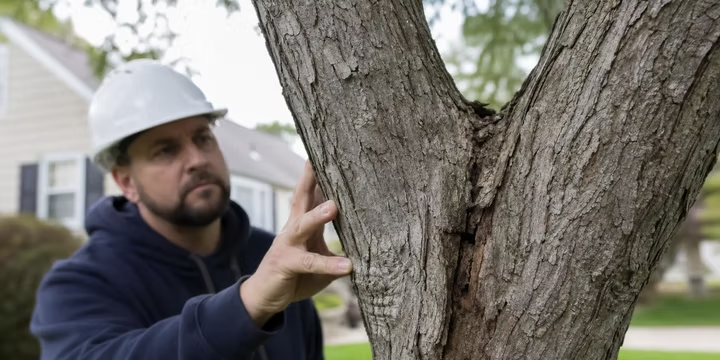
A V-shaped union is the opposite. Two similarly sized stems grow so closely together that bark grows between them inside the union. According to USDA Forest Service guidance, this ingrown bark doesn’t have the structural strength of wood, making the union much weaker than one without included bark.
The included bark can act as a wedge, forcing the union apart over time. The more the tree grows, the deeper that V gets, and the weaker the junction becomes.
Included Bark (Bark Inclusion)
Included bark is the defining feature of a hazardous union. Instead of interlocking wood fibers connecting two stems, you get bark sandwiched between them. The two limbs are literally pushing against each other as they grow rather than growing together.
You can often spot included bark from the ground by looking for these signs:
- Narrow branch angles. Branches joining the trunk at very sharp, tight angles.
- Visible bark in the union. Bark wedged between two branches instead of smooth wood.
- Cracks or splits. Cracks starting at the union, especially ones that follow the line of the bark inclusion.
- Bulging. Swelling around where the two sides meet, sometimes with a visible seam or crack running below the contact point.
Understanding how tree diseases compound structural weakness helps when evaluating the overall risk a weak union presents.
Codominant Stems (Codominant Leaders)
Codominant stems are two or more stems growing from the same point that are roughly equal in size. They form a V-shaped junction, and because neither stem is clearly subordinate, neither develops a proper branch collar. Tree care professionals consistently identify the junction between codominant stems as the weakest portion of an otherwise healthy tree.
The tight angle prevents proper bark integration, leading to included bark. This makes codominant leaders especially susceptible to failure under wind, snow, or the tree’s own weight.
Species Prone to Weak Unions
Some species are genetically inclined to produce codominant stems and included bark. The USDA Forest Service specifically calls out elms and maples as trees with a tendency to form upright branches that often produce weak branch unions. Bradford pears and silver maples are notorious.
In Lubbock and across West Texas, Siberian and Chinese elms are everywhere, and they are some of the worst offenders for codominant stem formation. Red oaks and Chinese pistache also appear frequently in local landscapes with union concerns.
How Topping Creates Hazardous Unions
Topping, the practice of cutting a main stem or large branch at a right angle, directly creates the conditions for future weak unions. The regrowth that sprouts from a topped limb consists of multiple shoots competing for dominance. These shoots attach only to the outer layers of the stub rather than forming the deep, interlocking wood grain of a natural branch union.
Topping remains common among unlicensed operators. Every topped tree is a future candidate for codominant stem failure.
How Weak Unions Fail
Understanding failure mechanics helps you gauge urgency when you spot a hazardous union.
Stress Concentration at the V
Wind, ice accumulation, and the increasing weight of the canopy all generate forces that concentrate at the narrowest point of a V-shaped union. Because included bark can’t resist tension the way interlocking wood fibers can, the union opens like a hinge. In a healthy U-shaped union, forces distribute across the overlapping growth rings of the branch collar. In a V-shaped union, there’s nothing to distribute.
After an Ontario storm, a professional arborist noted that most of the tree damage he observed came from weak branch connections splitting off in the wind. Strong gusts rip at the exact point where included bark provides no resistance.
The “No Target, No Hazard” Principle
A tree is only considered hazardous if it poses a risk to people or property. A tree with a weak union in the back of a vacant lot is a different calculation than one overhanging your roof. Arborists call this the “target zone,” and it’s central to formal tree risk assessment.
Ice loading from winter freeze events can dramatically increase the weight on already compromised unions, turning a manageable risk into an urgent one overnight.
Compartmentalization: Why Trees Don’t Heal
Trees don’t heal damaged tissue the way animals do. They practice compartmentalization (sometimes called CODIT): they wall off injury to protect the rest of the organism. This means a cracked or partially failed union will never knit back together. The tree can only isolate the damage and keep growing around it.
This is why waiting to see if a cracked union “gets better” is a mistake. It won’t. It can only get worse or stay the same while the tree walls off the wound. Diagnostic tools like plant tissue testing can help determine whether a tree’s overall health supports recovery after corrective work.
The Mitigation Escalation Ladder
This is where recognizing hazardous tree unions and mitigation converges into practical action. No other guide presents these options as a clear escalation. Each level is more invasive than the last, and a qualified arborist should determine where on this ladder a particular tree belongs.
Level 1: Structural Pruning (Young Trees)
Structural pruning of young trees is by far the best option for reducing or eliminating included bark and weak branch unions before they become dangerous. A professional catches codominant branches forming early and prunes one of them out over time, letting a single leader establish dominance.
The key phrase from practitioners: the best time to address a codominant branch is when it’s small. If you wait too long and it grows to a large size, removal may create a wound that causes an overall health decline. Young tree pruning every 3 to 5 years is an investment that pays for itself many times over.
The primary objectives in training young trees are developing strong branch unions and eliminating structurally weak codominant trunks.
Level 2: Crown Reduction Pruning (Mature Trees)
For mature trees where structural pruning windows have passed, crown reduction is the next step. This involves the systematic removal of select branches to reduce forces on the stems and unions, balancing the crown and reducing the load on weak points.
Crown reduction doesn’t eliminate the hazardous union. It reduces the stress on it, buying time and making it feasible to install support systems. Reduction pruning is recommended before supplemental support is installed.
Level 3: Cabling
Cabling involves installing flexible steel cables in the upper canopy to connect weak or heavy limbs and limit their movement during wind events. Cables are installed high in the tree, at a minimum two-thirds of the distance from the defect to the crown.
V-shaped unions create weakness by allowing excessive flexing. Cables restrict that range of motion, reducing the chance the union opens under load.
ANSI A300 Part 3, the tree care industry standard maintained by the Tree Care Industry Association and used as final authority in US civil courts, defines four cabling configurations:
- Direct cabling. A single cable between two tree parts.
- Triangular cabling. Connecting tree parts in combinations of three; preferred when maximum support is required.
- Box cabling. Connecting four or more tree parts in a closed series; used only when minimal direct support is needed.
- Hub and spoke. A center attachment with cable spans radiating to three or more leaders.
Level 4: Bracing (Through-Rod)
Bracing uses threaded steel rods installed directly through split trunks, cracked unions, or severely compromised crotches. The rods hold the separated sections together and prevent further opening.
An arborist in Roanoke, Texas documented a fractured pecan with codominant stems and included bark where through-rod bracing was installed using recognized best management practices. His key insight: “The important concept is that the treatment begins with an objective. We’re not installing hardware simply because the tree has two trunks.”
The word “supplemental” matters here. Hardware does not replace the tree’s natural structural system. It assists it.
Supporting tree health through deep root fertilization after cabling or bracing helps the tree recover from the stress of both the defect and the intervention.
Level 5: Removal
When decay has compromised the union beyond what support systems can mitigate, or when the defect is simply too severe, removal is the only safe option. A tree with all its foliage at the top and a major wound at a union will develop extensive trunk decay that no cable or rod can arrest.
No cable, brace rod, pruning treatment, or other arboricultural procedure can guarantee that a tree or branch will never fail. The objective across every level of this ladder is risk mitigation, not risk elimination.
If removal becomes the right call, understanding safe tree removal methods and stump treatment options helps you plan the process from start to finish.
Annual Inspections After Mitigation
Any tree that has received cabling, bracing, or significant structural pruning needs regular follow-up. Inspections should be carried out at least every year, or after severe weather events, to assess the condition of hardware and evaluate the tree’s overall health trajectory.
A maintenance plan that includes annual tree inspections keeps these checks from falling through the cracks.
The West Texas Factor
Recognizing hazardous tree unions and mitigation is important everywhere, but West Texas conditions make it urgent.
Wind Loading
Lubbock and the surrounding region experience sustained winds that most other parts of the country only see during storms. A weak union that might survive 20 years in a sheltered eastern city could fail in 5 years here simply because the constant wind loading opens the V a little more each season.
Soil and Water Interactions
West Texas soils are alkaline and often compacted. Overwatering (a common problem with poorly programmed irrigation systems) saturates the root zone, weakening root anchorage. A tree with compromised roots and a weak union faces a double threat. Understanding how irrigation and tree care work together is essential for managing this interaction, and soil testing through Texas A&M can identify specific soil health concerns that affect tree stability.
Local Species Concerns
Siberian and Chinese elms dominate Lubbock landscapes and are among the species most prone to codominant stem formation. Red oaks and Chinese pistache are also common and frequently develop included bark at major unions. These aren’t theoretical risks. They’re the trees in your yard.
The Cost of Doing Nothing
No competing guide quantifies what happens when a hazardous union fails, but homeowners should think about it concretely. A codominant stem failure on a mature elm can drop several thousand pounds of wood. If that wood lands on a roof, a car, a fence, or a person, you’re dealing with costs that dwarf what structural pruning or cabling would have run. Insurance may cover storm damage, but it won’t cover the tree work you deferred.
The earlier you intervene on this escalation ladder, the less it costs and the more options you have.
Frequently Asked Questions
How can I tell if my tree has a weak union from the ground?
Look for a tight V-shape where two stems meet, visible bark trapped between them, bulging at the junction, and any crack or seam running below the contact point. If the two stems are roughly equal in diameter, that’s a codominant situation that warrants closer evaluation.
Are V-shaped unions always dangerous?
Not always, but they are always weaker than U-shaped unions. The risk depends on the size of the stems, the presence of included bark, the species, the tree’s exposure to wind, and whether there are targets (people, structures) in the fall zone. An ISA Certified Arborist can assess the specific risk.
Can a weak union be fixed without removing the tree?
Often yes. Structural pruning on young trees can eliminate the problem entirely. On mature trees, crown reduction combined with cabling or bracing can significantly reduce the risk of failure. Removal is only necessary when decay or structural compromise is too advanced for support systems to help.
What is the best age to start structural pruning?
The earlier the better. Trees should be evaluated within the first few years after planting and then every 3 to 5 years through maturity. Early intervention keeps codominant stems from ever becoming a problem.
How often should cabling and bracing systems be inspected?
At minimum, once per year. After any severe weather event (high winds, ice storms, heavy snow), an additional inspection is warranted. Hardware can loosen, cables can stretch, and the tree itself changes shape as it grows.
Why are elms so prone to weak unions?
Elms naturally produce upright, closely spaced branches. This growth habit creates narrow V-angles and included bark at a much higher rate than species with wider branching angles. The Siberian and Chinese elms common in West Texas are among the worst offenders.
Does topping a tree make union problems worse?
Yes, significantly. Topping removes the natural leader and triggers multiple sprouts that compete for dominance. These sprouts attach only to the outer wood of the stub, creating unions with very poor structural integrity. Topping is one of the most direct causes of future hazardous unions.
What standard governs tree cabling and bracing in the United States?
ANSI A300 Part 3 covers supplemental support systems including cabling, bracing, and guying. These standards, maintained by the Tree Care Industry Association, are used as the final authority in US civil court proceedings related to tree care.
M&M Sprinkler and Tree Services has an ISA Certified Arborist (TX-4745A) on staff who evaluates tree unions and recommends the appropriate mitigation level based on these industry standards. If you’ve spotted a V-shaped fork, a crack at a union, or codominant stems on a tree near your home in Lubbock or the surrounding West Texas communities, a professional assessment is the right next step. Call (806) 794-1300 or visit mmsprinklerslbk.com to schedule an evaluation.