TL;DR
An irrigation retrofit upgrades specific components of your existing system (controller, heads, nozzles, valves, backflow) while keeping viable underground pipes in place. Costs range from $500 to $1,500 for minor updates, $1,500 to $4,000 for moderate upgrades, and $4,000 to $10,000+ for major overhauls on older, non-compliant systems. Knowing the right terms and cost ranges before you talk to a contractor puts you in a much stronger negotiating position, especially in Lubbock and West Texas where water restrictions and tiered pricing make every wasted gallon expensive.
Getting a handle on what an irrigation retrofit actually costs starts with knowing what you’re talking about. Not in a condescending way, but literally: the terms contractors use, the components they’re quoting, and the thresholds that separate a smart upgrade from a money pit.
Most homeowners with aging sprinkler systems face the same confusion. You know something is wrong (dry spots, zones that won’t turn on, a water bill that keeps climbing), but you’re not sure whether you need a $300 fix or a $7,000 project. The vocabulary gap between you and your contractor makes that uncertainty worse.
This guide breaks down every term you’ll encounter when estimating irrigation retrofit costs for older systems, pairs each one with real cost data, and gives you a framework for deciding what your system actually needs.
For Lubbock homeowners especially, the stakes are high. With mandatory two-day-per-week irrigation restrictions and an inclining block water rate structure that punishes overuse, an inefficient system costs more here than in most cities. Roughly 50% of summer water demand goes to irrigation, so fixing what’s broken isn’t optional.
Need to know where your system stands right now? A professional inspection is the best starting point. Learn more about scheduling a system checkup.
What Is an Irrigation Retrofit?
Irrigation Retrofit
Upgrading or replacing specific components of an existing irrigation system while keeping viable infrastructure (pipes, trenching, some wiring) in place.
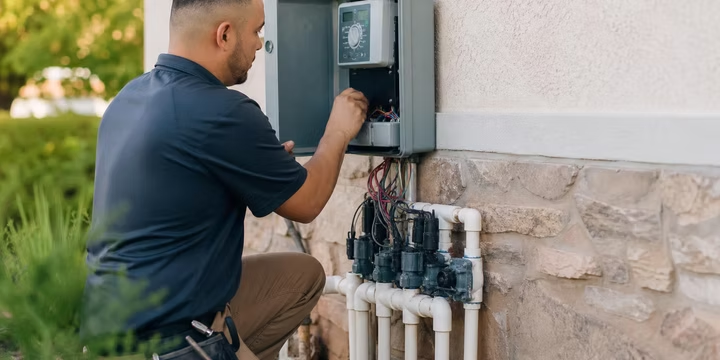
This is the most important distinction in the entire estimating process. A retrofit means you’re not starting from scratch. You can swap an old controller for a Wi-Fi weather-based unit, replace underperforming heads, add pressure regulation, convert some zones to drip irrigation, and bring your backflow preventer up to code, all without ripping out the underground pipe network that cost thousands to install originally.
The typical retrofit involves three layers: the control layer (controller, sensors), the delivery layer (heads, nozzles, valves), and the protection layer (backflow, pressure regulation). Your buried PVC lateral pipes and mainline usually stay put.
Cost tiers for a retrofit:
Full System Replacement
Tearing out all existing infrastructure and installing new pipe, valves, wiring, heads, controller, and backflow from scratch.
For a 5,000-square-foot yard, full replacement typically runs $2,750 to $8,750. That’s a big number, and it’s why estimating irrigation retrofit costs for older systems matters so much. If you can keep your underground pipes and focus spending on the components that actually fail, you save thousands.
The Key Question: When Does a Retrofit Stop Making Sense?
A useful rule of thumb: if the cost of repairs exceeds 50% of the cost of a new system, replacement starts looking smarter. This “50% rule” gives you a clear decision point. But it requires getting accurate estimates for both paths, which means understanding the components below.
Key Terms for Understanding Retrofit Scope
Code Compliance Upgrade
Bringing an older system up to current local plumbing and irrigation codes. In Lubbock, this often means installing or replacing a backflow preventer, adding a rain/freeze sensor, and ensuring pressure regulation meets manufacturer specs. Minor code compliance work runs $500 to $1,500. More involved projects with multiple violations push into the $1,500 to $4,000 range.
If your system predates the mid-1990s, there’s a good chance it doesn’t meet current backflow requirements. Code compliance isn’t just bureaucratic; a missing or failed backflow preventer can contaminate your drinking water. Learn what a backflow preventer does and why Lubbock takes it seriously.
System Audit (Checkup)
A professional walkthrough where a technician runs each zone (either through the controller or manually at the valve), checks for leaks, evaluates coverage patterns, tests backflow, and documents what needs attention. This is the single best investment before committing to a retrofit because it tells you exactly which components are still working and which aren’t.
Think of the audit as your cost estimate’s foundation. Without it, you’re guessing, and guessing on old systems is expensive.
Adding Zones
Sometimes an audit reveals that existing zones cover too much area or mix plant types that need different watering schedules. Adding zones to an existing system is a common part of retrofit projects, especially when converting beds to drip irrigation or correcting original design flaws.
Component Cost Terms
These are the individual line items you’ll see on a retrofit estimate. Understanding each one helps you evaluate whether a bid is reasonable.
Smart Controller Upgrade
Replacing an old mechanical or basic digital timer with a Wi-Fi and weather-based controller that adjusts watering schedules automatically.
This is often the first upgrade contractors recommend because it’s the highest-impact, lowest-disruption change you can make. A smart controller can reduce watering based on real-time weather data, enforce cycle-and-soak schedules to prevent runoff, and let you manage everything from your phone.
Cost breakdown:
- Controller device only: $130 to $500
- Installed with setup and programming: $500 to $900 for straightforward systems
- Installed on a system under 15 years old with balanced zones and solid wiring: $900 to $1,500
Here’s a critical nuance that practitioners emphasize: a smart controller can only be as good as the system it’s controlling. One scenario documented by an irrigation company presented a client with two options: install just the smart controller for about $1,200, or correct the system’s hydraulic imbalance first and then install the controller for about $3,800. The client chose the more expensive option because without balanced pressure and properly matched heads, the “smart” part of the controller has nothing useful to optimize.
If you’re considering a Hunter system, here’s a guide to programming a Hunter controller that covers what the setup process looks like.
High-Efficiency Rotary Nozzles
Retrofit nozzles that replace standard fixed spray heads. Instead of a fan-shaped sheet of water, rotary nozzles deliver rotating streams of larger water droplets at a lower precipitation rate.
Why this matters for cost estimates: rotary nozzles can reduce flow by up to 60% and improve water efficiency by up to 30% compared to standard spray nozzles. They also dramatically reduce runoff and provide more uniform coverage in windy conditions, which makes them particularly valuable in West Texas where a 20 mph afternoon wind is just a Tuesday.
Cost: About $45 to $50 per head, installed. On a system with 30 spray heads across several zones, that’s $1,350 to $1,500 for a meaningful water savings that shows up on your bill immediately.
Sprinkler-to-Drip Conversion
Converting spray zones to drip irrigation for flower beds, shrub areas, or vegetable gardens. This is common in retrofit projects because many older systems use spray heads everywhere, including beds where drip would be far more efficient.
Conversion kits run $60 to $130 per zone for the parts. With professional installation, expect $150 to $450 per zone depending on bed size and complexity. For a deeper comparison of these two approaches, read about drip irrigation vs. sprinklers.
Backflow Preventer Installation or Replacement
The code-required device that prevents contaminated irrigation water from flowing backward into your home’s potable water supply. This is non-negotiable in Lubbock.
Cost ranges:
- Residential irrigation backflow preventer: $100 to $600
- Average project with parts and labor: around $350
- Complex installations: $1,000+
If your existing backflow preventer is 15+ years old, cracked, or failing its annual test, replacement will likely be part of your retrofit estimate. For Lubbock-specific pricing details, see our backflow preventer repair cost guide.
Valve and Solenoid Replacement
Zone valves control water flow to each section of your system. The solenoid is the small electromagnetic coil on top of each valve that opens and closes it when the controller sends a signal. Both degrade over time, and old solenoids are one of the most common failure points in aging systems.
Valve and solenoid replacement typically falls in the $100 to $400 range per valve, depending on accessibility and whether the valve box needs excavation. To understand how solenoids work and what failure looks like, read about what a solenoid does in your irrigation system.
Sprinkler Head Replacement
Individual head swaps run $65 to $90 each, installed. That sounds modest until you realize an older system might need 10, 15, or 20 heads replaced. At $75 per head, replacing 15 heads costs $1,125 just for that line item.
Head condition is one of the first things an audit reveals. Cracked casings, stripped gears on rotors, and nozzles clogged with calcium deposits are all common in Lubbock systems that have been running on hard water for a decade or more.
Pressure Regulation
Adding or replacing pressure regulators to protect downstream components and improve efficiency. High water pressure (common in parts of Lubbock) causes misting, premature head failure, and wasted water. Low pressure from aging supply lines creates poor coverage and dry spots.
Pressure issues can cost $50 to $500 to resolve, depending on whether the fix is a simple regulator install at the backflow or a more involved diagnosis of supply-side problems.
Rain/Freeze Sensor
A wireless sensor that shuts down irrigation during rain or freezing temperatures. In Lubbock, where a late-spring freeze can surprise you in April and summer thunderstorms dump an inch in 30 minutes, this sensor prevents both wasted water and freeze damage to your system.
Most rain/freeze sensors cost $30 to $80 for the device, with professional installation adding another $50 to $100. It’s one of the cheapest components in a retrofit, and it pays for itself quickly.
Wiring Repair
The low-voltage wire that connects your controller to each zone valve underground. In systems older than 15 years, wire insulation can become brittle, connections corrode, and splice failures cause zones to stop responding.
Electrical wiring repairs for irrigation systems typically cost $60 to $100 per repair point. But wiring problems are often the hardest to diagnose because the wire is buried, and finding the exact failure point requires specialized tracing equipment.
Cost-Driver Terms: What Makes Estimates Vary
Two identical-looking yards with similar-aged systems can produce wildly different retrofit estimates. These are the factors that push costs up or down.
System Age and Compatibility
Older sprinkler systems, particularly those with discontinued or uncommon components, require more troubleshooting time and effort to source compatible parts. A system built with Toro Super 700 heads (discontinued) takes longer to retrofit than one with current-generation Hunter or Rain Bird components.
Component lifespan benchmarks give you a rough sense of what’s likely worn out:
The general system age threshold to watch: if your sprinkler system is older than 20 to 25 years, retrofits can only carry it so far. Beyond 25 years, breakdowns become more frequent and component obsolescence makes sourcing parts progressively harder.
Scope Creep and Cascading Failures
This is the single biggest reason irrigation retrofit estimates miss the mark on older systems.
Practitioners on contractor forums describe this pattern vividly. One contractor shared a job that initially appeared to need only a new controller, a couple of valves, some pipe break repairs, and a few new emitters. But once the valves were fixed, more pipe breaks and busted emitters appeared. Old, brittle wire caused connection failures at every splice point. The contractor spent nearly three days getting the system running and was significantly underbid because, as they put it, “there are just too many unknowns.”
That honest assessment is worth taking seriously. When you fix one weak point in an old system, the increased pressure or changed flow often exposes the next weakest point. A contractor who has seen this pattern will build contingency into the estimate. A lowball bid on an old system should make you nervous, not excited.
If your system shows signs it needs repair, multiple symptoms often mean the underlying infrastructure is deteriorating broadly, not just at one point.
For systems showing signs of hidden leaks, detecting underground sprinkler leaks early can prevent cascading damage.
Pre-1990 Pipe Material Assessment
This is a critical cost threshold. When pipe material is pre-1990 PVC or galvanized steel, the cost difference between retrofit and full replacement narrows substantially. Galvanized steel corrodes from the inside, restricting flow and eventually leaking at every joint. Early PVC formulations weren’t as durable as modern Schedule 40.
The good news: under normal conditions, properly installed Schedule 40 PVC can last 50 to 75 years. Many Lubbock homes built in the 1980s and 1990s have PVC that’s still the strongest component in the system. If an audit confirms your buried pipes are solid, that’s the green light for a retrofit rather than a full tear-out.
Seasonal Timing Premiums
Spring is peak season for irrigation companies. Emergency calls during this period, or after-hours service, often carry a premium compared to routine scheduled work. If you can plan your retrofit for late fall or winter, you’ll likely get faster scheduling and potentially better pricing.
Minimum Service Charges
Most irrigation companies charge a $50 to $150 minimum per visit. If your retrofit requires multiple small repairs, bundling them into one service call saves money. This is another reason the system audit matters: it identifies everything at once so work can be batched efficiently.
Zone Count and Yard Size
More zones means more valves, more heads, more wire, and more time. A 6-zone residential system is a fundamentally different estimate than a 14-zone property. Yard size also affects drip conversion costs, since larger beds need more tubing and emitters.
Decision-Framework Terms
These terms help you evaluate whether retrofitting makes financial sense for your specific situation.
The 50% Rule
If repair and retrofit costs exceed 50% of what a brand-new system would cost, replacement becomes the better investment. For a yard where full replacement would run $6,000, that threshold is $3,000 in retrofit costs.
The key is getting multiple bids for both paths. A single estimate gives you a number. Two or three estimates give you confidence.
Payback Period
The time it takes for water and energy savings to recoup your retrofit investment. The calculation is straightforward: divide the total retrofit cost by the expected annual savings.
For example, if a $2,000 retrofit (smart controller, rotary nozzles, rain sensor) saves $40 per month on your water bill, that’s $480 per year, giving you a payback period of about 4.2 years. In Lubbock, where tiered water rates punish high usage, the savings can be even more dramatic during summer months.
Thinking about how a retrofit affects your water bill? See practical tips for reducing your Lubbock water bill through irrigation improvements.
Component Lifespan Benchmarks
Use the lifespan table above to prioritize your retrofit spending. If your heads are 12 years old and your valves are 8 years old, replacing heads first makes more sense, they’re closer to end-of-life. If everything is 18 years old, you’re looking at a more comprehensive project.
System Age Threshold (20–25 Years)
The average irrigation system lifespan is 20 to 25 years. As systems age beyond 25 years, breakdowns accelerate and parts become harder to source. A system at year 22 might be a good retrofit candidate. A system at year 30 with galvanized supply lines is probably a replacement candidate.
West Texas Considerations That Affect Retrofit Costs
Estimating irrigation retrofit costs for older systems in Lubbock isn’t the same as doing it in Dallas or Houston. Several regional factors shift the math.
Water Restrictions
Lubbock enforces a two-day-per-week irrigation schedule with a daily blackout window from 10:00 a.m. to 6:00 p.m. Residents must keep irrigation under 1.5 inches per zone per week. These restrictions mean your system has to deliver water efficiently in a narrow window. A retrofit that improves distribution uniformity (rotary nozzles, pressure regulation, zone rebalancing) isn’t just nice to have; it’s the difference between a green lawn and a brown one.
Wind and Evaporation
West Texas wind is relentless, and it destroys the performance of standard spray heads. The fine mist from fixed spray nozzles gets carried 10 feet off target on a breezy afternoon, which is most afternoons. Rotary nozzles produce heavier droplets that resist wind drift and provide uniform coverage even in gusty conditions. This single upgrade, at $45 to $50 per head installed, often has the highest return on investment for Lubbock homeowners.
Inclining Block Water Rates
Lubbock uses a tiered rate structure where the per-gallon cost increases as you use more water. During summer, when irrigation can account for half your household water use, every gallon wasted to leaks, overspray, or poor scheduling pushes you into a higher pricing tier. A retrofit that reduces consumption by 30% doesn’t just save 30% on your irrigation water, it may drop you into a lower rate tier entirely, compounding the savings.
Prevalence of 1980s–1990s Systems
Lubbock saw significant residential growth in the 1980s and 1990s. Many of those original irrigation systems are now 30 to 40 years old. The underground PVC from that era is often still functional (Schedule 40 PVC can last 50 to 75 years), but everything above ground and at the valve level is past its service life. This makes these neighborhoods prime retrofit territory: solid pipes underground, worn-out components above.
Putting It All Together: A Sample Retrofit Estimate
Here’s what a moderate retrofit might look like for a typical Lubbock home with a 20-year-old, 8-zone system:
If a full system replacement for this yard would cost $6,500, this retrofit comes in at about 47%, just under the 50% rule. That makes it a solid investment, assuming the pipe assessment confirms the underground infrastructure is sound.
For an even more complete picture of what individual repairs cost, see our sprinkler repair cost guide.
Frequently Asked Questions
How much does it cost to retrofit an old irrigation system?
Costs range widely based on scope. Minor updates (a few heads, a sensor, programming adjustments) run $500 to $1,500. Moderate upgrades addressing multiple components and code issues cost $1,500 to $4,000. Major overhauls on older, non-compliant systems can reach $4,000 to $10,000 or more.
Is it better to retrofit or replace an entire sprinkler system?
Apply the 50% rule: if retrofit costs exceed half the price of a new system, replacement is usually the smarter move. Also consider system age. Systems under 20 years old with solid PVC underground are strong retrofit candidates. Systems over 25 years old with galvanized pipe or widespread failures lean toward replacement.
What is the most cost-effective upgrade for an old sprinkler system?
A smart controller paired with high-efficiency rotary nozzles typically delivers the best return. The controller optimizes scheduling based on weather, and rotary nozzles reduce water use by up to 30%. Together, they can cut irrigation water consumption significantly for a combined cost of $1,300 to $2,500 installed.
How long do the components of an irrigation system last?
Quality sprinkler heads last 10 to 15 years, controllers last 5 to 10 years, valves last 10 to 15 years, and properly installed Schedule 40 PVC can last 50 to 75 years. Budget heads may only last 2 to 3 years.
Why do retrofit estimates on old systems often end up higher than the quote?
Cascading failures. Old systems have brittle pipes, corroded wire splices, and degraded valve diaphragms that may not show symptoms until adjacent components are repaired and pressure changes. Experienced contractors build contingency into their estimates, but surprises are common on systems over 20 years old.
Does Lubbock require a backflow preventer on irrigation systems?
Yes. Backflow prevention is required by code to protect the potable water supply from contamination. If your system doesn’t have one, or if it’s failing its annual test, adding or replacing the backflow preventer will be part of any legitimate retrofit estimate. Residential units typically cost $100 to $600 installed.
When is the best time of year to schedule an irrigation retrofit in Lubbock?
Late fall through early winter offers the best scheduling availability and may avoid seasonal premiums. Spring is peak season for irrigation companies, meaning longer wait times and potentially higher prices for the same work.
How do I get an accurate estimate for my specific system?
Start with a professional system audit. A technician runs every zone, checks for leaks and coverage issues, evaluates your backflow preventer, and documents what needs work. That audit becomes the basis for an accurate, itemized estimate rather than a guess.
Ready to find out exactly what your system needs?Schedule a sprinkler system checkup to get a clear picture before committing to any retrofit work.