
TL;DR
Hunter sprinkler heads are the most widely installed rotors in the world, and most repairs come down to a handful of common problems: clogged nozzles, stripped gear drives, blown nozzles, leaking seals, and ratchet failures. This guide covers every Hunter model, tool, and repair term you need to diagnose and fix your system. When a head is over 10 years old and problems keep returning, replacement usually makes more sense than repeated repairs.
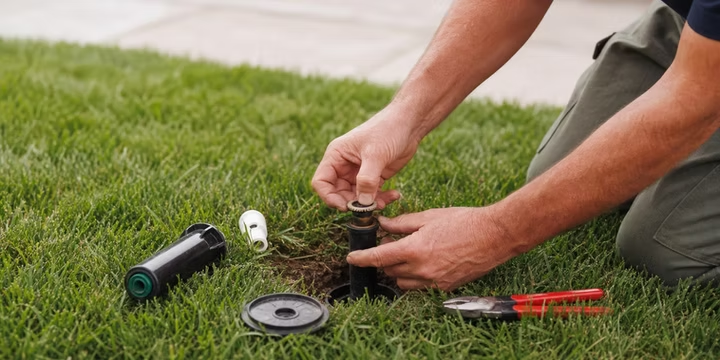
Owning a Hunter irrigation system means owning parts from the company that invented the residential gear-driven rotor back in 1981. The PGP alone remains the number-one-selling rotor worldwide. But popularity doesn’t mean invincibility. Gears wear, nozzles clog, seals crack, and eventually every homeowner needs to understand hunter sprinkler heads repair, whether that means a five-minute nozzle swap or a full head replacement.
This glossary covers the terms, parts, models, and failure modes you’ll encounter when working on Hunter equipment. It’s organized alphabetically so you can jump straight to whatever brought you here. After the glossary, you’ll find a repair-versus-replace decision guide, cost breakdowns, and notes on when the job calls for a professional.
If your system is showing signs it needs repair, this reference will help you figure out exactly what’s going on.
Hunter Sprinkler Head Repair Glossary: A to Z
Arc Adjustment
The arc is the left-to-right sweep of a rotor or spray head. On Hunter rotors, you adjust it by inserting the plastic end of the Hunter rotor key into the plus/minus socket on the top of the cap. Turning clockwise (toward the plus symbol) widens the arc; counterclockwise narrows it. The PGP-ADJ adjusts from 40 to 360 degrees, while the PGP Ultra ranges from 50 to 360 degrees.
Misadjusted arcs are the single most common cause of dry spots and overspray onto sidewalks. Before assuming something is broken, check the arc setting first. For a full walkthrough, see our guide on adjusting Hunter arc and radius.
Automatic Arc Return
A feature exclusive to the PGP Ultra. If someone (or a lawnmower) forces the turret out of position, the automatic arc return brings it back to the original spray pattern on the next cycle. This is a major upgrade over the older PGP-ADJ, where forcing the turret backward can permanently damage the drive.
Practitioners on Reddit’s r/Irrigation community frequently recommend the Ultra over the original PGP specifically because of this feature, especially for heads installed near sidewalks or driveways where foot traffic and mower wheels regularly bump them.
Blown Nozzle
If your Hunter rotor is shooting a wild, uncontrolled stream of water straight out the top, the nozzle has blown out. This happens when the nozzle physically ejects from the turret, usually because the set screw wasn’t tight enough or vibration worked it loose over time.
The fix is straightforward: retrieve the old nozzle (or select a matching one from the nozzle set that came with the rotor), insert it into the turret, and tighten the set screw with the Allen-key end of the Hunter wrench. Each nozzle has a number embossed into the plastic. If you don’t know what size should be in there, check the neighboring rotors on the same zone, as they should have closely matched nozzles.
Check Valve (Drain Check)
A check valve inside the sprinkler body prevents water from draining out of the lowest heads on a zone after the valve shuts off. Hunter sells PGP models with a built-in check valve (designated “CV” in the model number, like PGP-ADJ-CV). Without a check valve, you get low-head drainage: water pooling around the lowest heads for minutes after the zone turns off, wasting water and creating muddy spots.
If your system has loaded or weeping sprinkler heads, a failed check valve is often the culprit.
Clogged Filter Screen
Every Hunter rotor has a small mesh filter screen at the base of the riser, designed to catch debris before it reaches the nozzle and gear mechanism. Over time, dirt, sand, and mineral deposits build up and restrict water flow. The nozzle or filter may become clogged with debris and mineral deposits, preventing proper water passage and impairing sprinkler rotation.
To clean it, pull up the riser (use an insertion collar to hold it), unscrew the nozzle, and remove the screen. Flush it under running water or soak it in white vinegar if mineral scale is heavy. This is probably the most common hunter sprinkler head repair, and it costs nothing.
Drive Mechanism (Gear Drive)
The heart of any Hunter rotor. A small turbine powered by water pressure spins a series of internal gears that slowly rotate the turret back and forth across the set arc. When these gears strip or wear out, the head stops rotating and just shoots water in one direction.
The consensus among irrigation professionals is blunt on this point. On Reddit’s r/Irrigation, the standard advice when a PGP’s drive is damaged: “The only way to fix it will be to replace the head.” Internal gear repair isn’t practical for homeowners. The gears are tiny, proprietary, and not sold as individual replacement parts.
One useful tip from that same community: keep the old head after replacing it. The nozzles and filter screens are still good spare parts.
For a deeper look at rotation failures, see our article on sprinkler heads not rotating.
FloStop
A Hunter accessory that closes the flow of water from an individual sprinkler head while the rest of the zone keeps running. You thread it onto the inlet of the head you’re working on. This is ideal for changing nozzles, swapping heads, or turning off a specific head during construction, all without shutting down the whole zone and losing the ability to compare head performance.
Hunter Rotor Key (Wrench)
The dual-purpose adjustment tool included with every Hunter rotor (and available separately). The plastic end adjusts the arc by fitting into the plus/minus socket on the rotor cap. The metal Allen-key end adjusts the nozzle set screw and the radius reduction screw.
If you’re doing any kind of hunter sprinkler heads repair, this is the one tool you absolutely need. They cost a couple of dollars and should be kept near your controller.
I-20
Hunter’s heavy-duty rotor, designed for commercial properties and large residential lawns. Available with a stainless steel riser for high-traffic areas like athletic fields and medians. The I-20 shares many components with the PGP family but handles higher flow rates and tougher conditions.
The pressure-regulated version (I-20 PRB) takes incoming pressures of 50 to 100 PSI and reduces them to 45 PSI at the nozzle, saving up to 25% more water compared to unregulated operation.
Insertion Collar
A small plastic clip that holds the riser in the extended (up) position while you work on the nozzle or filter. Without it, the spring keeps trying to retract the riser back into the body, making nozzle swaps frustrating. This is a cheap accessory that saves significant time during Hunter sprinkler head repair.
Low-Angle Nozzle
Standard Hunter rotor nozzles throw water at a 25-degree trajectory. Low-angle nozzles cut that to about 13 degrees. This matters a great deal in windy areas. In West Texas, where sustained winds of 15 to 25 mph are routine, a standard trajectory nozzle loses a significant percentage of water to wind drift. Switching to low-angle nozzles is one of the simplest efficiency upgrades for any Hunter system in this region.
Matched Precipitation Rate
A design principle built into Hunter’s nozzle sets. Regardless of the arc setting (quarter circle, half circle, full circle), the precipitation rate stays consistent across all heads on the same zone. This means a quarter-circle head puts out roughly the same inches per hour as a full-circle head next to it.
If someone installs mismatched nozzles, some areas get twice the water they need while others stay dry. When troubleshooting uneven coverage, checking for uneven water distribution and nozzle matching should be early steps.
MP Rotator
Hunter’s multi-stream rotating nozzle, designed to fit on Pro-Spray bodies. MP Rotators deliver water at approximately 0.4 inches per hour, the lowest precipitation rate in the industry, and offer up to 30% water savings over traditional spray nozzles. They’re also excellent retrofit options for older systems struggling with low pressure and poor coverage.
The nozzles are color-coded for easy field identification. The range spans from the MP800SR (6 to 12 foot radius) up to the MP3500 (31 to 35 foot radius). Arc and radius adjustments can be made while the system is running, using the compact MPTOOL.
One important detail: MP Rotators run optimally at 40 PSI of dynamic pressure. Hunter recommends pairing them with a 40 PSI pressure-regulated spray body. Without regulation, high pressure can cause misting and poor distribution.
A built-in “double-pop” feature protects the nozzle from debris. When the head pops up, the outer cap rises first, pushing dirt away before the nozzle emerges. Competitor nozzles with open orifices tend to clog after just a few cycles. For setup details, check our MP Rotator adjustment guide.
Non-Strippable Drive
The PGP Ultra’s drive mechanism is engineered so the turret can be turned in either direction without damaging the internal gears. This is the single biggest practical difference between the Ultra and the older PGP-ADJ. On the original PGP-ADJ, forcing the turret backward against its travel direction can strip the drive, permanently killing the head.
If you’re replacing an old PGP-ADJ as part of a hunter sprinkler heads repair, upgrading to a PGP Ultra for this feature alone is worth the small price difference.
Nozzle Number
Every Hunter nozzle has a number embossed into the plastic body. This number corresponds to the flow rate and radius. When replacing a nozzle, match the number to the neighboring heads on the same zone. Mismatched nozzle numbers create uneven precipitation rates, leading to dry and soggy patches across the lawn.
Nozzle Set Screw
The small Allen-head screw that holds the nozzle in the turret. You adjust it with the metal end of the Hunter rotor key. When this screw loosens from vibration, the nozzle can blow out (see “Blown Nozzle” above). During any nozzle service, snug this screw firmly but don’t overtighten, as the plastic threads strip easily.
PGP-ADJ
Hunter’s original gear-driven rotor, first introduced in 1981. It features a 3/4-inch inlet, adjustable arc from 40 to 360 degrees, and remains the most commonly encountered Hunter head in residential systems, especially those installed before 2010.
The PGP-ADJ is a reliable head, but it has one critical weakness: its drive mechanism can be stripped if the turret is forced backward. After about 10 to 15 years of service, gear wear becomes the most common failure mode. When PGP-ADJ heads start having rotation problems after a decade of use, replacement rather than repair is usually the right call.
PGP Ultra
The updated version of the PGP, featuring a non-strippable drive, automatic arc return, and a wider arc range (50 to 360 degrees). It ships with 12 nozzle choices and covers a 25 to 46 foot radius. The PGP Ultra carries a 5-year warranty from Hunter.
The Ultra is the go-to replacement when repairing Hunter sprinkler heads that use the older PGP-ADJ. It’s a direct drop-in upgrade with the same body size and connection.
Pop-Up Height
Hunter rotors and Pro-Spray bodies come in 4-inch and 6-inch pop-up options. Taller heads clear thick turf more effectively, giving better spray distribution. But they also sit higher when extended, making them more vulnerable to lawnmower damage. In Bermuda lawns common across West Texas, 4-inch bodies generally work fine. Tall fescue or ornamental beds may benefit from 6-inch risers.
Precipitation Rate
The rate at which water is applied to the ground, measured in inches per hour. Hunter PGP rotors deliver approximately 0.4 inches per hour. MP Rotators match that rate. Traditional spray nozzles run much higher, around 1.5 inches per hour or more.
Mixing spray heads and rotors on the same zone creates a precipitation rate mismatch, one of the most common causes of overwatered and underwatered areas in the same yard. If you suspect this problem, see our guide on low water pressure effects that can compound uneven distribution.
Pressure-Regulated Body (PRB)
A sprinkler body with a built-in pressure regulator that reduces high incoming water pressure to the optimal operating pressure for the nozzle (typically 45 PSI for rotors, 40 PSI for MP Rotators). The regulator stays in place and continues to function even if the original riser is removed and replaced during service. Hunter offers PRB versions of the PGP and I-20.
High pressure causes misting, wind drift, and premature wear on internal components. In areas where municipal water pressure regularly exceeds 60 PSI, pressure-regulated bodies are a smart investment that extends head life and saves water.
Pro-Spray
Hunter’s spray body platform, not a rotor. The Pro-Spray is a pop-up body that accepts fixed nozzles, adjustable nozzles, or MP Rotator nozzles. It features a two-piece ratchet for directional alignment and an exclusive body cap design that doesn’t leak even when loosened slightly.
One note for anyone ordering parts: Hunter’s Pro Adjustable Nozzles (models 8A, 10A, 12A, 15A, and 17A) were phased out in 2026. If your system uses these, MP Rotator nozzles are the recommended retrofit.
Radius Adjustment
The radius (throw distance) of a Hunter rotor can be reduced by turning a set screw on top of the nozzle with the metal end of the Hunter rotor key. Turning it clockwise restricts the stream and shortens the throw. This is critical for heads near sidewalks, driveways, or property lines where overspray wastes water and creates liability.
You can only reduce the radius, not increase it beyond the nozzle’s rated maximum. If you need more distance, swap to a higher-numbered nozzle.
Ratchet Mechanism
The two-piece ratchet mechanism inside a Hunter Pro-Spray body allows you to rotate the nozzle to face the correct direction without unscrewing the body from the pipe. It works like a socket wrench: turn one way and it clicks into position, turn the other way and it locks.
When the ratchet fails, the nozzle can’t be aligned. Inspect the spring tension first, as a weak spring can prevent proper ratcheting. If the ratchet teeth are worn or broken, replacing the riser or the entire body is usually necessary. A contractor responding on JustAnswer noted that ratchet failure on systems 14 years or older typically signals it’s time for a new head, not just a new riser.
Riser
The vertical stem that pops up when water pressure pushes it out of the body. Risers crack from UV exposure, lawnmower strikes, or freezing. When removing a head for service, always inspect the riser for hairline cracks. A cracked riser leaks water around the stem instead of sending it all through the nozzle, and it will get worse over time.
Seal (Wiper Seal)
The rubber gasket between the riser and the body cap that prevents water from leaking out the top of the head during operation. Hunter uses chemical-resistant, co-molded seals, but they degrade over time, especially in hard-water areas where mineral deposits grind against the rubber every time the head pops up and retracts.
A leaking wiper seal shows up as water bubbling or spraying from around the stem rather than from the nozzle. Replacement seals are inexpensive and available at most irrigation supply stores. For more on this, see sprinkler head leaking causes.
Zone
A group of sprinkler heads controlled by a single valve. Every head on a zone turns on and off together. This is relevant to Hunter sprinkler heads repair because zone-level thinking is the professional’s first diagnostic step.
One experienced contractor put it well: “Observe the other rotors included in the same zone. If they come on normally, the fault is with the rotor specifically, not the controller, wiring, or water supply.” If multiple heads on the same zone are misbehaving, the problem is almost certainly upstream (the valve, the wiring, or the controller) rather than with the individual heads.
A practitioner’s field report shared on an irrigation review site reinforced this: “One time I replaced a valve after days of testing. The real issue was a wrong schedule. Check the controller first.” If your system won’t turn on at all, start at the controller before touching any heads.
Repair vs. Replace: A Decision Framework
Not every broken Hunter head needs to be thrown away, but not every one is worth saving either. Here’s a quick reference:
Simple repairs like cleaning nozzles or replacing gaskets can be done for under $10 in parts. More complex issues, like replacing the entire head, run $20 to $50 or more for parts alone. Most quality sprinkler heads last between 10 and 15 years, but factors like lawnmower damage, harsh freezes, and mineral buildup from hard water shorten that lifespan significantly.
The general rule: if a head is under 8 years old and the problem is a nozzle, seal, or filter, repair it. If it’s over 10 years old and the drive mechanism or ratchet has failed, replace it. Repeated repairs on old heads get expensive fast, as each service call from a professional typically costs between $60 and $110 for head-level work, with most technicians charging a $75 to $150 service call fee.
The annual average cost for professional sprinkler system repair sits around $278, with most projects falling between $137 and $422 depending on scope. Spring season (April through May) tends to push those numbers 25 to 40% higher due to demand.
West Texas Considerations for Hunter Head Longevity
Hunter heads installed in the Lubbock area and surrounding West Texas communities face conditions that accelerate wear beyond what generic maintenance guides account for.
Hard water mineral buildup. Lubbock’s municipal water and well water both carry significant mineral content. Calcium and magnesium deposits accumulate inside filter screens, nozzle orifices, and on wiper seals. Cleaning screens at least twice per season (spring startup and midsummer) prevents most clogging problems before they start.
UV degradation. West Texas sunshine is relentless. The UV index regularly exceeds 10 during summer months, and plastic components exposed above grade (caps, nozzle tips, above-grade risers) become brittle faster than in more temperate climates. Cracked caps and risers are more common here than in northern states.
Wind. Sustained winds of 15 to 25 mph are normal, not exceptional. Standard 25-degree trajectory nozzles lose water to drift. Low-angle nozzles (13-degree trajectory) are strongly recommended for any Hunter rotor installation in this region. They keep water closer to the ground where the grass actually benefits.
Sandy and caliche soils. Digging is generally easier than in clay-heavy regions, but fine sand particles work their way into sprinkler bodies more aggressively. Dirt and small stones entering the outer body can block the pop-up mechanism entirely. Flushing heads after any nearby digging or construction is essential.
When to Call a Professional
Some repairs genuinely belong to the pros. Here’s when to stop troubleshooting and make a call:
Multiple heads on the same zone failing. This almost always points to a valve, wiring, or mainline problem rather than individual head failure. An irrigation technician can isolate the real cause quickly.
Controller or wiring issues. If zones skip, run at wrong times, or won’t respond to programming changes, the problem lives in the controller or the field wiring, not in the heads. Replacing heads won’t solve electrical problems.
Buried pipe leaks. Water surfacing between heads, unexplained soggy areas, or a spike in your water bill can signal a broken underground line. Finding and fixing buried leaks requires specialized equipment.
Backflow preventer problems. These are code-regulated devices. Improper repairs can compromise your home’s potable water supply. Licensed testers should handle backflow work.
You’ve already tried two repairs and the problem returns. Recurring failures on the same head or zone usually mean the root cause hasn’t been found. A professional’s systematic diagnosis saves money compared to buying more replacement parts that don’t fix the real issue.
Replacing a single sprinkler head takes 30 minutes to 1 hour for a professional technician, including locating the head, shutting off water, removing the old unit, installing the new one, adjusting the spray pattern, and testing. Hiring a professional to replace one head typically costs $130 to $275 including parts and labor.
For Lubbock and West Texas homeowners needing professional hunter sprinkler heads repair, M&M Sprinklers has served the area since 1987 with licensed irrigators on staff.
Get professional sprinkler repair help from a team that knows Hunter systems inside and out.
Frequently Asked Questions
How do I identify which Hunter sprinkler head model I have?
Look at the cap of the head when it’s popped up. Hunter rotors have the model name printed or embossed on the cap (PGP, PGP Ultra, I-20). For Pro-Spray bodies, the name appears on the body sleeve. If the markings are worn, measure the pop-up height and check whether it’s a rotor (rotating stream) or spray head (fixed fan pattern) to narrow it down.
Can I fix a Hunter rotor that stopped rotating?
It depends on why it stopped. If debris is jamming the turret, cleaning it may restore rotation. If the internal gear drive is stripped, the head needs to be replaced. Practitioners on Reddit’s irrigation forums are consistent on this point: a damaged drive mechanism means a new head, not an internal repair.
How long do Hunter sprinkler heads last?
Most quality heads last 10 to 15 years under normal conditions. Hard water, lawnmower damage, and freeze events can cut that lifespan short. The PGP Ultra’s non-strippable drive and 5-year warranty give it a longer expected service life than the original PGP-ADJ.
Is it worth upgrading from PGP-ADJ to PGP Ultra when replacing a head?
Yes. The PGP Ultra is a direct drop-in replacement with the same body size. You gain a non-strippable drive, automatic arc return, and a wider nozzle selection. The price difference is typically a few dollars, making it an obvious upgrade during any Hunter sprinkler head repair that requires a new rotor.
What tools do I need for Hunter sprinkler heads repair?
At minimum, the Hunter rotor key (wrench). It handles arc adjustments, nozzle set screws, and radius adjustments. An insertion collar is helpful for holding the riser up during nozzle swaps. For MP Rotators, the MPTOOL handles arc and radius changes. A FloStop is optional but useful if you want to shut off one head without killing the whole zone.
Can I put MP Rotator nozzles on my existing Hunter Pro-Spray bodies?
Yes. MP Rotators thread directly onto Pro-Spray bodies. This is a common retrofit that solves low-pressure coverage problems and saves up to 30% water compared to traditional spray nozzles. Just make sure to pair them with a 40 PSI pressure-regulated body for best performance.
How much does it cost to repair a Hunter sprinkler head myself versus hiring a professional?
DIY repairs range from free (cleaning a clogged screen) to about $35 (buying a new PGP Ultra head). Professional repair for a single head typically runs $60 to $110, and a full replacement including labor costs $130 to $275. If you’re comfortable with basic hand tools and can locate your shut-off valve, most single-head repairs are manageable as DIY projects.
Should I repair one head or replace all the heads on a zone at the same time?
If one head fails and the rest are functioning well, replace just the one. But if you’re seeing multiple failures on heads that are all the same age (typically 10+ years), replacing the entire zone’s heads proactively can save on repeated service calls. This is especially true for older PGP-ADJ rotors where the gear drive is the most likely failure point across all units.